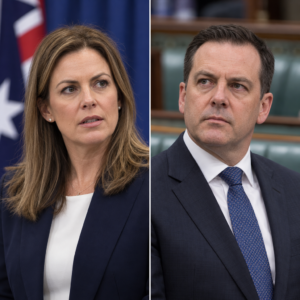
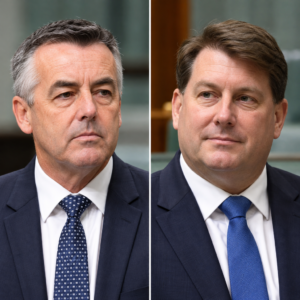
Question Time’s latest confrontation crossed from hard political argument into a breach of parliamentary order when Nationals MP Llew O’Brien was ejected after swearing at Prime Minister Anthony Albanese. Speaker Milton Dick’s intervention became part of a sitting already dominated by anger over inflation and cost-of-living pressures.
The Guardian’s live account of the sitting identified O’Brien as the Coalition MP removed for swearing at the prime minister. A separate removal of Nationals MP Darren Chester occurred later. The two incidents should not be confused or collapsed into one exchange.
The House of Representatives has rules designed to allow ministers and opposition members to challenge each other without turning the chamber into a sequence of personal abuse. The Speaker’s role is to maintain order, regardless of which party holds the floor.
The political backdrop was a 4.3 per cent annual monthly inflation reading. Government and opposition speakers were arguing about the role of federal spending, global fuel prices and the likely consequences for household budgets.
A disciplinary removal is an immediate procedural consequence in the chamber. It does not, by itself, amount to a criminal finding or indicate that an MP has lost their elected position.
A viewer watching a short clip might assume the most colourful moment was the central policy dispute. The actual policy argument remained inflation and the economic responsibility of government and opposition.
The event is distinct from Dick’s later exchange with Chester. O’Brien’s three-hour removal followed his own remarks; Chester’s separate removal occurred later and had different immediate circumstances.
The point for voters is not only whether politicians show restraint. Question Time is one of the few routine public settings in which ministers must face questions from opponents. Repeated disruption can reduce the time available for genuine scrutiny, while rigorous but orderly questioning can help clarify contested economic claims.
A formal response, new documents or a policy decision could clarify the remaining disagreements. At present, the opposing statements leave significant questions unresolved.
The evidence establishes the public disagreement, but not every claim made by the participants has been independently resolved. Official statements, allegations and formal findings remain distinct.
The Speaker’s ruling is the central verified fact. The Guardian’s live account reported that O’Brien was removed from Question Time after swearing during exchanges involving Prime Minister Anthony Albanese. Milton Dick said the language was unacceptable and instructed him to leave the chamber for three hours. Those details are sufficient to report a parliamentary sanction without assigning invented words or motives to the MP.
The incident occurred during a question about removing a government department concerned with climate change. Albanese responded that climate change was real, and interjections intensified. It would be a mistake to infer that every person who called out, or any particular political position on climate policy, caused the ejection. The reported procedural reason was unacceptable language.
A three-hour removal is not equivalent to a court penalty. The Speaker is responsible for order within the House, and temporary exclusion is one way to enforce the institution’s rules. Members remain elected representatives and may continue other parliamentary responsibilities subject to the chamber’s procedures. The language of arrest, criminal conviction or permanent expulsion would therefore be inaccurate.
The right to challenge a prime minister is a core part of adversarial parliamentary politics. Opposition questions can expose contradictions, force explanations and give voters a public account of government decisions. That right does not guarantee that interruptions or abuse will be allowed. The Speaker is expected to manage the tension between energetic debate and rules that make proceedings possible.
Disputes over whether a ruling is proportionate are political judgements unless backed by evidence of an irregular procedure. Some voters may see strong language as a symptom of legitimate anger at government decisions. Others may regard it as conduct that weakens the institution. Those competing opinions do not change the confirmed fact that the Speaker directed O’Brien to leave for three hours.
The setting was politically charged by inflation figures showing annual headline inflation of 4.3 per cent in September on the monthly measure. But the immediate interruption concerned the government’s climate-change responsibilities, not a vote or a formal ruling on inflation. Context should explain the atmosphere without substituting an unrelated policy issue for the actual exchange.
Later in the same Question Time, Darren Chester was also removed. This is a useful chronological fact, but the reason and words associated with the later ejection cannot be copied back onto O’Brien’s incident. O’Brien’s conduct, Dick’s ruling and the climate-policy question provide the key context for this incident.
Readers who see the incident in a short clip should look for the surrounding question and the Speaker’s instruction. Edited excerpts can make ordinary procedure appear like an entirely new political crisis. The full record, if available, is more reliable than a compilation of confrontational moments selected for social-media attention.
What remains to be established is whether O’Brien or his office issued a specific response to the ejection, and whether any further procedural action followed. No later apology or additional disciplinary step has been established in the material reviewed. The confirmed result is that he was directed to leave for three hours following language the Speaker found unacceptable.
Parliamentary language rules serve a broader purpose than etiquette. Representatives are elected to disagree publicly, often over decisions affecting millions of people. The public expects pointed questions and forceful criticism, but it also needs enough order to understand what a minister has said and whether an answer has addressed the question. Disorder can make the most dramatic moment the least informative one.
The Speaker’s authority is institutional rather than a personal political contest with the member being directed out. Dick’s intervention was not a referendum on O’Brien’s climate-policy position. It addressed behaviour during the proceedings. That difference matters because social-media posts sometimes describe the result as someone being silenced for holding an unpopular view, even where the documented reason concerns conduct.
Temporary exclusion can carry political consequences beyond the procedural sanction. It may attract media attention, produce criticism from opponents or energise supporters who favour confrontational tactics. Those effects are possible, not automatic. An election or polling outcome cannot be inferred from the fact that a member was asked to leave one sitting.
An accurate timeline should begin with the question to the prime minister about climate-change responsibilities, follow the interjections and then describe Dick’s intervention. Placing the ejection ahead of the topic or merging it with later interruptions can imply a different cause. The preceding climate-policy question and the Speaker’s instruction explain both the debate and the reason for the ruling.
The government and opposition hold different responsibilities during Question Time. Ministers have a public obligation to account for policies, while opposition members must decide how to use limited speaking opportunities. When either side turns to performance for its own sake, questions that matter to families can become harder to evaluate. The solution is not a quiet chamber without scrutiny but a chamber where scrutiny remains intelligible.
The incident is also a reminder that parliamentary privilege and parliamentary discipline are not the same thing. Members have important protections for speech in proceedings, but the institution also has rules governing how that speech is delivered. Those protections should not be confused with an unconditional right to ignore the Speaker’s instructions.
The report’s evidentiary limits are straightforward. It verifies the identity of the member, the Speaker’s immediate ruling, the three-hour direction and the general setting. It does not independently establish the exact offensive word spoken, a motive behind it or a later apology. Filling those gaps with conjecture would turn a useful account into a less reliable one.
Readers can draw their own conclusions about whether the Speaker was too strict or whether the member should have exercised more restraint. That opinion depends on a person’s expectations of parliamentary behaviour. The factual foundation should remain stable across competing views: a member was removed for swearing during a difficult sitting and ordinary parliamentary scrutiny continued.
The media emphasis on a single swearing incident can also obscure the purpose of Question Time. During the same sitting, MPs raised issues that affect voters directly, from inflation to the way government services are organised. The Speaker’s intervention happened inside that wider process. Reporting it alongside the original question, rather than presenting it as a free-standing shouting match, lets readers distinguish accountability from disruption. That distinction is especially important when a story is shared through a photograph or a short caption.
Parliamentary penalties are often misunderstood outside Canberra. A temporary direction to leave the chamber limits a member’s participation for a defined period but does not alter the outcome of an election or automatically determine the member’s standing within a political party. Such differences might sound procedural, yet they protect the accuracy of a headline. The facts here support a three-hour removal and a criticism of the language used. They do not establish a longer sanction or a separate investigation into the member’s conduct.