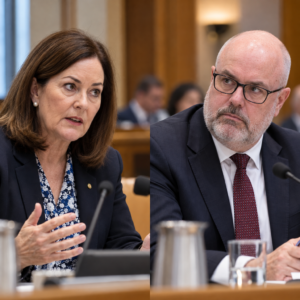
Youth Advocacy Centre chief executive Katherine Hayes has challenged the Queensland government over the loss of a major bail-support contract, saying she fears the decision may be connected to her organisation's public criticism of youth justice policy. Youth Justice Minister Laura Gerber has defended the government's decision on performance grounds, setting up a dispute over the reasons for removing longstanding funding.
The Brisbane-based service says the decision costs it about $3 million a year and affects 19 staff. Hayes argues that children who relied on its support may lose important relationships with workers who helped them navigate bail and avoid further contact with the justice system.

According to reporting by The Guardian and The Courier-Mail, the Youth Advocacy Centre has operated for decades as a community legal and support service. Its bail-support program worked with young people, including children at risk of offending or breaching bail, and used counselling, family assistance and referrals as part of its approach.
Hayes says the organisation met performance measures and believes the cut could be retaliation for its criticism of government approaches including adult crime, adult time. That allegation is her interpretation of events. No finding has established political retaliation as the reason the contract was not renewed.
A spokesperson for Gerber said the previous program was not meeting the government's targets to prevent offending while on bail and cited a reoffending rate above 60 per cent. The department has moved toward a new risk-response model delivered through Anglicare and other providers. Those statements represent the government's explanation, which Hayes disputes.
The two sides are not merely disagreeing about a line in a budget. They are using different yardsticks to assess the same work. Hayes points to the broader support a young person receives, including engagement with family and early intervention. The government points to reoffending and the need to focus assistance on children subject to court-ordered bail.
To judge the claims fairly, readers need more than a headline about the amount withdrawn. It matters which participants were included in the reported reoffending rate, how long outcomes were tracked, and whether the program was expected to prevent all later offences or meet more limited targets. Without those details, a single percentage cannot establish whether the service was useful or ineffective.
The funding change also has a practical implementation question: who will support children previously referred to the Youth Advocacy Centre, and whether new providers are operating in the same communities. Reporting indicates that the replacement program is intended to provide targeted assistance, including rapid contact with young people leaving custody or appearing before courts.
Hayes has warned that some clients have few stable adults in their lives and that replacing established relationships may increase risk. That is a prediction about consequences rather than an outcome already measured. Equally, the government's claim that a redesigned approach will be more effective remains something that future results must demonstrate.
Queensland’s youth justice policy has been the subject of sustained argument over detention, tougher penalties and the value of community support programs. Hayes has been one of its prominent critics. Her advocacy role gives context to why she questions the contract decision, but does not prove government retaliation.
The disagreement has also drawn political responses from opposition and Greens politicians. Their criticism should not be confused with independent evidence of motive. A credible review of the contract would examine the assessment criteria, any evaluation provided to the department, the reasons for selecting replacement organisations and the consequences for children and staff.
The Youth Advocacy Centre is not necessarily closing all of its operations because one program lost funding. An accurate account distinguishes the loss of the bail-support contract from the continued existence of the wider organisation.
The government has published the design of its replacement Risk Response Bail program. The Department of Youth Justice and Victim Support says the initiative will target young people aged 10 to 17 and their families, help them understand bail conditions, address factors contributing to non-compliance and connect them with services. It identifies a statewide delivery network operating from 13 locations, with Anglicare Southern Queensland in Brisbane and other organisations serving communities across the state. This official description confirms that the government is replacing support arrangements rather than declaring that young people on bail will receive no assistance.
Yet the replacement model does not automatically answer Hayes’s objection. She says the previous Youth Advocacy Centre program worked with a broader group, including children reached through early-intervention and police-referral pathways. A service designed principally around young people already subject to court-ordered bail may target a different population. If the eligibility rules change, families who received assistance under the previous program may not qualify for exactly the same form of help. A full comparison would need referral criteria from both schemes, not just the total funding announced.
This difference in program design is central to the political dispute. The government says it wants services that improve compliance and reduce reoffending among children considered at high risk. Hayes argues that supporting a young person and their family earlier can prevent problems that later bring them before a court. Both approaches have a logical rationale, but they should be evaluated on the outcomes they are intended to produce. A program reaching children before a bail order may not be fairly assessed solely on the same metric as one assisting a narrower group facing immediate bail conditions.
Gerber’s office referred to reoffending rates above 60 per cent as part of the case for change. A percentage requires a denominator. Readers need to know whether the measure applied to every participant, a subset considered high risk, a particular time period or the broader population of young people supported by the service. It matters whether the outcome was a charge, a proven offence or another measure of non-compliance. None of those methodological details can be assumed from a reported headline figure alone.
Hayes says her organisation met its targets and points to the value of long-term relationships between support workers and children. The claim deserves examination through the relevant contract performance reports. Meeting contractual targets and achieving the government’s preferred policy outcome may not be identical tests, especially if the targets changed. A service can meet agreed outputs without achieving all the outcomes a new government later wants; a government can change priorities without proving the previous program was worthless. Understanding that distinction would reduce the temptation to portray either explanation as obviously dishonest.
The financial figures must be kept separate as well. Reporting describes the withdrawal of an approximately $3 million annual contract affecting 19 jobs at the centre. The government says its broader risk-response arrangements involve additional funding and a larger statewide network. Those totals are not automatically a one-for-one replacement for the former Brisbane service. To compare them fairly, an analysis would need to know the annual allocation per location, expected caseloads, staffing models, coverage hours and whether specialised legal or family support will continue to be available through other pathways.
Losing 19 positions at an organisation can have consequences even if government funding is redirected elsewhere. Existing employees may have relationships with young clients, referral agencies and local families. Replacement providers must recruit, train and coordinate their workforce, which can take time. The possibility of disruption is a reason to examine transition arrangements, not proof that harm has already occurred. Equally, a well-designed new service might expand coverage in other areas. Those outcomes require measurement once the new program operates.
For a child and family, bail can involve complicated rules, appointments, travel and communication with multiple authorities. Missing a condition can have serious consequences. Support workers may help a family understand obligations, attend court or find services addressing housing, education or health needs. How that support is delivered can matter as much as the name of the organisation funded to provide it. The centre's argument is that established community connections should not be discarded lightly; the government's response is that delivery should be tied to reducing risk.
The allegation of retaliation calls for a different form of evidence. Hayes fears the funding decision was affected by the centre's criticism of the government's youth justice policies. It would be necessary to examine the procurement timeline, documented evaluation, selection criteria, communications and any ministerial involvement before drawing a conclusion about motive. The fact that an organisation publicly opposed a policy and later lost a contract is grounds for scrutiny, not proof of a punitive decision.
The government can defend changes to its funding model and still be expected to explain them transparently. If performance metrics genuinely drove the decision, publishing those criteria and making a comparable assessment available would help establish that explanation. If other providers were selected for a new model, explaining how the model differs from the old one would show whether the change concerned performance, service eligibility or a broader policy direction. These questions can be answered without assuming wrongdoing.
Critics also need to make distinctions. The Youth Advocacy Centre’s long history and role as a legal and advocacy organisation do not mean that every contract it holds must be renewed. A government can legitimately commission services differently. But a contract decision that affects a program assisting children in the justice system warrants scrutiny of the continuity of care, particularly where both sides disagree over the evidence used.
There is a broader public interest in ensuring organisations can speak openly about policy while competing fairly for public funding. It would harm confidence if funding were used to punish criticism; it would also harm confidence if an agency could not change an ineffective program for fear of being accused of retaliation. Transparent reasons, accessible performance information and appropriate review pathways are therefore valuable to both critics and the government.
The immediate dispute remains unresolved: Hayes questions both the rationale and potential motive; Gerber’s office says the program failed to deliver desired results. The fairest public test will be transparent assessment records and the actual outcomes of the replacement services.