A Vanuatu minister has publicly challenged the suggestion that Chinese police assistance to his country is on a path towards being reduced, complicating Australia’s efforts to deepen security cooperation with its Pacific neighbour. Internal Affairs Minister Andrew Napuat says Vanuatu has made no decision to phase out any particular partner, despite a joint Australia–Vanuatu statement that described China’s policing program as expected to diminish over time.
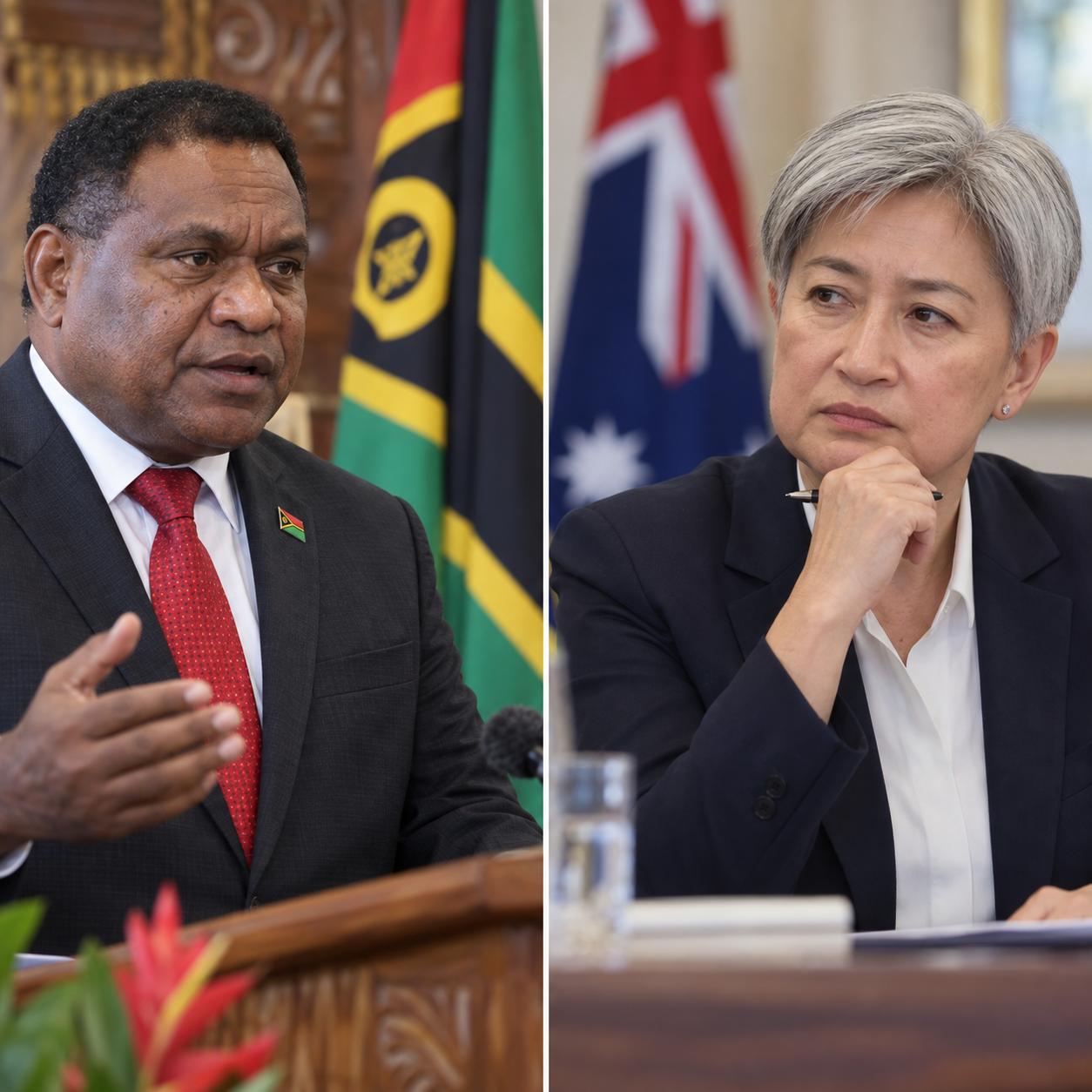
The different messages matter because policing cooperation has become one of the most sensitive parts of regional diplomacy. Australia and Vanuatu have signed a significant bilateral agreement covering areas including police support and security cooperation. Their joint implementation statement characterised Chinese assistance as time-limited while emphasising the continuing nature of Australia’s arrangements. Napuat’s response contests the implication that another partner’s presence is being negotiated away.
In comments reported by ABC News, Napuat stressed that the country is not in a position to dispense with outside advisers while it continues to build its own police capability. He argued that Vanuatu should make its own decisions about when and how any partners might be phased out. His comments should not be reported as an announcement that Chinese officers will remain indefinitely. Rather, the minister’s point is that no decision to remove a partner has been reached.
The ABC reported that the joint statement had been agreed between the two governments after discussions about implementing the Nakamal Agreement. The wording matters. Saying a program is expected to reduce is a statement about anticipation or policy direction; it is not necessarily an enforceable agreement to expel officers. Napuat has criticised the language because he says it does not reflect Vanuatu’s position on relations with international partners.
Vanuatu Prime Minister Jotham Napat has emphasised that his government does not wish to choose sides between international partners. That approach reflects a fundamental sovereign interest: small Pacific states often seek assistance from several governments while retaining control over their own institutions. Australia may regard expanded Australian Federal Police involvement as a valuable strategic outcome, but Vanuatu is entitled to distinguish technical assistance from an exclusive security alignment.
For Canberra, the diplomatic challenge is both practical and symbolic. A public statement can be read as evidence of growing Australian influence, yet a minister from the partner government can offer a different account of what has actually been agreed. That does not automatically mean the bilateral agreement has failed. It does suggest that expectations about third-country activity should be described carefully and tested against Vanuatu’s own decisions rather than assumed to be settled by a single document.
Policing partnerships can include training, equipment, intelligence support and assistance in building institutions. The different elements need not be interchangeable: a government may value assistance from more than one source for different tasks. They also raise questions about national decision-making, operational standards and long-term institutional independence. Those concerns are broader than competition between flags and should not be reduced to a claim that the Pacific nation is simply choosing one major power over another.
The Australian government has publicly described its own policing commitment under the Nakamal framework as legally binding and without an expiry date. Napuat’s remarks also included the aspiration for Vanuatu’s police to run without outside advisers eventually. Both statements can coexist if the distinction between the duration of an agreement and the future shape of an operational presence is made clear. A legal commitment to assist does not necessarily specify an unchanging number of officers.
The episode is also a reminder of the limits of reading diplomatic statements as political victories. The agreement and the joint text are real, but their significance lies in what the parties implement. Claims that China has already been pushed out would overstate the available evidence. Claims that Vanuatu has cancelled Australian assistance would overstate it in the opposite direction. Neither conclusion follows from Napuat’s reported comments.
For Australian readers, the outcome is significant because the Pacific region is a focus of diplomacy, security planning and development partnerships. Trust depends on understanding what each government believes it has committed to, not simply announcing an alignment that may be politically contested in the partner country. Effective cooperation will require agreement on practical priorities and respect for Vanuatu’s authority over its police.
Policing is the immediate issue, but the economic relationship between Australia and Vanuatu explains why the disagreement is significant. DFAT describes extensive cooperation covering trade, development assistance, transport links, tourism, labour mobility and emergency preparedness. Each area relies on a functioning relationship between governments, even when individual priorities differ. That makes a disagreement about outside police assistance a diplomatic management problem rather than an isolated argument over the presence of advisers. The possibility of differing expectations does not, by itself, establish a trade disruption or withdrawal of Australian funding.
DFAT’s overview puts bilateral goods and services trade at more than half a billion Australian dollars in a reported annual period. It also identifies tourism and related services as a major part of Vanuatu’s economy, with Australian travellers and cruise passengers providing an important share of visitors. Those economic connections create incentives for both governments to maintain predictable links and responsive emergency services. They also show why discussion of security partnerships should not be reduced to a contest between Australia and China: Vanuatu has commercial and community interests that reach far beyond policing.
The Pacific Australia Labour Mobility scheme is another direct point of contact for Australian readers. Workers from Vanuatu participate in Australian agriculture and other approved sectors, sending earnings home while filling labour needs for employers here. Australian government material describes Vanuatu as one of the largest participating countries. The program involves questions about recruitment, accommodation, deductions, worker welfare and the effect of money sent to families. None of these issues was caused by the police statement. They illustrate how broad the relationship is, and why the consequences of an unnecessary diplomatic rupture would extend beyond ministers’ press conferences.
Official research into remittances under the labour scheme also points to the financial significance of those personal links. Money transferred by participating workers can support household spending, education or business activity in their communities. Such transfers are private earnings rather than a payment from the Australian government, and they should not be described as a direct result of any security agreement. The relevance is that the bilateral relationship has a household-level economic dimension: cooperation affects people who earn a living across national borders, not only officials engaged in strategic negotiations.
Vanuatu’s leaders also face the practical question of how to finance and sustain public institutions. Police training, equipment and specialist advice can be obtained from different partners, but the recipient government remains responsible for deciding how assistance fits its laws and priorities. Donor commitments are not automatically identical: they can differ in duration, scope, legal form and reporting arrangements. A statement describing an expected reduction from one partner may therefore be understood very differently if officials have not agreed on the pace or conditions. Napuat’s objection highlights the importance of separating Australia’s expectations from a decision that Vanuatu itself has formally made.
The bilateral Nakamal Agreement provides a wider framework for discussing security and mobility. Its published text refers to partnership and Vanuatu’s sovereignty, alongside commitments relating to regional stability. Those provisions should be assessed as written, not used to imply that every future interaction with another country is prohibited. In particular, a promise to prioritise policing cooperation from Pacific partners is not the same wording as a blanket exclusion of all other assistance. The interpretation of obligations may be contested, but the agreement’s actual terms remain a more reliable starting point than competing political characterisations.
For Australian businesses, diplomatic stability is valuable chiefly because it supports predictable labour arrangements, travel and commercial dealings. Businesses considering tourism, agriculture or logistics investment need to assess infrastructure, contracts and workforce conditions on their merits. It would be speculative to assert that this particular exchange has already raised insurance premiums, changed flight demand or deterred investment. The rational financial angle is the potential exposure of these established relationships to a deteriorating political climate, not an invented economic loss.
The immediate outcome is therefore limited but important. A Vanuatu minister has challenged how a joint statement characterises the expected trajectory of Chinese police assistance. Australia still has a framework for long-term cooperation, and Vanuatu still insists on making sovereign choices about its partners. Whether those positions can be reconciled through further clarification remains a matter for the governments involved. Australian readers have reason to follow the exchange because security cooperation is tied to a substantial set of trade, travel and employment relationships.
The confirmed development is a sharp difference between the joint statement’s description of Chinese police assistance and Napuat’s insistence that Vanuatu has not chosen to phase out any partner. The future of those arrangements has not been definitively settled in the public record. Australia’s security partnership continues to matter, but this episode illustrates the complexity of translating diplomatic language into practical decisions on the ground.