Australian data-centre operator NEXTDC has suffered a brutal sharemarket sell-off after delays to electricity works at its M3 facility in Melbourne forced a major downgrade to its revenue and earnings forecasts. The company says the shortage of additional grid supply will prevent it from delivering and billing some contracted capacity as planned.
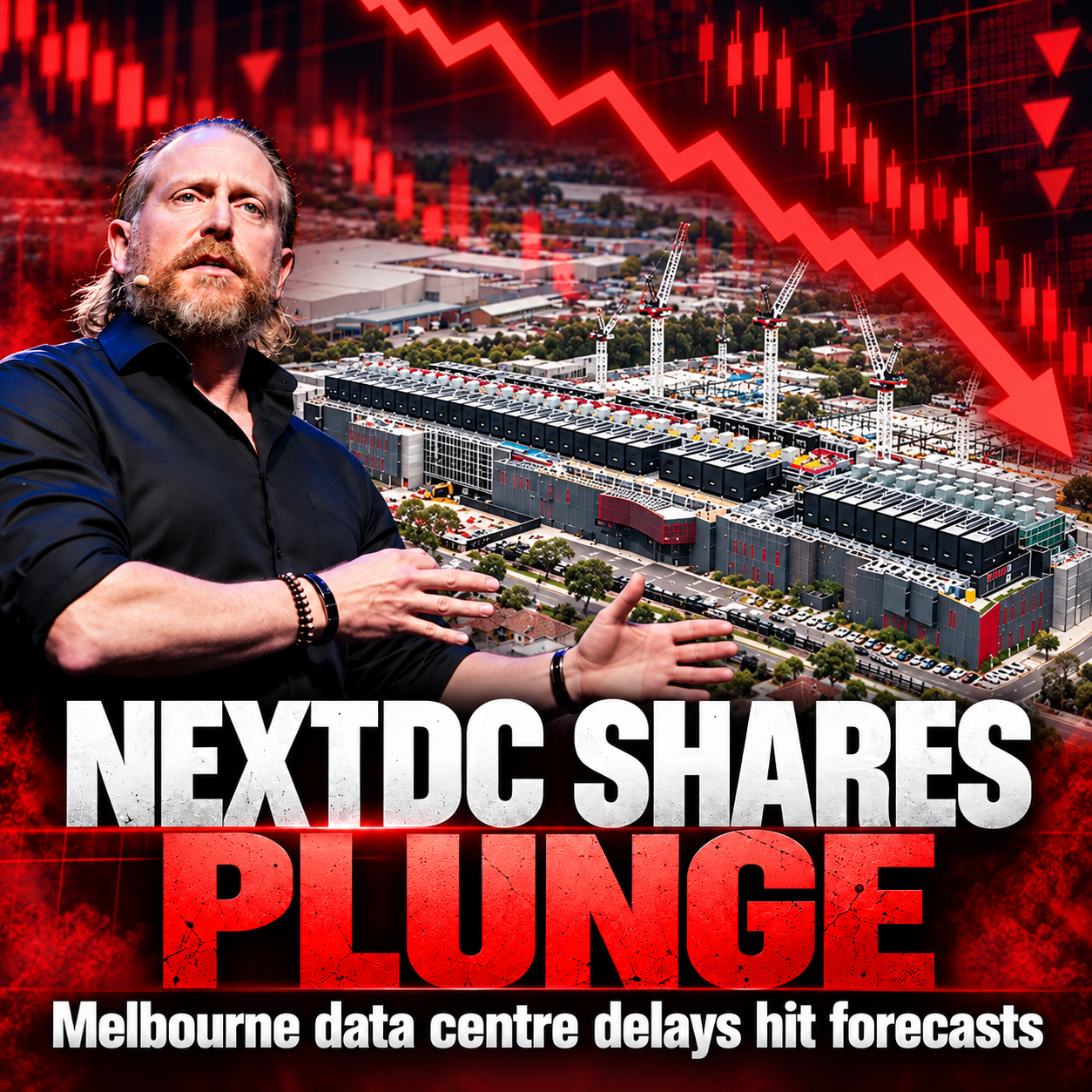
The problems centre on the West Footscray site and the high-voltage electricity infrastructure needed to support its expansion. Electricity distributor Jemena has suspended parts of the network works after community and stakeholder opposition, according to NEXTDC’s announcement to the Australian Securities Exchange. Without the additional power, the data centre cannot bring the affected capacity into service.
Investors reacted sharply. NEXTDC shares plunged by about 42 per cent, wiping billions of dollars from the company’s market value. The fall reflects concern not simply about a construction delay but about the timing of earnings the company had expected from a large capital investment.
NEXTDC now expects net revenue in a range of $475 million to $500 million, down from previous guidance of $615 million to $640 million. Its forecast for underlying earnings before interest, tax, depreciation and amortisation was also reduced, from $385 million to $410 million to $245 million to $265 million. The revised figures exclude the contribution from the affected M3 contracts until the company can estimate it reliably.
The numbers are substantial for a business built around long-lived infrastructure. A data centre can have customers committed to capacity, but its operator cannot deliver that capacity without sufficient power. Each delay pushes out the point at which a capital-intensive development begins producing the revenue expected from its contracted customers.
The sharp share-price fall illustrates how infrastructure investments are valued. Investors do not simply look at how many customers have signed agreements; they estimate when a company can deliver its services, what it will cost to build the facilities and how much cash will remain after operating and financing expenses. Bringing anticipated revenue forward or pushing it back can change those calculations dramatically. NEXTDC still has contracted demand, but the disruption means earnings from some of that demand may arrive much later than shareholders expected. A company carrying substantial development spending can be especially sensitive to that shift.
Data centres differ from many other commercial buildings because electricity is part of the service they sell. Customers expect power, cooling, connectivity, physical security and reliable operation for computing equipment. If a site has completed halls but inadequate network capacity, it cannot simply fill the space like an ordinary warehouse. The equipment inside can require very high and consistent energy supply. That is why a disputed power connection can become a problem for revenue guidance rather than a minor engineering inconvenience. The West Footscray delay has made that interdependence visible to the sharemarket.
Community opposition in Melbourne’s inner west has focused in part on electricity infrastructure planned to serve the facility. The ABC and other outlets have reported concerns about large poles and the effect of construction in residential streets. Local people may weigh traffic, visual impacts and the industrial character of their neighbourhood against the promised economic benefits of new digital infrastructure. Electricity distributor Jemena has paused the relevant works while concerns and approvals are considered. The dispute illustrates how the practical route taken by power infrastructure can become as controversial as the building that ultimately uses the electricity.
The Melbourne disruption illustrates a growing challenge for Australia’s data-centre industry. Demand for computing power is rising rapidly, driven by cloud services and artificial intelligence. Large facilities require reliable electricity, network connections and approvals, often in areas where the surrounding community is already concerned about congestion, construction and the effect of infrastructure works.
The electricity network is not something a data-centre operator can expand alone. Projects need coordination among developers, distributors, planning authorities and local communities. NEXTDC’s announcement shows how a problem involving one part of that network can affect the finances of a listed company even when it has secured customers for the space it intends to provide.
Investors also have to distinguish between accounting measures. Revenue represents the sales a company reports, while underlying earnings measures exclude certain costs and are not the same as net profit or free cash flow. Capital expenditure is another important figure because data centres require large amounts of upfront money before contracted capacity can generate a return. NEXTDC’s revised guidance reduces expected revenue and underlying earnings while the company reviews spending on projects that are not committed. Those numbers show why the stockmarket is concerned about both the delay and how management will prioritise future construction.
The broader artificial-intelligence boom has drawn enormous investment into buildings, chips, telecommunications links and electricity supply. For a developer, the attraction is the prospect of customers needing more computing power to run software and store information. But electricity networks are not instantly expandable, and local planning processes do not disappear because demand is strong. A data-centre operator can therefore face the unusual problem of finding willing customers before it can provide the physical infrastructure needed to serve them. That gap between demand and delivery is a risk that highly optimistic growth forecasts may understate.
Australian electricity customers may also have questions about who pays for network upgrades. Some infrastructure can be built for a particular large customer, while broader grid investment is governed by regulatory and commercial arrangements. The cost allocation depends on the connection agreement and relevant network rules; it should not be assumed that households automatically pay for a data-centre expansion. Nevertheless, large new users affect the discussion about investment priorities, local capacity and the resilience of supply. Their arrival can make planning decisions contentious in suburbs where residents are also worrying about electricity bills and the reliability of existing services.
The company has also lowered its capital expenditure expectations and is reviewing plans for projects that are not yet committed. That gives management options to conserve cash while it deals with the power delay, but it may also slow the scale of expansion investors had expected from the business.
Shareholders are watching the distinction between signed demand and deliverable services. Strong interest from customers is valuable, but contracts alone do not remove the need for power, construction, approvals and funding. NEXTDC’s revised forecasts put those constraints into a very public financial statement.
The fall in NEXTDC shares is not a measure of the value of artificial intelligence as a technology. It is an immediate market reassessment of a particular company’s ability to turn construction spending and customer contracts into earnings. Investors considering exposure to this sector must separate broad demand forecasts from project-level realities such as approvals, grid access, financing, construction costs and competition. Even a business with sophisticated customers can suffer a steep valuation change when expected cash flows become less certain. Market prices may subsequently move again as new information becomes available.
Financing has become another test for capital-intensive developers. Building additional facilities can require debt or fresh equity long before the asset begins generating enough cash to cover its cost. A lower share price can make raising equity more expensive for existing shareholders, while debt obligations remain in place. NEXTDC’s review of uncommitted projects offers management a way to limit further commitments, but it also confronts investors with the possibility of slower expansion. How much the company spends, and on which sites, matters as much as the headline amount of contracted capacity.
For local communities, the practical question is whether developers can secure social acceptance through better design and consultation. Residents may support jobs and digital services while opposing a specific line of pylons or the placement of backup generators. Those concerns are not inherently a rejection of technology. Developers who address noise, construction routes, power connections and emergency arrangements at the design stage may avoid expensive disputes later. NEXTDC’s setback gives a clear financial illustration of the cost of a conflict that remains unresolved once a project is far enough advanced for customers and investors to expect delivery.
For the wider industry, the M3 problem may become a test of how Australia balances investment in digital infrastructure with the requirements of electricity networks and local communities. New data centres promise jobs and services, but their appetite for power can create difficult decisions over who bears the costs and disruption of supporting them.
NEXTDC still has an operating business and a pipeline of contracted demand. Its challenge is to restore confidence in when the Melbourne capacity can be delivered and how it will finance the rest of its expansion. The share-price collapse shows how little patience investors have for uncertainty when growth depends on expensive infrastructure being ready to operate.






