Latrell Mitchell has told former teammate James Tedesco to contact him directly after the Sydney Roosters captain criticised the South Sydney star for standing over young player Toby Rodwell following a heavy tackle. Both men agreed the hit itself was fair. The argument was about what Mitchell did next.
The exchange followed the Rabbitohs and Roosters met near the end of the NRL season. The incident involved Rodwell, a 20-year-old in only his second first-grade appearance, and one of the game’s most recognisable and physically imposing players.
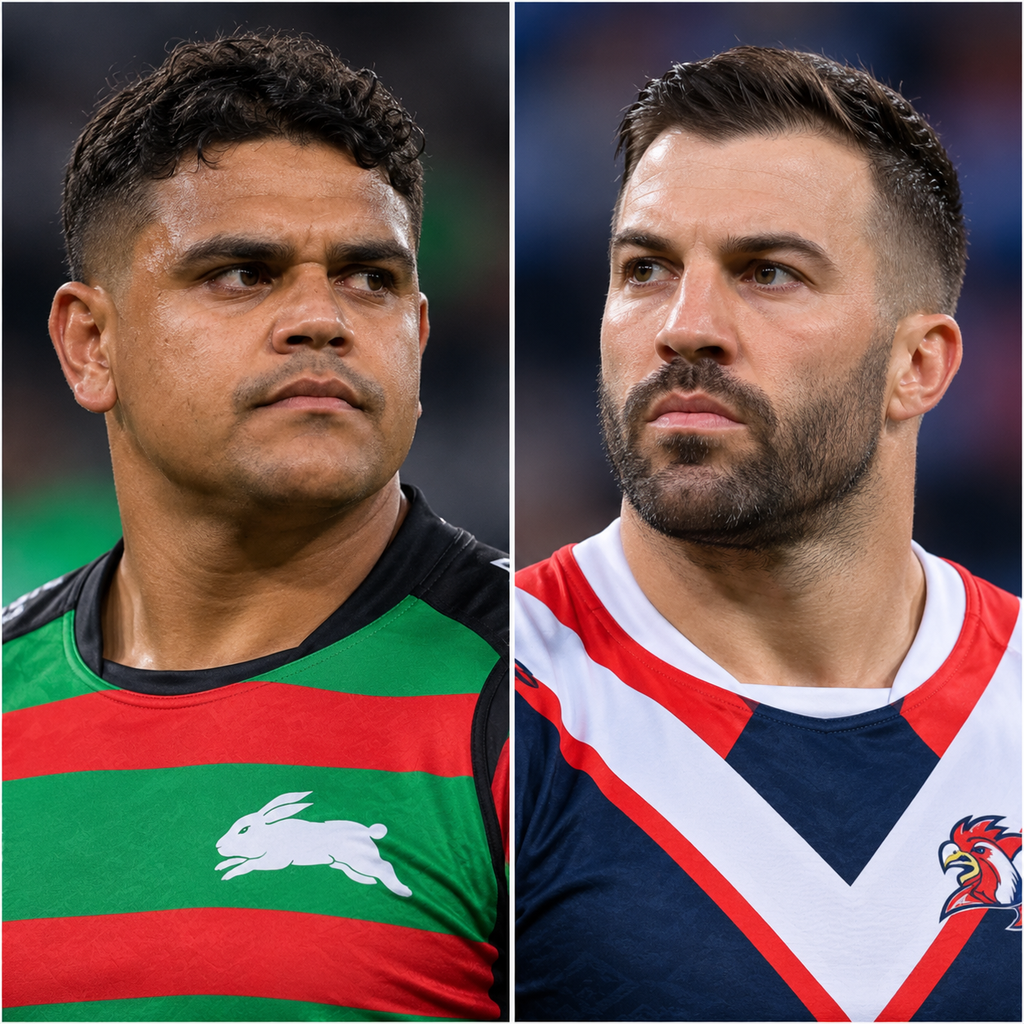
Mitchell delivered a forceful front-on tackle on Rodwell that dislodged the ball. Afterwards, he stood over the young Roosters player. The contact was described as legal, but the gesture drew a response from Tedesco, who was uncomfortable seeing an established star make a point of his dominance over an inexperienced opponent.
Tedesco, the Roosters captain, did not claim the tackle was illegal. His criticism focused on the moment after the collision and on the difference in experience between the two players. It was a matter of sportsmanship rather than an accusation that an official rule had been broken.
Mitchell took exception to the public criticism. He said hard lessons were part of playing first grade and pointed to the physical treatment he had received when he entered the competition. He also wished Rodwell well, a detail that sat alongside his sharper message to Tedesco.
If Tedesco had a problem, Mitchell said, he could ring him. The invitation was the line that turned an argument about an on-field gesture into a direct dispute between two experienced representative players.
There was history between the men even before the exchange. Both have represented Australia and NSW, and Mitchell previously played for the Roosters before joining South Sydney. That connection helps explain why comments that might have been routine between unrelated opponents became more personal.
The clubs’ rivalry heightened the atmosphere further. South Sydney and the Roosters have one of rugby league’s oldest and most closely watched contests. Supporters read meaning into almost every collision, celebration and post-match remark when the two sides meet.
Mitchell’s view reflected the hard edge of the sport. A young player stepping into first grade faces bigger, faster and more experienced opponents than in junior grades. The intensity of those encounters is part of the challenge of earning a place in the NRL, and many seasoned players remember receiving difficult welcomes of their own.
Tedesco’s response reflected a different responsibility. As captain, he had reason to speak up for a younger teammate and to distinguish a fair tackle from a gesture that could be interpreted as disrespectful. He was not asking for a change to the sport’s laws; he was questioning what example established players should set.
The distinction matters in a competition where player welfare attracts increasing attention. Clubs train players for contact and provide medical and rehabilitation support, but the laws of rugby league do not settle every argument about respect. An action can be lawful and still divide opinion over whether it was necessary.
Rugby league has formal medical processes for situations that go beyond questions of etiquette. The NRL’s concussion guidance stresses that suspected head injuries require urgent assessment and a player’s welfare must come first. A player who suffers a diagnosed concussion can face a mandatory stand-down period, subject to tightly defined medical procedures. Those rules are important context for the sport, but Rodwell was not reported as suffering a concussion in the accounts of Mitchell’s tackle. His collision cannot be turned into an invented medical case.
For clubs, a serious injury can have consequences extending beyond the next match. Rehab, medical care, player availability and career planning all create costs and responsibilities. The Rugby League Players Association describes a Past Player Medical Support Fund, negotiated through the collective bargaining agreement, that can provide discretionary help to eligible former players with treatment costs for injuries sustained during NRL or NRLW careers. The fund is not an insurance payout automatically triggered by a legal tackle, and nothing in the Mitchell–Tedesco exchange suggests anyone involved made a claim against it.
The players’ collective bargaining arrangements offer a clearer picture of what financial protection in rugby league can involve. The Rugby League Players Association says the share of competition revenue negotiated with the NRL supports salaries as well as insurance, retirement funds, wellbeing and education services, and payments for representative football. The negotiated agreement underpins those benefits. Those benefits are part of the game’s broader labour arrangements, rather than compensation automatically payable whenever a player is hit hard.
The past-player medical support fund is particularly relevant to the discussion about protecting footballers beyond their playing days. Established through arrangements negotiated under the collective agreement, it can provide discretionary assistance to eligible former NRL and NRLW players with treatment costs for injuries suffered during their professional careers. Eligibility and decisions depend on the fund’s rules. Rodwell’s tackle, as described in the match reporting, was not itself an application to the fund or evidence that anyone would be entitled to a payment.
The RLPA also describes a transition program with five areas of support: employment and education, medical needs, financial matters, social connection and mental fitness. Players can face very different circumstances after retirement. Some move into coaching, media or business, while others need help finding work outside football or managing lingering injuries. The resources provide a safety net during that shift, but the extent of assistance can vary from person to person.
For a young player in the first weeks of an NRL career, this future may feel remote. The immediate job is to earn selection, learn the pace of the competition and recover between matches. Yet the same body that negotiates salary conditions also deals with insurance and longer-term wellbeing. That is why player protection should not be reduced to whether a single tackle was legal. It extends to the medical processes, income security and support available across a career.
Financial protections are not the same as preventing every collision. Rugby league remains a contact sport, with experienced players expected to tackle hard within the rules. Tedesco’s criticism of Mitchell’s gesture was an argument about behaviour after contact, while Mitchell’s response drew on the experience of being tested as a young player. The existence of injury insurance or a medical fund does not decide that argument, and it certainly does not establish that Rodwell sustained a particular injury.
These distinctions matter when a highly publicised confrontation puts a rookie’s name into national discussion. Medical speculation can follow a heavy hit even when the reports contain no confirmed diagnosis. On the other hand, dismissing all concern because an official deemed the tackle fair overlooks the value of long-term welfare. The NRL’s rules and the players’ support funds address different parts of that picture.
An athlete’s livelihood depends on more than a wage listed in a contract. Availability for selection, access to rehabilitation and the opportunity to continue a career can all affect earning capacity over time. The RLPA’s negotiated support demonstrates that the industry treats those matters as part of the employment relationship. Mitchell and Tedesco were arguing about a moment on the field, but the wider debate about a veteran’s responsibility to a younger opponent speaks to the working life behind the entertainment.
Those broader protections are useful because they show that player welfare is taken seriously even in a physically demanding competition. Hard contact is part of the game, but it is not the same as an absence of duty towards young players. A captain might reasonably question whether a veteran needs to stand over a rookie after the ball has been lost, while a rival might regard the gesture as part of competitive intensity. The rules can govern the tackle; teammates and supporters still debate the tone.
The financial pressure of injury also makes depth important at professional clubs. When players cannot train or compete, teams may have to change selections and training plans, and athletes may need medical support to return to play. None of that establishes a particular expense in Rodwell’s case. Tedesco’s complaint concerned what he regarded as an unnecessary gesture, and Mitchell’s invitation to call him directly kept the disagreement personal rather than procedural.
Nothing in the reports of the exchange established a disciplinary charge against Mitchell for the stand-over, or a medical diagnosis for Rodwell arising from the collision. The public disagreement was about conduct that spectators could see, not an official ruling that one player had injured another or broken the rules.
The rivalry was also unfolding as the Roosters managed their squad around the finals. Mitchell questioned aspects of the team’s preparation in his response. Yet team selection and the gesture over Rodwell remained separate questions, both capable of generating debate without proving the players harboured personal grudges.
Professional athletes often answer questions about rivals through media interviews, so criticism can travel quickly. Tedesco’s remarks were public because he was asked about the incident. Mitchell would clearly have preferred a private call. Neither approach prevented the other player from expressing his view.
For supporters, the disagreement comes down to a familiar line in a contact sport: playing hard is expected, but how a player behaves immediately afterwards is open to judgment. Tedesco thought the stand-over went too far. Mitchell defended the tough education that first grade provides and challenged his former teammate to speak to him directly.
The argument was carried through comments after the game, not a new confrontation between the two players away from the field. Both men made their positions clear, leaving fans to debate the gesture rather than the legality of the tackle itself.






