A New South Wales parliamentary inquiry has recommended a moratorium on proposed energy-from-waste facilities and called for two controversial incinerator projects to be rejected, intensifying the debate over where Sydney’s growing waste burden should go.
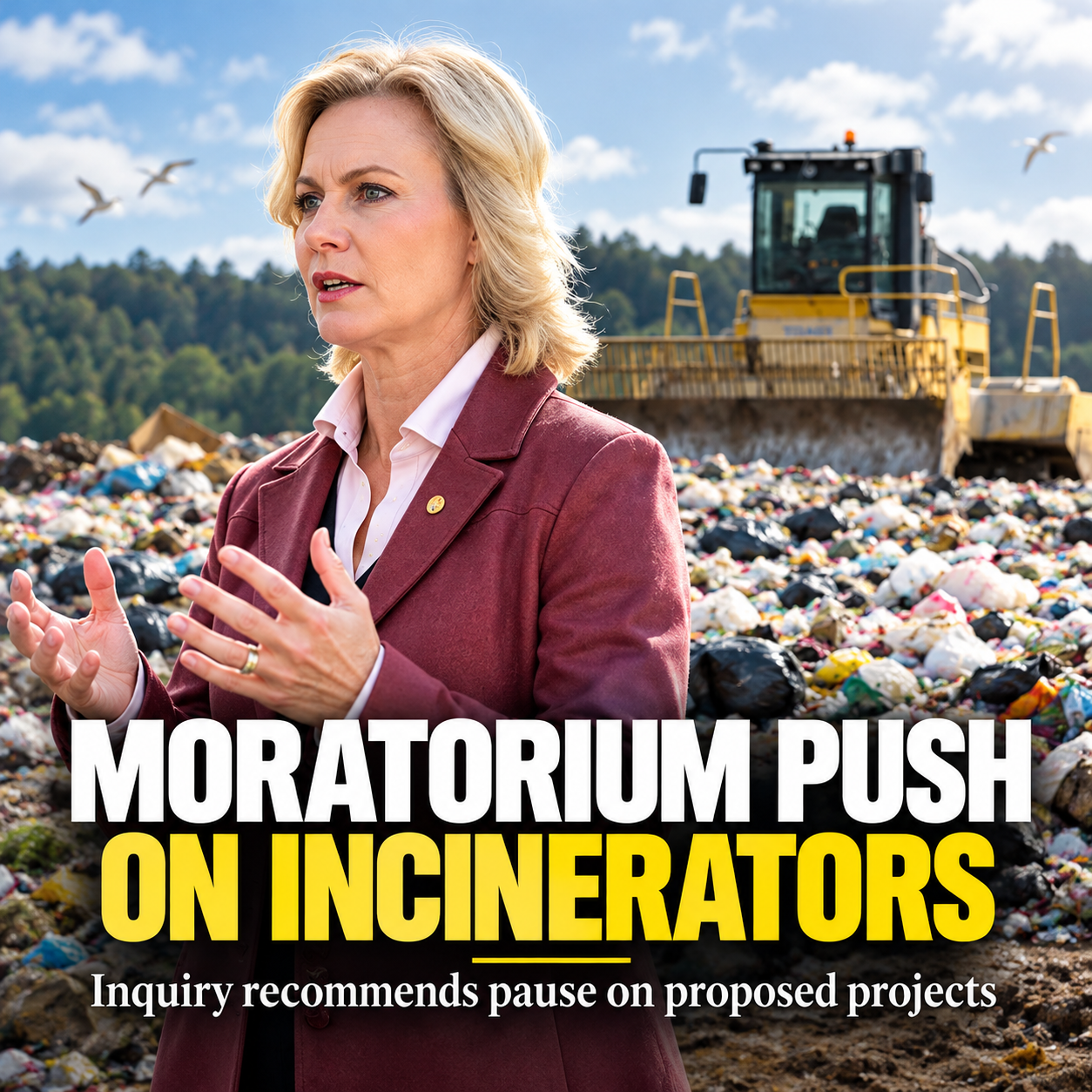
The committee delivered 22 recommendations on Tuesday, 20 October, after examining plans to use high-temperature technology to convert waste into energy. Its findings focus attention on regional communities including Parkes and Tarago, near Goulburn, where proposed facilities have drawn sustained opposition.
Crucially, the inquiry has made recommendations. It has not itself passed a statewide ban or finally determined the planning applications. The NSW government is required to respond by 20 January 2027.
What the inquiry recommended
The parliamentary committee examined proposed waste-to-energy technology over seven hearings held during 2025 and 2026. It received more than 1,400 submissions, with a majority opposing the development of the technology.
Its recommendations included a pause on new proposals and an independent review of designated energy-from-waste precincts. It also recommended that development applications for the Parkes and Tarago facilities should be rejected.
The report called for appropriate buffer distances between proposed plants and sensitive locations such as schools, hospitals and food-production areas. These recommendations reflect community worries about the long-term consequences of locating industrial waste facilities near places where people live, work and grow food.
Committee chair Nichole Overall, a Nationals member of the NSW Legislative Council, pointed to the absence of community acceptance and the need for more credible decision-making. The finding challenges the idea that technical assessment alone is enough if residents and local councils believe the process has not properly engaged them.
Why regional towns are resisting
Sydney generates enormous volumes of waste and faces pressure on existing landfill capacity. ABC reporting notes expectations that current landfill arrangements may reach capacity around 2030, adding urgency to the search for alternatives.
Proposals to process city waste in regional areas can create an uneven distribution of costs and benefits. Metropolitan residents and businesses gain a way to dispose of waste; regional communities are asked to host the facilities, additional freight movements and potential environmental risks.
Supporters of energy-from-waste technology argue that modern plants can recover energy from material that might otherwise be buried and can operate safely under strict conditions. Opponents question the emissions, health implications, transport movements and whether incineration could undermine waste avoidance and recycling.
Those arguments should not be flattened into claims that all incinerators are demonstrably unsafe or that every project is harmless. The environmental performance of a facility depends on its design, operation, waste stream, regulation, site and enforcement.
The committee’s criticism centred partly on whether the current policy framework properly accounts for the views of communities that would live with these projects.
The debate is not unanimous
The report did not end political disagreement over the technology. Labor committee member Emily Suvaal raised concerns about imposing a moratorium without viable alternatives for handling waste.
That caution matters because the waste problem does not disappear when one technology is delayed. Landfill constraints, recycling performance and demand reduction must still be addressed. If governments refuse a proposed solution, they need credible timelines for what replaces it.
On the other hand, the urgency of a waste-capacity problem does not automatically justify building industrial facilities in places where community consultation or environmental safeguards may be inadequate.
A sound government response would therefore need to evaluate both the risks of continuing with the present projects and the consequences of pausing them.
What happens at Parkes and Tarago?
The committee’s recommendations place the two developments under additional scrutiny, but they remain separate from final planning decisions. It would be inaccurate to declare either project permanently cancelled solely because the committee recommended rejection.
There is also a difference between rejecting particular applications and prohibiting an entire technology indefinitely. The inquiry considered both the suitability of specific sites and broader questions about the government’s existing policy framework.
NSW regulations currently restrict where energy-from-waste plants can be considered, including designated precincts at Parkes and in the southern Goulburn region. The committee has urged further review of that framework.
The experience of these towns demonstrates why ‘social licence’ has become a central concept in infrastructure policy. Formal approvals may answer whether a project meets regulatory requirements, while public acceptance reflects trust, fairness and the quality of consultation.
What energy-from-waste facilities are meant to solve
Energy-from-waste plants are promoted as one possible way to handle residual rubbish that cannot readily be recovered or recycled. Supporters argue that processing this material can reduce reliance on landfill and generate usable energy. But a facility does not make waste disappear: it requires transport, emissions monitoring and management of by-products. Its value depends on the specific technology, the waste stream, the local environment and the alternatives available.
That makes this more complex than a simple choice between ‘clean energy’ and ‘pollution’. Recycling and waste prevention are separate objectives; a plant designed to process rubbish may not solve inadequate sorting or a lack of recycling infrastructure. The inquiry’s recommendations should be assessed against these competing questions, rather than being presented as proof that every use of the technology is unsafe or that every opposition campaign is anti-development.
What regional communities are asking to know
The Parkes and Tarago debate involves where a city places the infrastructure needed to process its rubbish. Residents may want independent information about air emissions, truck movements, road wear, property amenity and how monitoring would operate over many years. These are legitimate planning and public-health questions even before a final environmental assessment. Equally, communities elsewhere may ask what happens if proposed facilities do not proceed and more waste remains in landfill or requires transport to another site.
A credible decision process therefore needs clear evidence, transparent assumptions and genuine local participation. A company’s modelling, a community group’s concerns and a parliamentary committee’s recommendations are all different forms of information. None replaces a formal planning determination. The 20 October report provides a basis for political decisions; it does not itself decide the fate of every future project.
The business costs behind waste policy
Waste infrastructure is ultimately financed through some combination of private investment, contracts and charges paid by councils, businesses or households. The economic questions include capital costs, operating costs, the price of moving waste and the risk of being locked into a long-term supply contract. Electricity revenues may offset some costs, but whether a particular project is financially attractive requires its own disclosed assumptions. This story does not establish a dollar figure for the likely effect on household council rates.
There are also questions for regional logistics businesses and landowners. More truck movements can create demand for transport services while imposing costs on roads and communities. Plant operators may promise local jobs, but the scale and duration of any employment benefits should be checked project by project rather than inferred from the industry as a whole. These issues help explain why both investors and local councils are likely to pay close attention to the government’s response.
What happens between an inquiry and a decision
A parliamentary report is not legislation. Ministers may accept, reject or modify recommendations, and some proposals may continue through separate regulatory or planning processes. Readers should watch for a written government response, decisions by planning authorities and any independently published environmental assessments. The committee recommended a pause and rejection of specific proposals, but that should not be rewritten as a final statewide prohibition.
For the government, the challenge is to provide a practical alternative if it declines to support energy-from-waste construction. For opponents, it is to explain what mix of recycling, reduction and other treatment can handle residual waste. Either way, the policy choice will involve trade-offs in cost, environmental impacts and public trust. Those choices need to be assessed openly rather than settled by a slogan about Sydney sending its rubbish to the regions.
What should readers watch next?
The NSW government has until 20 January 2027 to respond to the recommendations. Ministers will need to indicate whether they support a moratorium, whether to revisit the designated precincts and how they intend to manage the state’s longer-term waste capacity.
Project proponents, councils, residents and environmental advocates may all respond separately. Each position should be attributed to its source. At the time of the report, the outcome of the planning applications was not settled by the inquiry itself.
The findings have sharpened a difficult question: should regional communities accept new waste infrastructure to help solve Sydney’s disposal problem, and under what environmental and democratic conditions?
That is a legitimate public-policy debate with costs on both sides. The immediate confirmed development is the parliamentary committee’s recommendation for a pause and for rejection of the two proposals — with the government’s decision still to come.






