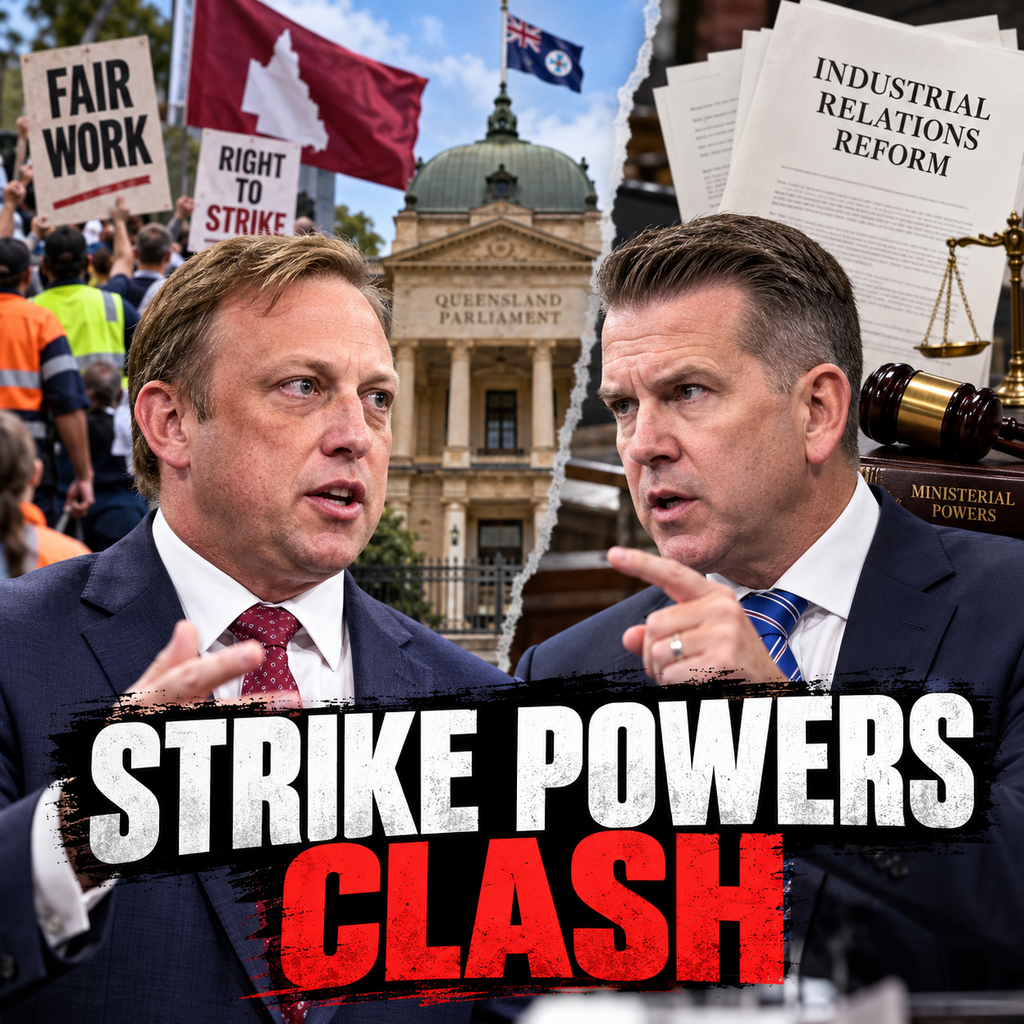
Queensland Opposition Leader Steven Miles has accused Deputy Premier Jarrod Bleijie of seeking excessive powers under legislation that would allow a minister to terminate certain protected strikes. Bleijie says the proposed intervention would be reserved for extraordinary circumstances.
The disagreement follows the introduction of a bill that would allow the state’s industrial relations minister to terminate protected industrial action under specified tests. It is a proposed change, not an existing power that has already been exercised under the bill. The legislation has been referred to a parliamentary committee for scrutiny.
Under the bill reported by the ABC on 15 October, the responsible minister would be able to terminate protected industrial action in circumstances involving a sufficient public interest justification. Those circumstances include threats to personal safety, health or welfare, significant economic harm, and substantial disruption to certain public services.
The reform package would also require a minimum of three working days’ notice before protected industrial action. Other proposed provisions concern psychological injury claims, including the role that employment must have played in causing an injury. The package therefore reaches beyond the narrow question of who can stop a strike.
Queensland’s state industrial relations system covers a smaller group of workers than the federal Fair Work system. The ABC puts the state workforce at about 383,000 people, compared with around 2.66 million employees under Commonwealth arrangements. The proposed ministerial powers would operate within the state system, not across Australia.
The comparison with the federal Fair Work system requires care. Fair Work Ombudsman guidance explains that protected industrial action can be suspended or ended on specified safety or economic grounds, with roles for the Fair Work Commission and, in certain circumstances, the federal minister. Queensland’s argument is about how similar or different a proposed state power should be and what thresholds must be met. A ministerial declaration is not the same as an employer deciding that a stoppage is inconvenient. The legislative wording matters because a very broad public-interest test could reach disputes that would not satisfy a narrower serious-harm threshold.
Miles said the reforms would give Bleijie incredible powers and accused the government of concentrating too much authority in a single office. He argued the proposed intervention threshold differs from the protections applied to damaging industrial action in the federal system.
His concern is that powers originally justified by exceptional public emergencies could also be invoked during difficult bargaining disputes. A minister could become a direct participant in an argument that might otherwise be handled through independent industrial relations mechanisms.
Bleijie said the proposed measures were modelled as closely as possible on Commonwealth industrial relations provisions. He maintained the powers would be exercised in extraordinary cases and pointed to the problems Queensland commuters experienced during lengthy rail bargaining disputes.
The deputy premier has stressed that the system would retain existing methods of conciliation and arbitration. In the government’s presentation, a power to intervene where a dispute seriously harms the public is a safeguard rather than a routine bargaining tool.
Bleijie’s reference to rail disruptions gives the debate a practical setting. When trains are delayed, businesses lose staff time and workers can miss shifts; commuters may have to spend money on fuel, parking or alternative transport. Yet the right to take protected industrial action is part of the bargaining power employees possess when negotiations fail. Any mechanism that ends that action can change the balance between employers and unions. It can also shape the incentive to reach a settlement before a dispute becomes prolonged.
The government’s broader overhaul includes a proposal to tighten the test for compensation for psychological injuries. Union representatives warn that jobs are not always the sole source of psychological harm and that a restrictive test could make it harder for legitimate claimants to obtain support.
Bleijie has pointed to increasing numbers of accepted psychological injury claims as a reason for review. Those figures are relevant to the policy debate, but they do not by themselves establish how many claims are inappropriate or what effect a new threshold would have on particular workers.
Protected industrial action is a defined part of workplace bargaining, not simply any protest or stoppage. Employees taking action under the relevant procedures have legal protections that generally do not apply to unprotected strikes. The Queensland proposal would give the minister an additional route to stop action that otherwise qualifies for that protection in specified circumstances.
There is a financial dimension for councils and other public-sector employers covered by the state system. Enterprise agreements determine wage commitments that often run over several budgets. A cancelled stoppage might contain immediate operational costs, but it would not necessarily resolve a disagreement over pay, staffing or workloads. The underlying dispute could move instead to arbitration or further bargaining. Bleijie says those processes would remain available; the opposition wants to know whether workers would lose meaningful leverage before the process reaches that point.
For workers, the dispute goes to the leverage available when enterprise bargaining stalls. For commuters and public-service users, it is about how long serious disruption should be allowed to continue. Bleijie says the legislation preserves workers’ ability to strike; Miles fears the ministerial power would erode it when a dispute becomes politically difficult.
An extended rail stoppage may impose losses on the employer, disrupt commuting and force parents to change work or care plans. In other essential services, industrial action can create public-health or welfare consequences. Government ministers argue those wider harms must form part of the calculation. Yet there is also a cost when workers have little bargaining leverage: wages, staffing conditions and retention may be harder to resolve, potentially affecting service quality after the immediate dispute ends.
The public-interest test therefore needs to be precise. If a minister can intervene whenever a service is disrupted, the existence of disruption alone could make many effective strikes vulnerable. If the threshold is too narrow, people relying on essential services may have limited protection against prolonged harm. That is the balancing exercise parliament must undertake. The ABC reported Miles contrasting the proposal with the higher bar he says applies in the federal Fair Work framework; Bleijie has disputed the characterisation of the bill as an attack on workers’ rights.
Employers also need predictable rules for rostering, negotiating pay and responding to a stoppage. Uncertainty can lead organisations to postpone agreements or make contingency spending decisions. Workers need to know in advance whether action is lawful and what financial penalties or lost pay might follow. A law that depends on a discretionary power should explain both the grounds for use and the avenues for challenging a decision.
The industrial action powers are not the only commercially significant part of the proposed overhaul. The bill also changes the proposed test for compensation for psychological injury. Bleijie has pointed to a sharp rise in accepted psychological injury claims; unions warn that requiring employment to be the major significant contributing factor could exclude workers whose illness has several causes. The figures about the growth of claims are a government justification, not proof that the existing claims are fraudulent.
Workers’ compensation changes create a separate set of questions for employers, insurers and injured staff. A psychological injury claim may involve medical evidence, workplace factors, income replacement and rehabilitation. A tougher eligibility test could alter claim outcomes, but it does not demonstrate in advance that premiums would fall by a specified amount. Employers considering their insurance costs would also need to look at prevention, staffing practices and support for employees returning to work. Those issues are commercially important without being grounds to assume every contested claim lacks merit.
Workers compensation also has financial consequences for employers, employees and insurers. Premiums help cover treatment, rehabilitation and lost wages after qualifying workplace injuries. Changing the eligibility test could affect both accepted claims and costs, but the government’s proposal has not yet established how premiums, claims or services would change.
The parliamentary committee is expected to examine the thresholds for intervention and the safeguards applying when a minister uses the power. Unions and employers have different interests in those details, particularly where essential services are affected.
The committee stage allows unions, employers, public agencies and affected workers to test the language of the bill before parliament decides whether to pass it. It may also reveal whether review rights and safeguards are adequate when a minister exercises such a consequential power.
The parliamentary inquiry is an opportunity to seek examples, not simply political slogans. Unions can test the circumstances in which a minister could stop a lawful stoppage; employers can explain disruption costs; compensation experts can examine how psychological injury provisions might work. Questions about review rights, written reasons and the point at which a public-interest threat becomes sufficiently serious should be answered before the laws are made. None of those safeguards can be assessed solely from the claim that the bill mirrors part of an existing federal scheme.
Until Queensland’s parliament passes legislation, workers’ existing rights and obligations have not been changed by this proposal. The committee process is the next opportunity to test the government’s case and the opposition’s objections.






