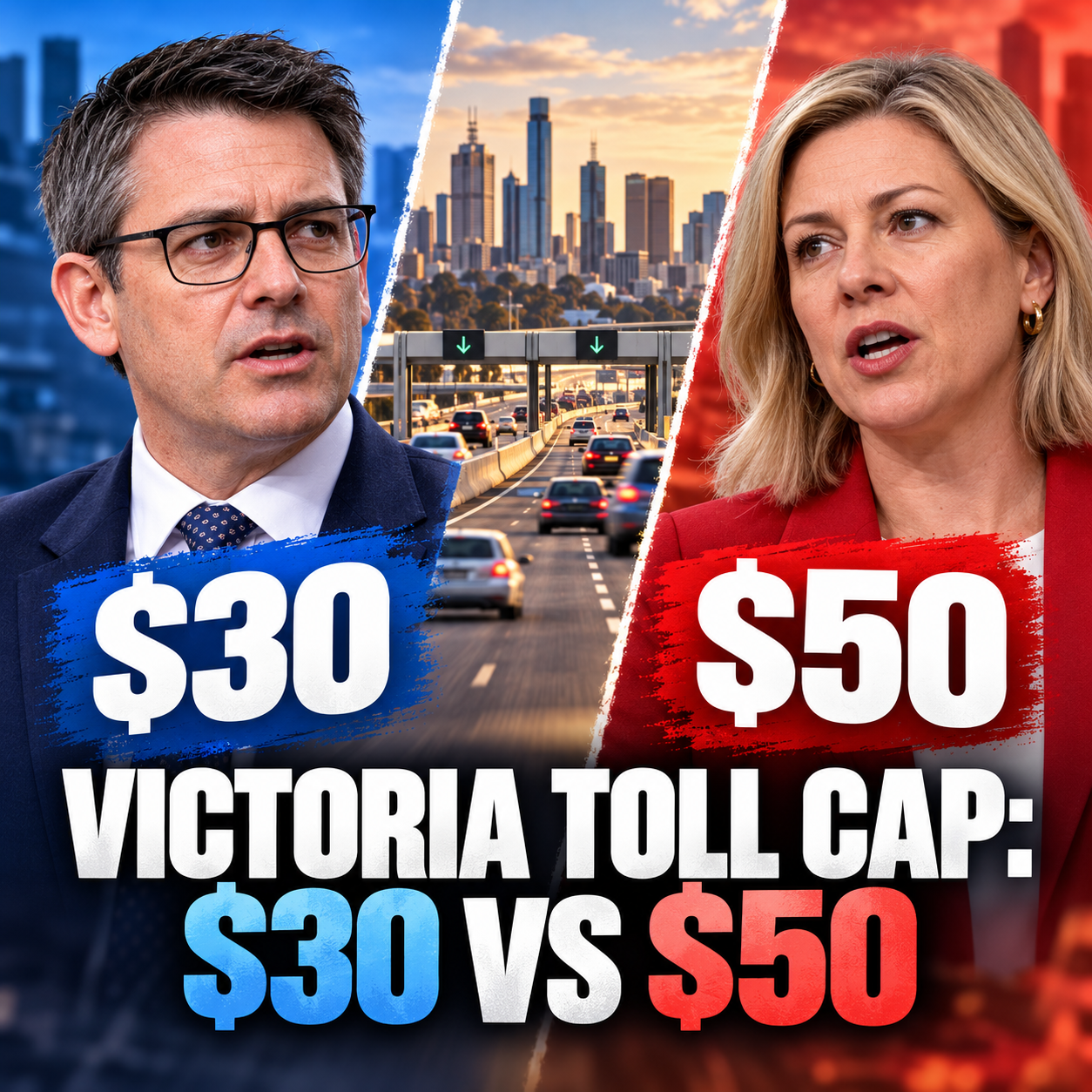
Victorian motorists are being offered two different promises about the cost of using toll roads, as Premier Ben Carroll and Opposition Leader Jess Wilson put household budgets at the centre of their campaigns. Labor has proposed a cap of $30 on eligible weekly toll charges, while the Coalition has already committed to a $50 weekly cap for a limited period. The figures make an easy comparison, but the schemes have different conditions and are not yet operating under either party’s proposed terms. Understanding what motorists could actually receive requires looking beyond the headline numbers and the political contest surrounding them.
Labor’s latest announcement is presented as a rebate arrangement rather than a simple removal of toll charges at the point of travel. That distinction matters because a driver would still need to understand which journeys qualify, how claims are made and whether any limit applies to the rebate. The government has said its proposed measure would assist individuals and eligible small businesses. Carroll has pitched it as relief for people who need toll roads to get to work, run errands or keep a business moving. Those aims make the policy relevant to everyday commuters, but they do not mean every household would receive the same benefit.
According to the details reported by the ABC, Labor’s approach would involve a maximum rebate amount of $350 a week or $5,000 in a year. Eligible vehicles would include cars, utes, motorbikes and vans, with small businesses able to make claims for a limited number of vehicles. These limits are significant because the phrase “toll cap” can suggest there is no distinction between an occasional road user and a person with extremely high toll bills. The fine print determines how much can actually be returned. Anyone comparing the offers needs to distinguish the weekly threshold from the separate maximum benefit figures.
The Coalition’s earlier promise was framed around a $50 weekly cap on toll-road use for two years. That is a larger threshold than the figure now proposed by Labor, but duration and eligibility are part of the comparison as well. The parties are promising future changes under different arrangements, not describing two schemes that motorists can currently choose between. It would be misleading to state that drivers will automatically pay one amount or the other regardless of the election result, the eventual legislation or administrative design. Both plans are campaign commitments that still require practical implementation.
For a motorist who regularly pays more than either proposed threshold, the difference could be meaningful over a long period. But a headline subtraction of $20 does not tell the whole story. A driver who seldom uses a toll road may receive no additional benefit. A family with two vehicles may need to examine how eligibility and claims are defined. A business with several vehicles would have a different set of questions again. These are not reasons to dismiss cost-of-living assistance; they are reasons to assess the two offers on the basis of their actual rules rather than only their advertising.
Carroll has described the policy as part of Labor’s broader effort to reduce household and business costs. The Premier has also linked it to the government’s approach to other registration and transport expenses. That political framing is important because the policy is aimed at voters already feeling pressure from bills, travel and everyday necessities. Governments often use targeted rebates to provide visible relief without changing the underlying price charged by a service provider. A rebate, however, shifts the question to who pays for the assistance and what administrative steps a person must complete to receive it.
Toll roads are an especially visible expense for people whose jobs require repeated travel across major cities. A commuter may choose a tolled route to save time, avoid congestion elsewhere or make a journey possible within work and family commitments. For small businesses, toll use can form part of regular operating costs, particularly when staff travel between customers or deliveries. These examples explain why parties see the issue as politically important. They do not establish how many people would qualify under each promise, or how much any particular user would save. Those figures require the parties’ detailed eligibility and usage information.
The proposal also sits within a broader national conversation about the affordability of transport infrastructure. New South Wales already has a weekly toll-cap relief program, and both Victorian parties have pointed to the general idea of limiting the burden on frequent users. The existence of a scheme in another state provides a policy reference, not proof that the same design or cost can simply be copied. Toll networks, contracts, usage patterns and rebate administration differ. Claims about the benefits of a Victorian policy should therefore be grounded in the state’s own proposed rules and financial estimates.
From a public policy perspective, one of the central questions is how a rebate would be funded. A reduction in the amount a qualifying driver ultimately pays does not necessarily lower the revenue collected for the journeys. If government reimburses users, the expense moves to the public budget. The broader benefits might include helping people maintain access to work or reducing pressure on small businesses. The costs could include the amount reimbursed and the administration needed to process claims. Without a full costing and the expected number of participants, voters cannot reliably calculate the overall budget effect from a headline threshold alone.
There is also the question of fairness between people who use toll roads and those who do not. Some motorists have little practical alternative to a tolled route, while others live or work in places where tollways are irrelevant. Rural and regional residents may see the announcement differently from commuters in Melbourne’s outer suburbs. Such differences are common with targeted transport measures. A useful public debate would explain why this group of users has been selected for assistance, how the measure fits alongside other transport priorities and whether there are safeguards against benefits being concentrated among unusually high users.
The parties’ competition has unfolded as the state election approaches, with cost-of-living announcements occupying an increasingly prominent place in the campaign. Carroll and Wilson have presented themselves as responding to pressures on households, but their proposals should be evaluated separately on design and evidence. Labor’s lower weekly figure is a clear numerical difference. The Coalition’s stated two-year duration is another concrete characteristic. Neither feature on its own constitutes a verdict on which plan is more effective. Effectiveness depends on what is delivered, how much it costs and who receives support.
For workers who use vehicles for business, the vehicle eligibility rules could be as important as the headline cap. The inclusion of utes and vans in Labor’s proposal is likely to draw attention from trades and smaller service businesses. Yet claims should not assume that every commercial vehicle will qualify or that a business can make unlimited claims. Labor has specified a limit for the number of business vehicles. The actual process, proof of eligibility and treatment of shared vehicles would need to be explained before a business could confidently incorporate the rebate into its budget planning.
Motorists might also reasonably ask how the system would interact with existing toll accounts and payment arrangements. Would relief be calculated automatically or claimed after charges are incurred? What information would people need to provide? How would a user confirm which charges were eligible? These questions are not evidence of a flaw in either party’s proposal; they are standard implementation matters that can determine whether a scheme is easy to use. Until detailed operating rules are published, the most accurate account is that the parties have offered competing promises rather than a fully available service.
A lower cap has obvious appeal as a campaign message because it offers a number voters can remember. But governments are ultimately measured by the gap between a promise and its application. The policy would need rules capable of handling different types of motorists, avoiding duplicate claims and providing clear information to users. Voters may also want to compare the likely budget cost with alternative forms of transport relief. These considerations deserve attention even when an announcement is designed to be delivered in a few headline words.
The contest between Carroll and Wilson now gives Victorian voters a concrete comparison: Labor’s proposed $30 cap and the Coalition’s earlier $50 cap, alongside different conditions and timeframes. Both positions are politically important, but neither is a guarantee of the precise amount an individual will pay. For the people most affected, the next useful information will be the full eligibility rules, costs and claims process. Until those details are settled and a scheme is enacted, the promises remain part of the campaign rather than a change already reflected in motorists’ toll accounts.






