Bob Katter has spent a long political career insisting that North Queensland deserves to be heard. His latest intervention brought that argument directly to Prime Minister Anthony Albanese in federal parliament, where a question about creating a separate state received an answer that began with a joke but ended with an acknowledgment of the region’s infrastructure needs. The exchange was brief, yet it exposed a substantial disagreement about how a vast state distributes power, money and attention between its capital and its northern communities.
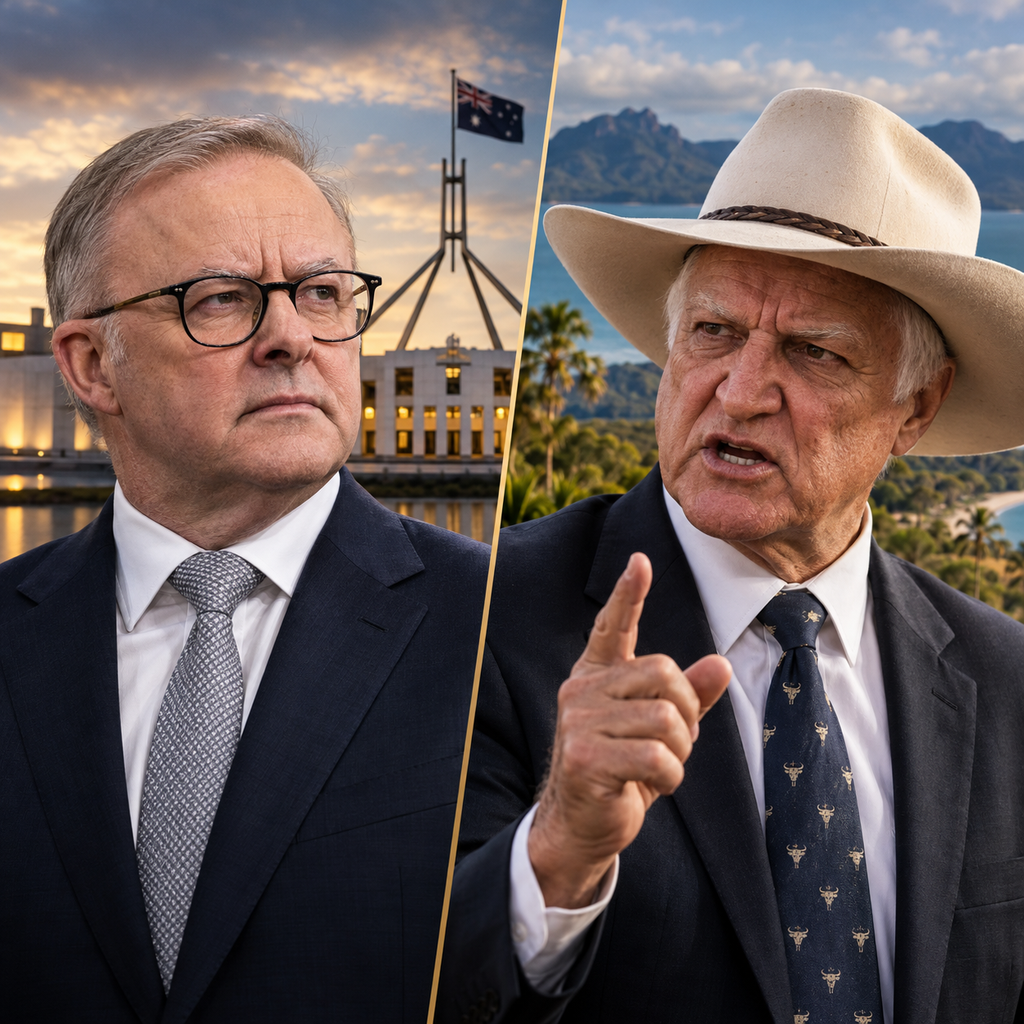
The member for Kennedy asked whether the government would commission a report into the viability of a separate North Queensland. He argued that major mining and irrigated agriculture projects were being held back while decisions were made far from the communities affected. Albanese replied that the prospect of a Premier Katter was not one he had expected to discuss in Question Time. He also joked that dividing Queensland could weaken its State of Origin rugby league team, whose players have long come from northern towns.
The lighter moment did not mean the prime minister dismissed every part of the complaint. Albanese said Queensland’s size made regional representation an important issue and accepted the need for Far North Queensland to receive its share of infrastructure and resources. The distinction matters: recognising regional frustration is not the same thing as endorsing a new state. There was no announcement that the Commonwealth would begin a formal statehood process, and Katter’s request for a viability report remained a political demand rather than an approved government program.
For Australians outside Queensland, the argument may sound like a colourful local dispute. In the north it touches practical questions about roads, electricity, water, investment and the distance between a voter and the government making decisions. A capital city can be the centre of a state’s economic administration without being the place where its mineral deposits, agricultural projects or remote transport problems are located. Katter is challenging the assumption that a government in Brisbane can adequately balance all of those interests without a more fundamental change in the distribution of power.
Distance is a powerful part of his pitch, although distance by itself does not establish that separation would improve outcomes. Regional Queensland covers communities with markedly different needs. A cattle producer facing freight costs, a household worried about energy reliability and a town seeking better medical services may all share dissatisfaction with distant decision-makers. Turning that dissatisfaction into support for statehood, however, requires showing that an entirely new administration would deliver measurable improvements. The benefits cannot simply be assumed from the fact that the present arrangements are unpopular with some residents.
A proposed state would need more than a name and a premier. It would require a working plan for revenue, public services, administration, parliamentary representation, debt, infrastructure commitments and the transition from Queensland’s existing systems. Residents would reasonably want to know where the capital would be, what taxes and charges might apply, whether hospitals and schools could be maintained, and how local councils would relate to a new state government. Those questions are precisely why a feasibility study could be useful, even to voters who are undecided or sceptical about Katter’s final objective.
The Australian Constitution makes the legal hurdle significant. It allows for new states, but the separation of territory from an existing state requires the consent of that state’s parliament. Federal political enthusiasm alone would not suffice. That provision sharply limits any suggestion that a prime minister could simply approve a North Queensland state at the dispatch box. Nor does a parliamentary question amount to an application that has cleared constitutional requirements. Katter has also floated territory status as a possible alternative, but such an idea would bring its own legal, political and administrative questions.
North Queensland’s economic role explains why the proposal can find a receptive audience even if the mechanics remain difficult. Mining, agriculture and transport links connect the region to national supply chains. When a major project is delayed, the consequences may extend through contractors, freight operators, shops and families whose employment depends on those activities. Katter cited stalled investment as part of his argument. It is important, though, not to treat every delay as proof that southern Queensland deliberately withheld development. Projects can also face financing, environmental, technical, commercial and regulatory obstacles that a new border would not automatically remove.
Albanese’s response took the government down a more conventional path. Rather than discuss a fresh state bureaucracy, he pointed towards investments and engagement with regional Queensland. That approach assumes the federation can respond to northern complaints through existing institutions: funding agreements, transport programs, energy policy and direct cooperation with local representatives. Whether it satisfies voters depends on what is actually delivered. A promise of attention may be politically useful for a day, but a reliable power connection or completed road is more tangible to someone running a business or raising a family.
The disagreement is therefore not neatly described as a personal feud between the two men. Katter demanded an examination of separation; Albanese answered with humour and a defence of the existing government’s regional attention. They were arguing over the proper remedy for a longstanding problem, not trading allegations of personal wrongdoing. The exchange illustrated their different political styles as much as their different preferences: one emphasises confrontation and regional grievance, while the other seeks to absorb the complaint without opening a potentially divisive constitutional debate.
Queensland’s State of Origin reference was a familiar way to bring the dispute back to shared identity. Rugby league loyalties stretch across geography and political affiliation. But the joke also shows how easily a structural question can be reduced to entertainment in a busy parliamentary sitting. Viewers may remember the idea of a Premier Katter more readily than the feasibility question. That does not settle the merits of the proposal. Political humour can make an exchange memorable while leaving the hard details to be addressed outside the chamber.
A serious assessment of the northern statehood case would need to separate at least three claims. First, is North Queensland being underserved compared with its economic contribution and population? Second, if the answer is yes, could Queensland and Commonwealth governments correct the imbalance within current boundaries? Third, if those remedies are insufficient, would a new state produce better outcomes after transition costs? Evidence about funding, service access and project delivery matters at every stage. Supporters and opponents should be held to the same standard rather than relying on assumptions about either Brisbane’s indifference or the transformative power of secession.
The question of representation is especially complex. A northern parliament could give local communities a more concentrated voice on regional issues, yet it could also introduce disputes between northern centres and remote districts. Townsville, Cairns, Mount Isa and smaller communities do not have identical priorities. A new state would face its own decisions about which places receive roads, hospitals and investment first. Moving the seat of government closer to a region does not guarantee that every town in that region will feel close to power. Governance still requires trade-offs, oversight and durable financing.
Nor is the national government a bystander to regional development under the present system. Canberra makes major decisions about national infrastructure, defence, taxation and wider economic settings. The Commonwealth works with states on investments that can matter profoundly to remote communities. That is one reason Katter directed his question to Albanese rather than limiting his complaint to Queensland authorities. It also means the prime minister can engage with the substance of northern disadvantage without adopting statehood as the solution. The two positions should not be confused in reporting the exchange.
Some advocates point to local sentiment as evidence that the north is ready to go its own way. Polling circulated by supporters may offer a useful snapshot of frustration, but a campaign survey is not a formal referendum and the wording, sample and methodology would need scrutiny before its results could stand for regional consent. Residents who favour greater autonomy might still disagree about statehood, territory status or enhanced regional funding. Asking what people want is only the beginning; explaining the institutional choices and likely costs is necessary for informed consent.
There are clear political incentives on each side. Katter gains attention for communities he argues have been neglected, while Albanese can present himself as attentive to regional needs without unsettling Australia’s state arrangements. Both positions leave room for a dispute over actual investment. The prime minister’s willingness to acknowledge a need for a fair share may be welcomed, but Katter and northern voters can reasonably ask how that assurance translates into funding decisions. Equally, proponents of separation can be asked how they would replace the financial and administrative functions now provided by Queensland.
For the people whose concerns fuel this debate, the next meaningful evidence may be decidedly untheatrical. It could be a published analysis of northern projects, a clear explanation of resource allocation, a commitment to examine constitutional and financial options, or measurable progress on an infrastructure bottleneck. None of those outcomes followed automatically from Question Time. The political exchange raised the issue and exposed the divide; it did not resolve it.
The lasting question is whether North Queensland needs a different government or a better response from the government it already has. Katter has put the most dramatic option on the table. Albanese has declined to treat it as an immediate program while acknowledging the legitimate issue of regional access to resources. Between those positions lies the difficult work of establishing what northern communities lack, who can supply it, and how the public can judge the result. That is a more consequential test than who delivered the better line in parliament.






