Liberal senator Andrew McLachlan has criticised the Nationals’ rejection of Australia’s agreed but unratified trade deal with the European Union, describing Matt Canavan’s approach as ‘performative’. The dispute exposes an uncomfortable split within the Coalition over whether to pursue more trade access in Europe or reject an agreement that some Nationals say offers too little to Australian farmers. It also raises a question about who can speak for both Coalition parties before they settle a position through their own processes.
Canavan said the Coalition would oppose the Australia–EU free trade agreement, arguing that the terms were inadequate for Australian producers and jobs. Reporting showed that the position had not been debated and approved across the relevant Coalition partyroom or shadow cabinet at the point he asserted it. Bridget McKenzie supported the Nationals’ concerns, while several Liberals wanted further talks on the deal. The treaty has been agreed between the negotiating parties but still requires Australian parliamentary ratification.
McLachlan, a Liberal senator, called the rejection ‘performative’, according to reporting in The Australian, and challenged the idea that the Nationals’ position settled the matter for all Coalition parliamentarians. The criticism was directed at Canavan’s approach to the treaty. Canavan’s wider objections to its terms are on record, but no direct answer from him to McLachlan’s particular word has been confirmed.
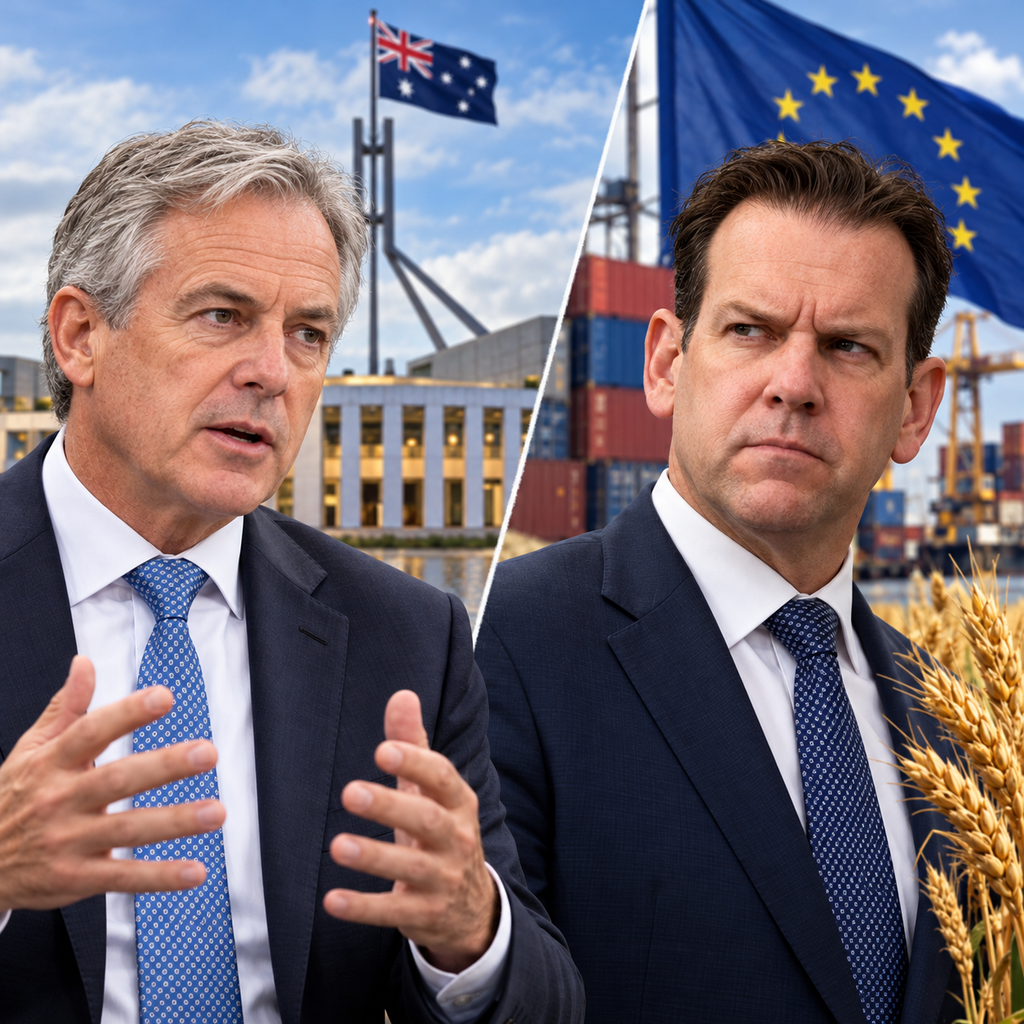
The economic argument begins with access to one of the world’s largest trading blocs. A trade agreement can reduce tariffs and other obstacles for exporters, while requiring compromises over agricultural quotas, geographical indications and regulatory standards. Those effects depend on the detailed terms and on how businesses can use them. Supporters see the agreement as a chance to diversify markets. Critics contend that important rural industries have not received access worth the concessions Australia would make.
Agriculture is central to the disagreement. Farmers and regional businesses are especially interested in what the agreement would mean for products such as beef and sheep meat. An arrangement that makes overall trade easier may still leave producers dissatisfied with the quota or conditions on a particular commodity. It is possible for politicians to support closer trade relations in principle while arguing that the negotiated concessions are inadequate for some industries.
That is the core of Canavan’s political case. The Nationals often put rural and regional economic interests at the centre of their public statements, and Canavan argued that the proposed terms were not good enough. His assertion deserves to be assessed against the actual market-access provisions, rather than treated as evidence that all cross-border trade would harm Australian employment. Nor does opposition to a draft deal prove that the National Party has secured the support of every Liberal colleague.
Why the Coalition is divided
Liberal senators are not speaking with a single voice. Some, including Sarah Henderson, have argued the deal is not strong enough for Australian farmers and want further discussion with Trade Minister Don Farrell. Other Liberals have questioned a blanket rejection before the partyroom has settled its approach. McLachlan’s criticism exposed that tension, even though disagreements within a Coalition do not automatically amount to a final split in the parliamentary vote.
McLachlan and Canavan are weighing different interests within the same trading relationship. Agricultural exporters may judge the treaty by additional market access for beef and sheep meat; manufacturers and services firms may put more emphasis on tariffs, investment and regulatory certainty. The final commercial effect will depend on the detailed terms and on whether Australian businesses can use the opportunities offered. That is why broad declarations of victory or failure are unlikely to satisfy every sector.
The Coalition’s structure makes the quarrel more complicated than an ordinary opposition-versus-government argument. The Liberal and National parties cooperate to present an alternative government but have separate histories, memberships and constituencies. A Nationals senator may feel a responsibility to resist terms seen as unfavourable to agricultural regions, while a Liberal colleague may want to preserve a broader message about trade openness. Those positions may be reconciled, but not by simply declaring consensus before it exists.
Trade Minister Don Farrell has defended the negotiated agreement and argued there is little scope to reopen terms with the European Union. That places pressure on the opposition: voting it down would block a major proposed expansion in trade ties, while supporting it risks criticism from some rural constituencies. Labor’s strategy in the Senate also depends on how other parties vote. None of those parliamentary outcomes is settled by Canavan’s public announcement alone.
There is an institutional step beyond the news conferences. Parliamentary scrutiny of treaties is designed to allow committee examination of international agreements, including evidence from industries, specialists and interested Australians. That process is relevant precisely because sweeping claims about jobs and national benefit need to be tested against the negotiated text and competing submissions. A politician’s strong declaration is not a substitute for that examination.
Businesses will be interested in whether uncertainty delays planning. An importer may want to know if equipment will become cheaper or whether standards will change. An exporter may need to estimate future market access before expanding production. Services firms may be interested in professional recognition or regulatory predictability. These effects depend on the deal’s actual provisions and its implementation, not simply which Coalition personality appears to win an internal argument.
The controversy also touches on how trade policy is explained to voters. A broad agreement may create diffuse gains for many consumers and firms while imposing concentrated adjustment costs on some producers. The latter groups have understandable reasons to organise and press their case. A serious public debate needs to compare those effects transparently rather than portraying all sceptics as isolationists or all advocates as indifferent to regional livelihoods.
The agreement has completed negotiations but faces the separate step of parliamentary consideration. A committee review can assess concerns raised by affected industries and offer recommendations before the vote. That process matters because an opposition statement about how members intend to vote is not itself the act of ratifying or rejecting an international treaty. Australian producers need clarity about the final rules rather than confusing the current political dispute with a law already in force.
What exporters and farmers stand to gain or lose
McLachlan’s criticism may also reflect a concern about Coalition discipline. When a frontbench or party colleague makes a sweeping declaration on behalf of others, internal disagreements become more visible and opponents can question whether the alliance has a coherent policy. That is a political consequence regardless of the merits of the proposed treaty. A group seeking to present itself as ready for government needs a process for settling major policy differences.
Canavan’s supporters can counter that an opposition should be prepared to reject a deal it considers inadequate rather than endorse it merely to appear united. That is a legitimate position in a democratic debate. But an assertion about what both parties will do requires confirmation from the relevant decision-making bodies. The tension between firmness of conviction and authority to speak collectively is the real significance of this episode.
For Australians, the disagreement is best judged by questions that have practical answers. Which agricultural quotas are proposed? What is the impact on regional producers and local jobs? What other sectors would gain improved access? Which safeguards would apply to standards and procurement? Can the terms be changed, and what alternatives would be realistic? Those questions go further than the personalities and can help voters understand what is at stake.
The debate becomes more concrete when different industries examine the treaty’s provisions. Farmers look closely at tariff-rate quotas and the conditions attached to export access. Manufacturers assess rules of origin, supply chains and access to imported equipment. Service providers may consider licensing and recognition of qualifications. A deal can offer clear opportunities to some sectors while providing less than others had sought. Those differences help explain why the Coalition’s internal argument is difficult to settle with a single position statement.
A closer trading relationship with Europe could give businesses more choices about customers, components and investment partners. That may have value when international supply chains are disrupted. Yet strategic benefits do not remove the concerns of farmers who consider the agricultural terms insufficient. Both issues can be tested against the agreement’s details and Australia’s existing trade patterns, rather than assuming every industry will gain equally.
The effects on consumers also warrant examination: lower trade barriers may eventually influence prices and product choice, while adjustment costs in particular industries can take more time to absorb. Neither effect is guaranteed without the specific negotiated provisions. Public debate becomes more productive when disagreements are expressed in terms that can be checked. Instead of treating “jobs” as an all-purpose argument, politicians could identify the industries, the expected effects of particular provisions and the evidence used to estimate those effects. The parliamentary process offers an opportunity to hear that information. The Coalition’s internal disagreement will ultimately be more meaningful if it leads to a clear account of why the proposed text is supported or rejected.
The next stage will reveal whether the Coalition can reconcile its differences and how parliament assesses the agreement. McLachlan has criticised Canavan’s approach; Canavan and fellow Nationals have questioned the commercial value of the deal, particularly for agriculture. Businesses and farmers will be watching the treaty scrutiny and the votes that follow. The political argument is loud, but the final legal and trading consequences remain undecided.






