Melbourne hiker Jordan Yap has been found dead in Peru, weeks after he failed to return from a solo expedition in a remote Andean mountain range. The 30-year-old's disappearance prompted his family and friends to organise a search after a planned hotel check-in and onward flight were missed. The announcement has ended the uncertainty about whether he was still missing, while leaving the circumstances of his death unanswered.
Friends shared news of the discovery through a page established to help coordinate the search, according to ABC News. Australia's Department of Foreign Affairs and Trade has separately confirmed it is providing consular assistance to the family of an Australian who died in Peru. Those accounts support the sad outcome, but they do not establish a cause of death or identify a precise accident or medical event.
Mr Yap had set out to hike in the Huayhuash region, a dramatic and remote part of central Peru renowned for steep terrain and high-altitude landscapes. He was reportedly an experienced hiker, although his father said the Peru journey was among his first solo multi-day trips. It is important not to treat either experience or a remote setting as proof of what happened on the trail.
Jordan left a hostel in Huaraz on 14 September and planned to complete a trek of about 10 days. His itinerary called for him to check into a hotel on 23 September before taking a flight from Lima to Cusco the next day, ABC reported. When he did not arrive for the hotel booking and missed the flight, his relatives became increasingly worried.
His father, Vinh Dao, had previously explained that Jordan told the family he would be out of contact during the trek. Hiking in remote areas can involve long periods without mobile reception, so a missed message alone may not signal an emergency. It was the failure to reach agreed points in the itinerary that transformed a planned communications gap into an alarming absence.
The family contacted Australian consular authorities and sought help from people in Peru. They also arranged a private mountain rescue team to look for Jordan. The decision illustrates the practical difficulty for families when a person disappears far from home: relatives may need to coordinate with local responders, consular officials and people familiar with the terrain while trying to establish basic facts about the traveller's last known movements.
By late September, the search was already difficult. Jordan's father said there had been an indication that people encountered his son early in the route, but information after that point was limited. That was part of the earlier missing-person account. Such reported sightings should not be transformed into a final confirmed timeline until investigators or rescuers verify exactly where and when they occurred.
The family considered travelling to Peru as concern intensified. At the same time, friends used the search page to circulate updates and appeal for assistance. These steps were undertaken while the outcome remained uncertain. They now form the background to a loss rather than an ongoing appeal for the hiker's whereabouts.
The ABC reported on Sunday that relatives and friends had been notified of the discovery and that Jordan's body was understood to have been found in the area of Mitucocha Lagoon, also rendered Lake Mitococha. The lake is roughly 4,270 metres above sea level and lies in the central Peruvian Andes, around 200 kilometres north of Lima.
Those geographic details provide a sense of the remoteness involved, but they should not be used to invent a particular sequence of events. The reporting did not establish whether Jordan died from a fall, an illness, an environmental hazard or another cause. It would be particularly misleading to describe the lake itself as the cause of his death merely because a discovery was reported nearby.
The Huayhuash region attracts experienced walkers because of its mountain scenery and demanding routes. Conditions on high-altitude trails can change, and journeys may be physically challenging. These are general characteristics of the environment, not evidence about Jordan's final hours. The family's description of him as an experienced hiker likewise does not explain the outcome.
His friends' announcement asked people to remember the person he had been and the joy he brought into others' lives. It was not a medical or investigative report. The statement's significance lies in the confirmation of loss and the community's desire to recognise Jordan beyond the headlines about a missing traveller.
DFAT said it was offering assistance and conveyed condolences to the family. Consular help can assist Australians dealing with deaths overseas, though the precise services provided in this case have not been described in the public record. The family's privacy should be respected in matters such as arrangements, official documents and future plans.
Australia's Smartraveller advice on Peru highlights why long-distance trekking requires more than ordinary sightseeing arrangements. Much of the country is at altitude, with sickness possible above 2,500 metres; advice for travellers includes assessing conditions, consulting a doctor before travel and understanding what medical evacuation may involve. These cautions describe general risks on mountain routes. They cannot establish that altitude sickness, the weather or any other identifiable hazard caused Jordan's death. The circumstances of his final movements have not been made public.
A missing-person investigation abroad often requires information from different sources. Family members may hold travel plans and contact dates; local guides or searchers may know the terrain; and authorities may be responsible for formal findings. Without a complete and released record from those involved, apparently precise timelines assembled on social media can contain gaps or contradictions.
Travel cover presents a separate practical issue for people entering remote regions. Smartraveller warns Australians not to assume every insurance policy covers adventure activities or evacuation from altitude, and advises checking the product disclosure statement before departure. A policy may distinguish an ordinary holiday from a high-altitude trek and specify limits on rescue-related costs. There is no verified evidence about Jordan's insurance arrangements, however, and his family's search effort should not be portrayed as a dispute with an insurer.
The first public stage of Jordan's case included a last message before the trek, missed itinerary commitments and the decision to engage professional search help. The second stage is the announcement that he had been found dead. Conflating the two stages can leave readers mistakenly believing a search is still under way for a missing person or that an early unverified sighting has been settled by the later discovery.
For family and friends, the uncertainty before the discovery was likely exhausting, although personal feelings beyond their public statements should not be presumed. They had to consider where Jordan might be and what resources could help locate him, with thousands of kilometres between their home in Australia and the mountain area where he travelled.
His father had described Jordan as a confident walker with experience on other hikes. That detail helps explain why relatives expected him to complete the planned route, but it also underscores that experience does not eliminate every risk on a demanding solo journey. The reporting does not justify turning this tragedy into a lesson about a specific mistake Jordan allegedly made.
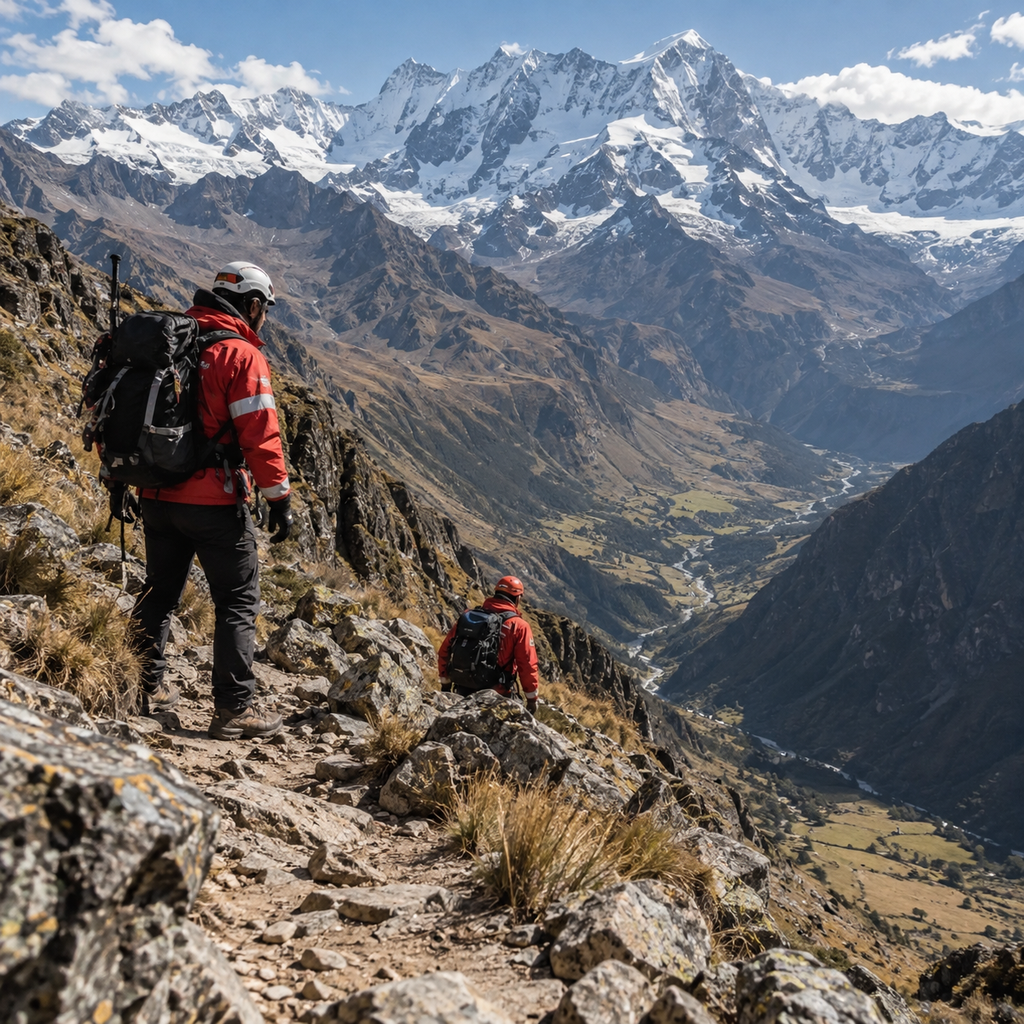
The location has attracted significant attention because the Cordillera Huayhuash is known for striking peaks and isolated paths. Readers may be tempted to interpret every photograph of the mountains as a view of the precise search site. That would be mistaken: an image of the wider Andes can illustrate the kind of country involved without documenting where Jordan was found.
The same government guidance recommends using an experienced guide where appropriate, monitoring local conditions and considering a GPS-enabled device or satellite tracker to share location information. Such equipment can help establish a route or signal for assistance, but it does not guarantee timely rescue in remote terrain. The reporting has not established what devices Jordan carried or whether communication technology played any role in the search. Presenting a general safety recommendation as a missing precaution on his part would be unfair.
A death abroad may prompt questions about search timing, rescue capacity, weather, equipment and medical cause. None of those questions has been answered publicly for Jordan in the sources available on Sunday. Reporters should not fill the space with theoretical reconstructions that could distress relatives or mislead readers into believing an official finding exists.
There is also a difference between saying a body was found near a landmark and asserting that a person reached, entered or fell into it. The former is a reported location; the latter would require evidence. In the absence of an official explanation, accuracy depends on holding that boundary.
The public-facing facts are straightforward even as the circumstances remain unresolved. Jordan was 30, from Melbourne, undertook a solo trek in the Huayhuash mountains in September, missed a hotel booking and flight, and became the subject of a family-led search. His death has now been reported by friends, with Australian consular assistance confirmed.
Consular assistance is frequently misunderstood in cases involving Australians overseas. The Department of Foreign Affairs and Trade may help families deal with authorities and find information, but Australia's travel advice emphasises that the government does not pay an individual's overseas medical or evacuation bills. Those general service limits matter when explaining why families sometimes coordinate significant practical arrangements themselves. They do not reveal the cost, location or precise method of the operation undertaken to find Jordan, and they do not remove the need to respect his family's privacy.
His community has asked that he be remembered for his life and relationships rather than the mystery of his final days. That request deserves space alongside the timeline of the search. Turning an unresolved death into a dramatic theory risks overshadowing the people who knew him and does not bring the public closer to a verified answer.
Further information may come from authorities in Peru or the family when they are ready to share it. Until then, the story can report the outcome of the search, the circumstances in which alarm was raised, the geography of the region and the limits of the evidence without claiming to know how Jordan died.