A 15-year-old boy is being treated in hospital after a suspicious fire at a Korean barbecue restaurant in Springvale, in Melbourne's south-east, early on Sunday. Victoria Police say the teenager was arrested and taken to hospital under police guard after reports of a boy with burns at a separate location. Detectives are continuing to investigate the restaurant fire and the movements of two males reported at the premises.
The fire occurred during a troubling run of suspected arson incidents across Melbourne. While the latest case may become part of a broader picture being examined by investigators, police have not publicly established that the same people organised or committed the incidents. The investigation into the Springvale restaurant must therefore be reported on its own evidence, without assuming a network, motive or criminal guilt.
The restaurant was unoccupied when the fire began, authorities said. That is a significant detail for assessing the immediate danger to people inside the building, although firefighters still had to respond to smoke and suspected fire damage. The exact extent of structural damage and any financial losses to the business have not been independently established in the official statement available on Sunday.
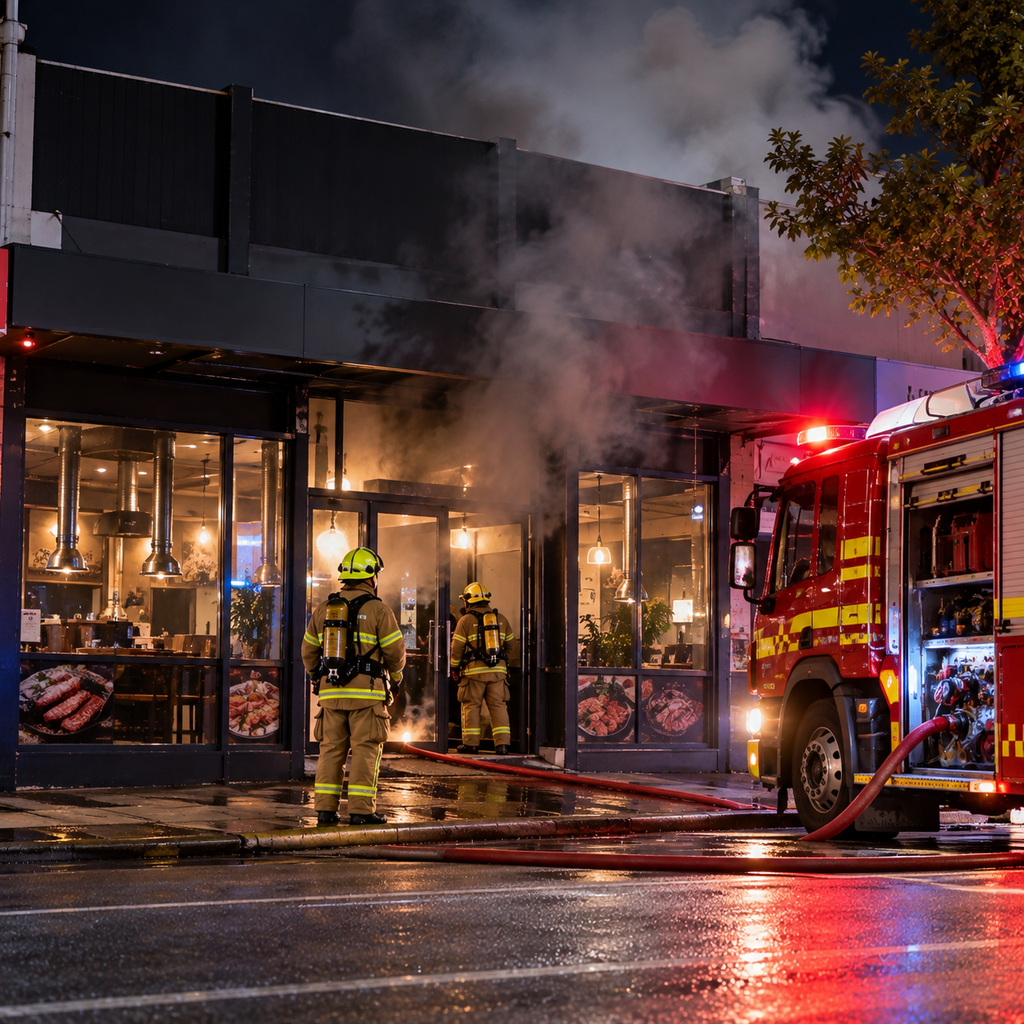
Victoria Police said Protective Services Officers working at Springvale Railway Station were told that two males had been seen breaking into a restaurant on Springvale Road near Windsor Avenue at about 12.15am. Black smoke was then observed coming from the building's upper floor. Fire crews were called, and officers established a crime scene to preserve evidence.
The wording of the initial police report is important. Officers were responding to information about a reported break-in and a suspicious fire; it was not a court finding that either person had committed arson. The people said to have been at the business had not been identified publicly in the statement, and the account does not establish exactly what each person did inside the building.
Police believe the males left in a vehicle. Not long afterwards, emergency services attended a fast-food restaurant on Warrigal Road in Heatherton following reports of a teenage boy with burn injuries. Police said the 15-year-old was arrested and taken to hospital under guard. The geographic separation of the two locations makes the sequence noteworthy but does not, on its own, supply a complete account of what occurred.
Investigators were still searching for another male believed to be involved when the story was first reported. The boy's medical condition, the precise cause of his injuries and what charges, if any, might follow were not definitively outlined. It would be misleading to describe him as convicted, or to present an unverified account of how the burns occurred, simply because the arrest followed the fire.
The official account also stated no one was inside the restaurant at the time. That fact rules out a claim that staff or diners were trapped in the premises, but it does not mean there was no risk to neighbours, emergency workers or surrounding shops. An urban commercial fire can generate smoke and require a substantial response even when a building is empty.
ABC News reported that the affected business was a Korean barbecue restaurant and that a jerry can was located near the scene and taken as evidence. The presence of an item under examination does not establish its precise use or who handled it. Only forensic work and the investigation can determine whether and how particular objects are connected with a suspected offence.
The first images of a fire scene can easily be misread. A blackened shopfront, damaged window or firefighting hose may be visible after responders have worked at a location. Those features do not, by themselves, prove the seat of the fire, whether an accelerant was used or the final degree of building damage. This is why the official description of smoke from the top floor should be kept distinct from any reconstruction.
For the business, the immediate consequences may extend beyond the emergency itself, but details of reopening, insurance, lost trading days or repair costs were not verified in the reports available. It would be speculative to quote a loss figure or state that the premises were permanently destroyed. Any later business statement or insurance assessment would be a separate development requiring confirmation.
Victoria Police's general guidance on preventing deliberately lit fires at business venues identifies practical vulnerabilities that do not depend on the motive in any one case. It recommends keeping bins, pallets and cardboard away from entrances, walls and windows, securing gas bottles and maintaining well-lit access points. Businesses are also encouraged to monitor exits and external areas and preserve useful CCTV. These are preventative measures for venues generally; there is no public evidence that the Springvale restaurant ignored them or that a particular security feature would have prevented Sunday's fire.
A suspicious fire is investigated differently from an accidental fire because detectives may need to establish the actions of individuals, secure any available CCTV, interview witnesses and compare forensic findings with eyewitness accounts. Those are general investigative considerations, not a description of steps that police have confirmed taking in this particular case. The distinction protects the integrity of a developing story.
The same police guidance explains why preserving a scene matters after a suspected arson incident. Material left near a building, footage showing approaches and departures, and other records may all become relevant once investigators reconstruct a sequence. Victoria Police's forensic service says its specialists examine serious fire scenes and exhibits, including laboratory testing connected to possible causes. That describes the capability available in such investigations, not a claim that a particular test has produced a result in the Springvale case.
ABC reported that the Springvale incident occurred on the seventh consecutive day of arson incidents in Melbourne. That headline provides context for public anxiety, particularly after a separate vehicle firebombing at Taylors Hill earlier in the week severely injured a 13-year-old boy. The two episodes involve different locations and circumstances, and the evidence released so far does not justify identifying the same offenders or organiser.
In the Taylors Hill matter, ABC previously reported allegations that young people had received directions through intermediaries on WhatsApp. Those details belong to the Taylors Hill investigation. They must not be copied into the Springvale narrative as if a similar arrangement had been established here. At most, the wider coverage illustrates why the role of adolescents in alleged fire attacks is attracting close attention.
The two events also involve different reported injuries. The earlier case concerned a much younger boy with extremely serious burns; the Springvale case involves a 15-year-old taken to hospital after a restaurant fire. Their conditions should not be conflated. Police have not released enough material to treat one injury pattern as evidence of what happened in the other incident.
Concern about a run of fires is understandable, but identifying a pattern is not the same as proving a conspiracy. Separate criminal investigations can eventually be linked through evidence such as verified communications, common suspects or forensic material. Until authorities announce such a link, responsible reporting keeps the incidents separate, especially where people may already face damaging public suspicion.
The background also raises difficult questions about how vulnerable young people become involved in serious alleged offences. Those questions can be examined at the level of social and criminal justice policy, but the circumstances of this particular teenager are not publicly known. Nothing reported so far establishes whether the boy was acting independently, had been instructed by someone else or had any motive of his own.
An arrest is a police action and not a conclusion by a court. The allegation that a teenager was involved in lighting the restaurant fire remains an allegation while detectives gather evidence. The other person sought by police should not be presented as a convicted offender or assigned a name without authoritative confirmation. Their precise role has not been proven publicly.
Victoria Police appealed for anyone who witnessed the incident or had relevant information to contact Crime Stoppers. That appeal is particularly relevant because the reported break-in and subsequent vehicle departure happened after midnight. Camera footage, observations from nearby premises or material relating to the intervening movements could help investigators clarify what occurred, but the police appeal should not be translated into a request for social-media accusations.
The public also has an interest in the safety of shopfronts and neighbouring businesses. Owners and workers want to know whether an incident forms part of a repeated threat, while residents want accurate information about the risks in their area. Prematurely combining investigations may create fear without helping anyone assess the particular event or the evidence behind it.
As of the Sunday reporting, the confirmed picture was that officers received a break-in report at the Springvale restaurant, smoke was seen, firefighters attended, no one was inside, a 15-year-old was hospitalised and arrested, and another male was being sought. Police continued to investigate. Charges, motives, detailed fire damage and possible links to other cases remained open questions.
For a restaurant, an emergency can become an operating problem even before the full damage is known. Business Victoria's recovery advice identifies premises, equipment, staff wellbeing, suppliers and communication with customers as important considerations after disruption. Insurance terms, leases and responsibility for repairs can affect how quickly a venue reopens. None of those general matters establishes whether this restaurant was insured, how much it lost or whether anyone will be compensated. Until its operator supplies details, financial consequences should be described as potential, not quantified.
An accurate account also separates the immediate emergency response from a longer commercial recovery. Firefighters may make a premises safe, police may preserve evidence, and a business owner may later need building assessments before making decisions about trading. Those stages need not conclude together. The fact that the restaurant was empty when smoke was observed does not answer questions about damage to fit-out or stock, but it prevents assumptions about diners being trapped. The available police account remains the strongest guide to what has actually been confirmed.
Any new information should come from the police investigation, verified legal proceedings or a confirmed account from the business. For now, what happened at the restaurant is serious enough to warrant careful scrutiny without turning an untested allegation into a verdict.