Barnaby Joyce’s claim that conversations have taken place between One Nation and Liberal figures over a possible future confidence-and-supply arrangement has been publicly disputed by senior Liberals, creating a political argument over whether any meaningful talks have occurred at all.
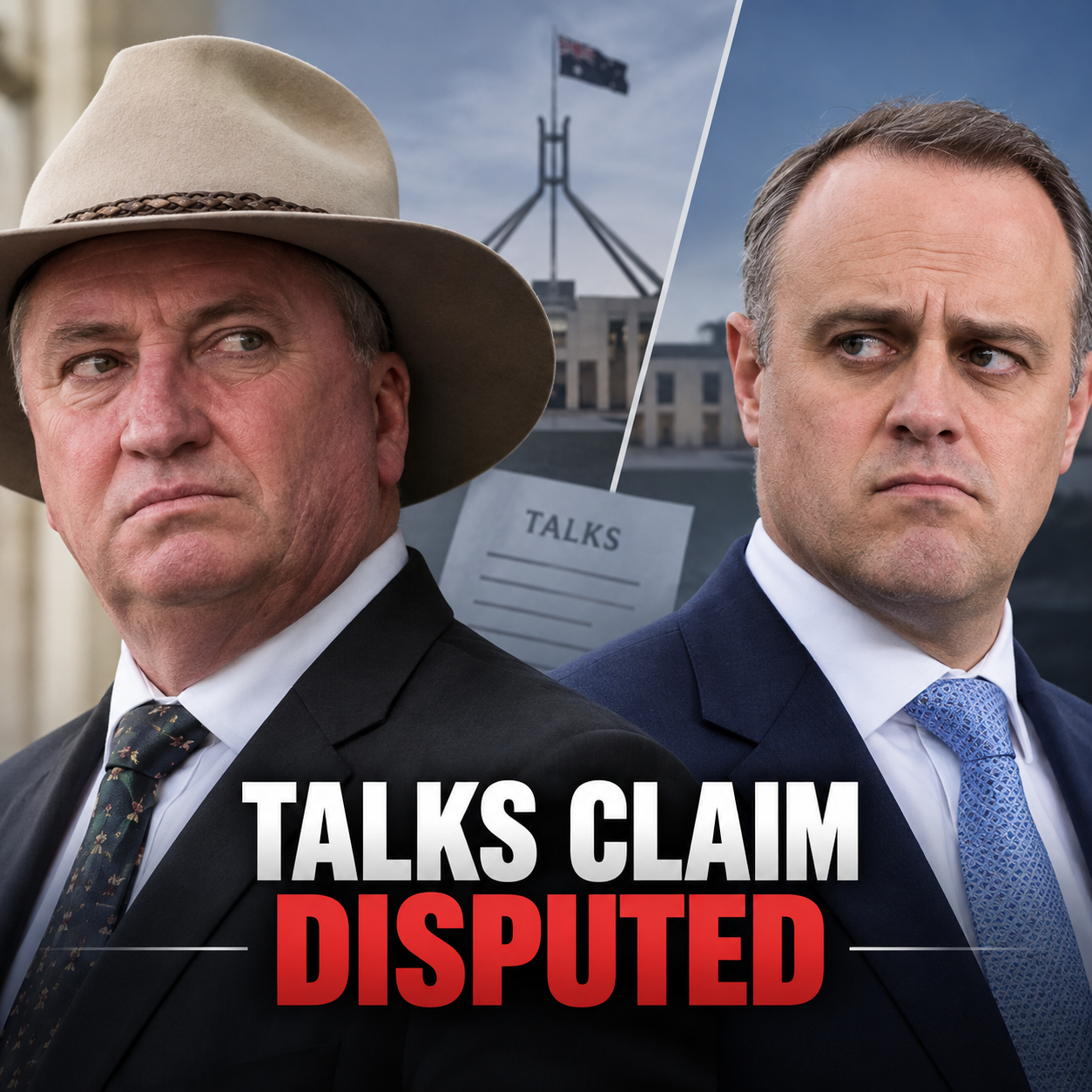
Joyce has said discussions have taken place, while also rejecting the idea that One Nation is seeking a formal coalition with the Liberal Party. His comments were framed around the possibility that neither the Coalition nor One Nation could form government alone and that support arrangements might become relevant in a hung parliament.
Shadow Treasurer Tim Wilson rejected that account, describing it as a “figment” of Joyce’s imagination. Shadow Housing Minister Andrew Bragg has also said the Liberals are not seeking formal alliances with other parties.
Opposition Leader Angus Taylor later went further, saying the Liberals were not in talks with One Nation about confidence and supply and that he had given no authority to anyone else to have such a conversation.
That leaves the central fact in dispute. Joyce says talks occurred but has not publicly identified the Liberal figures involved. Senior Liberals say there is no authorised negotiation and dispute the suggestion that a deal is being developed.
There is no verified formal alliance, coalition agreement or confidence-and-supply pact between the parties.
The distinction between informal political conversations and formal negotiations matters. Members of parliament regularly speak with colleagues from other parties about legislation, electoral strategy and possible parliamentary scenarios. Those contacts do not automatically amount to an authorised negotiation on behalf of a party leadership.
A confidence-and-supply agreement is more specific. In a hung parliament, a minor party or independent can agree to support a government on motions of confidence and on the supply of money needed for government to function, while remaining outside a formal coalition.
Such an arrangement does not necessarily mean the supporting party receives cabinet positions or joins the government. It can instead be based on written commitments, policy concessions or procedural agreements while the parties continue to compete against each other.
Australia has examples of minority governments relying on agreements with crossbenchers, but every arrangement depends on the parliamentary numbers and the terms negotiated after an election. The current dispute is taking place well before any such scenario exists.
Joyce’s comments are therefore best understood as a claim about political conversations and a possible future mechanism, not evidence that a government-forming agreement has already been reached.
That is also why the Liberal response is important. Taylor is the opposition leader and has said he did not authorise negotiations. Wilson has flatly disputed Joyce’s account. Bragg has said the party is not seeking formal alliances.
Those statements do not prove that no individual Liberal has ever spoken privately with Joyce or another One Nation figure. They do establish that the Liberal leadership is rejecting the suggestion of an authorised confidence-and-supply negotiation.
Joyce’s position also includes a qualification that can be lost in the headlines. He has said One Nation does not want to enter a formal coalition. A confidence-and-supply arrangement, if one were ever negotiated, would be structurally different from the Liberal-National Coalition, where parties maintain a formal governing partnership.
The dispute is occurring as One Nation attempts to expand its influence in federal and state politics and as the Coalition works through its own policy and organisational challenges. That environment gives both sides reasons to define their relationship carefully.
One Nation can present itself as independent from the major parties while arguing it could use parliamentary leverage to secure policy outcomes. The Liberals, meanwhile, have reasons to avoid suggesting that future governing arrangements have already been negotiated before voters have made any decision.
Those strategic considerations do not establish what private conversations occurred. They help explain why the language around them is being contested.
Joyce’s move to One Nation has added another layer. He has longstanding personal and political relationships across the Coalition from his time in the Nationals and as deputy prime minister. That means he is more likely than many minor-party figures to have direct channels to Liberal and National MPs.
But personal access is not the same as authority. A conversation with an individual MP does not bind the Liberal Party, just as Joyce speaking about a possible arrangement does not by itself create an official One Nation negotiating position.
For readers, the safest way to interpret the dispute is to separate three propositions.
First, Joyce says conversations took place. That is his public account and is attributable to him.
Second, senior Liberal figures dispute that an authorised confidence-and-supply negotiation is happening. Taylor has denied the party is in such talks, Wilson has rejected Joyce’s claim and Bragg has said no formal alliance is being sought.
Third, no formal deal has been produced or independently verified. There is no public agreement setting out policy concessions, parliamentary commitments or the identities of authorised negotiators.
That makes strong claims that the Liberals and One Nation “have a deal” unsupported by the evidence currently available.
The language of confidence and supply can also create confusion because it sounds similar to a coalition. In parliamentary practice, the difference is significant. A coalition involves parties combining to form government and usually sharing ministerial responsibility. A confidence-and-supply agreement can leave the supporting party outside government while guaranteeing enough parliamentary support for the government to survive.
The arrangement only matters if the election produces a parliament in which no party or existing coalition has a majority. If one side wins enough seats to govern in its own right, a confidence-and-supply deal may be unnecessary.
That is why discussion of such an agreement now remains hypothetical even if informal conversations have occurred.
The next federal election outcome cannot be known in advance, and current polling or political commentary does not establish what the parliamentary numbers will be. Any actual negotiation would depend on the seats won, the composition of the crossbench and the positions parties take at that time.
There is also no basis for assuming a minor party would automatically support the Coalition rather than negotiate issue by issue. One Nation has its own platform and political interests, and a formal parliamentary arrangement would require decisions by the parties involved.
Joyce has suggested that any support would need to deliver policy outcomes One Nation could identify to its voters. That is consistent with how minor parties and independents often describe their leverage in hung parliaments: support is exchanged for commitments rather than given without conditions.
The Liberal leadership’s denial, however, means readers should not treat that scenario as an agreed plan.
The public dispute may continue because the two sides are arguing about different levels of conversation. Joyce can maintain that he has spoken with Liberal figures; Taylor can maintain that no authorised party negotiation is under way. Those statements are not necessarily identical claims, although Wilson’s dismissal directly challenges Joyce’s account.
Without named participants or documentary evidence, the existence and scope of any private talks cannot be independently established beyond the statements already on the record.
For political reporting, that makes attribution essential. Joyce’s claim should remain Joyce’s claim. Liberal denials should remain Liberal denials. Neither side’s statement should be converted into an independently proven fact about a secret agreement.
The issue is likely to matter because relationships between the Coalition and One Nation will continue to be scrutinised wherever preferences, parliamentary votes or policy overlaps arise. But cooperation on a particular bill or preference arrangement is not the same as a government-forming pact.
The clearest current position is therefore limited but important: Joyce says talks have occurred about a possible confidence-and-supply relationship; senior Liberals publicly deny an authorised deal is being negotiated; and no formal alliance has been verified.
That may be less dramatic than claims of a secret coalition, but it is the factual boundary supported by the public record.
There is also a procedural reason not to overstate the significance of the current exchange. A genuine confidence-and-supply negotiation would normally require clarity about who is authorised to speak for each party, what votes are covered, how long the arrangement lasts and what happens if either side breaches it. None of those elements has been publicly produced in this case.
Until that happens, the argument remains one about competing accounts of political contact rather than a completed governing arrangement. Any future agreement would need to be assessed on its actual text and parliamentary effect, not inferred from speculation or from the existence of ordinary cross-party conversations.