Australia’s debate over artificial intelligence has moved from broad questions about safety and productivity to a more immediate fight over who controls copyrighted work and who gets paid when that work is used to train AI systems.
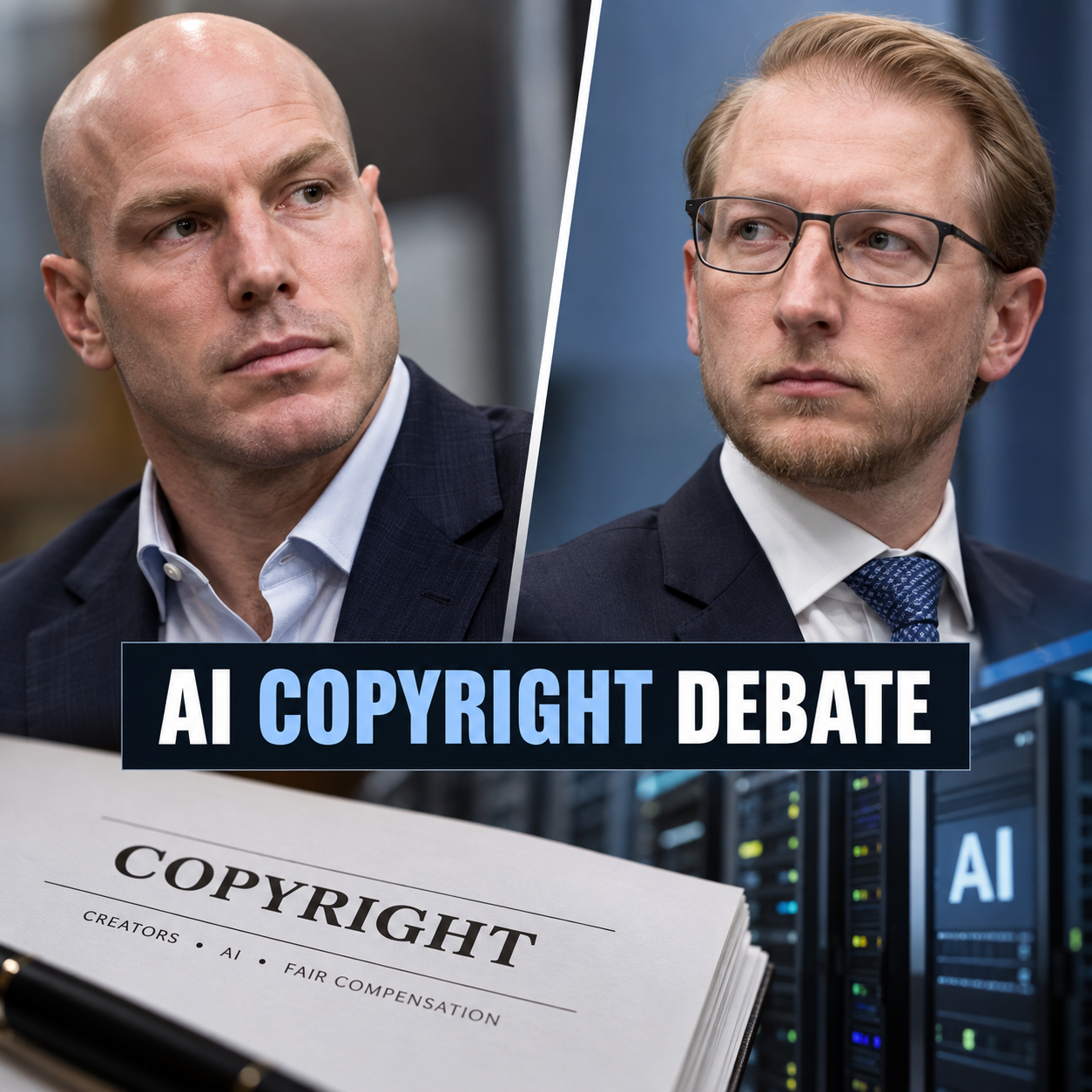
Government consultation material obtained by the ABC shows officials have been considering copyright models that could make some online material available for AI training unless rights holders opt out. The documents also canvass collective licensing arrangements intended to make it easier for AI companies to obtain permission across very large pools of content.
No final copyright reform has been adopted. The proposals are options under discussion, and the federal government says any future framework should give creators meaningful control and fair compensation.
The political argument has nevertheless become intense because the policy choices sit at the intersection of two competing objectives: protecting the rights and income of creators, and creating conditions that could attract large AI and data-centre investments to Australia.
What the proposed copyright models would do
Under the material reported by the ABC, one option would make online material available for training by default unless the owner had taken steps to opt out. AI companies could then satisfy licensing requirements through payments or deals with collecting bodies representing categories of rights holders.
The attraction of that model is administrative scale. Modern AI systems are trained on enormous quantities of text, images, audio, code and other material. Negotiating separately with every copyright owner can be difficult or impossible when millions of individual works and creators are involved.
Collective licensing already exists in other parts of copyright law, where organisations manage rights and distribute payments on behalf of large groups of creators. The policy question is whether that concept can be adapted fairly to AI training, particularly when some creators may not belong to the collecting organisation that receives the money.
The concern raised by critics is that an opt-out system reverses the ordinary expectation that a rights holder controls whether a protected work can be copied or licensed. Instead of an AI developer first obtaining permission, the creator may have to take action to prevent use.
Independent senator David Pocock has argued that this places too much of the burden on creators. His criticism is not simply about whether some payment eventually reaches rights holders; it is about who has the default legal position and whether an individual creator can realistically prevent their work from being used.
Writers, musicians, visual artists, publishers and other rights holders have also raised practical questions about how an opt-out would work. A creator may publish the same work across multiple websites and platforms, while AI developers collect data at large scale. A system that depends on technical signals would need to be consistent, visible and enforceable if it is to give creators real control.
There is also a payment problem. If an AI company pays a collecting body for access to a broad class of material, policymakers need a method for identifying who should receive money, how much each person should receive and what happens to creators who are not members of the collecting body.
The government’s consultation therefore involves more than deciding whether AI training should be legal. It also requires rules for consent, licensing, record keeping, compensation, transparency and enforcement.
Why AI investment is part of the argument
Liberal frontbencher James Paterson has taken a different emphasis. He has said Australia has strong economic and national-security reasons to attract the most advanced AI companies and their infrastructure, including the possibility of training frontier models inside Australia.
Paterson has argued that waiting indefinitely for a perfect policy settlement could mean missing an investment window. He has also said creators should be paid when their intellectual property is used, meaning his position is not that copyright protection should disappear. The disagreement is over how a payment and licensing mechanism should work without making Australia unattractive for large-scale AI investment.
That distinction matters because the political debate can otherwise become an oversimplified choice between creators and technology companies. There are policy models in which AI training is permitted while rights holders receive compensation, but designing one that both sides regard as workable is difficult.
The government is also considering the strategic value of having advanced AI infrastructure located in Australia. Supporters say local data centres and model-training capability could bring investment, technical expertise and access to advanced computing systems. They also argue that sovereign access to important technologies may matter in areas such as cyber security, defence and critical infrastructure.
Those benefits are not automatic. Data centres require large amounts of electricity, land and in some cases water. They can generate construction activity and investment, but their long-term employment profile is different from that of labour-intensive industries. Governments therefore have to weigh the headline capital value of projects against energy-system impacts, infrastructure requirements and the conditions attached to investment.
The copyright question becomes especially sensitive when investment discussions appear linked to changes in legal settings. Critics say copyright should not be weakened simply to secure data centres. Supporters of a negotiated framework say the objective should be to modernise rules that were not designed for the scale and technical features of generative AI.
Australia is not alone in confronting the problem. Governments and courts around the world are dealing with disputes over whether AI training involves copyright infringement, what exceptions should apply and whether creators are entitled to payment. Different jurisdictions are taking different approaches, which creates another factor for investment decisions by global technology companies.
What has and has not been decided
The most important fact for Australian creators is that the consultation documents are not legislation. They do not themselves change anyone’s rights, and no reported option should be described as the final government policy.
Attorney-General Michelle Rowland’s office has said the government wants any future approach to provide meaningful control and fair compensation. Other ministers have also said they do not want Australian creators traded away in return for investment.
That leaves difficult details unresolved. “Meaningful control” could mean an opt-in model, a technically reliable opt-out, a collective licence with individual protections, or another system. “Fair compensation” requires a method to calculate and distribute money across different industries and different kinds of work.
There is also a transparency issue. Creators may want to know whether a particular model was trained on their work. AI companies often treat training datasets and model-development processes as commercially sensitive, while rights holders argue they cannot enforce rights they cannot observe.
Any workable scheme would therefore need to consider documentation and disclosure obligations, not just whether use is technically authorised.
Another unresolved issue is the difference between training and other uses of AI. A data centre can be used to train a model, but it can also be used for inference — the process of running an already trained system to generate answers for users. A large investment in Australian computing infrastructure does not necessarily mean copyright-protected Australian material will be used for local training.
That distinction was highlighted by a major Queensland data-centre announcement involving Anthropic, where reporting indicated the facility would initially be used for inference rather than model training. It shows that copyright policy and data-centre investment are related but not identical issues.
The political divide is therefore not a simple argument over whether Australia should embrace AI. Pocock and other critics accept that AI can bring economic benefits but argue the rights of creators should not become the price of entry. Paterson and other advocates of attracting frontier investment argue Australia also carries a cost if legal uncertainty causes important technology infrastructure to go elsewhere.
The government has to find a framework that answers both concerns. If it gives AI developers broad default access, it will need to demonstrate that creators retain genuine control and a reliable path to compensation. If it keeps a more restrictive system, it will have to explain how licensing can operate at the scale required for modern model training and what that means for investment.
Until that framework is settled and put through a formal legal process, Australian copyright law remains unchanged. The leaked and reported options are useful because they reveal the choices being examined, but they should not be confused with an enacted exemption or a final deal with technology companies.
For creators, the next stage is about the details of consent and payment. For the technology sector, it is about certainty and whether training can take place under rules that are commercially workable. For government, it is about whether those two objectives can be reconciled without making one side carry most of the risk.
That is why the copyright fight has become one of the clearest tests of Australia’s wider AI strategy. The debate is no longer only about how quickly the technology should be adopted. It is about the terms on which Australia is willing to adopt it, who controls valuable creative material, and how the economic value created by AI should be shared.