Labor has intensified its attack on One Nation’s plan to let renters and mortgage holders redirect part of their compulsory superannuation into take-home pay, warning the short-term cash boost could leave workers tens of thousands of dollars poorer in retirement.
The proposal would allow eligible Australians to receive the equivalent of three percentage points of their future compulsory super contributions as cash for up to three years.
For a couple earning a combined $168,000, One Nation estimates that would deliver about $4,300 a year after tax — roughly $82 a week.
A full-time worker earning about $90,500 would receive around $2,300 a year, or $44 a week.
Those figures have made the policy easy to understand politically.
For households trying to cover a mortgage, rent, groceries, electricity, fuel and insurance, another $82 a week is money they can use immediately.
But the proposal has opened a much bigger argument about whether Australians facing financial pressure today should be allowed to sacrifice some of the investment returns they would otherwise receive decades from now.
The plan does not raid existing balances
One important distinction has been lost in some of the political rhetoric.
One Nation is not proposing that participating workers withdraw money they have already accumulated inside their super accounts.
Existing balances would remain untouched.
Employers would also continue making the full 12 per cent compulsory Superannuation Guarantee contribution.
The difference would occur after that contribution reaches the worker’s super fund.
For someone who chooses to participate, at least nine percentage points would remain invested for retirement while the equivalent of three percentage points would be paid by the fund into the worker’s nominated bank account.
The arrangement would be available for a maximum of 36 months.
Workers could stop earlier and return to having the full 12 per cent retained in super.
Changing employer or super fund would not restart the three-year limit.
Eligibility would be restricted to people paying rent or a mortgage on the home in which they live, rather than investment-property expenses.
Partners genuinely contributing to the household’s housing costs could also qualify even if their name was not formally recorded on the lease or mortgage.
The $4,300 payment would not be tax-free
Another important point concerns tax.
Some reporting has described the proposed $4,300 annual payment for a typical working couple as being available without tax.
That is not what One Nation’s published policy says.
The party wants the redirected contribution to retain the concessional tax treatment it would ordinarily receive inside super.
For most workers, that means a 15 per cent tax rate.
One Nation says the payment would not then be taxed again as ordinary salary at the worker’s personal marginal rate.
Its example of a worker earning $90,500 begins with three per cent of wages, or $2,715, and produces approximately $2,300 after applying the 15 per cent concession.
For a couple earning $168,000, three per cent equals $5,040 before the concessional tax, leaving about $4,300.
The tax treatment is central to the attractiveness of the policy because simply converting the contribution into ordinary wages and applying standard income tax would produce a smaller take-home benefit for many workers.
Labor calls it a raid on retirement
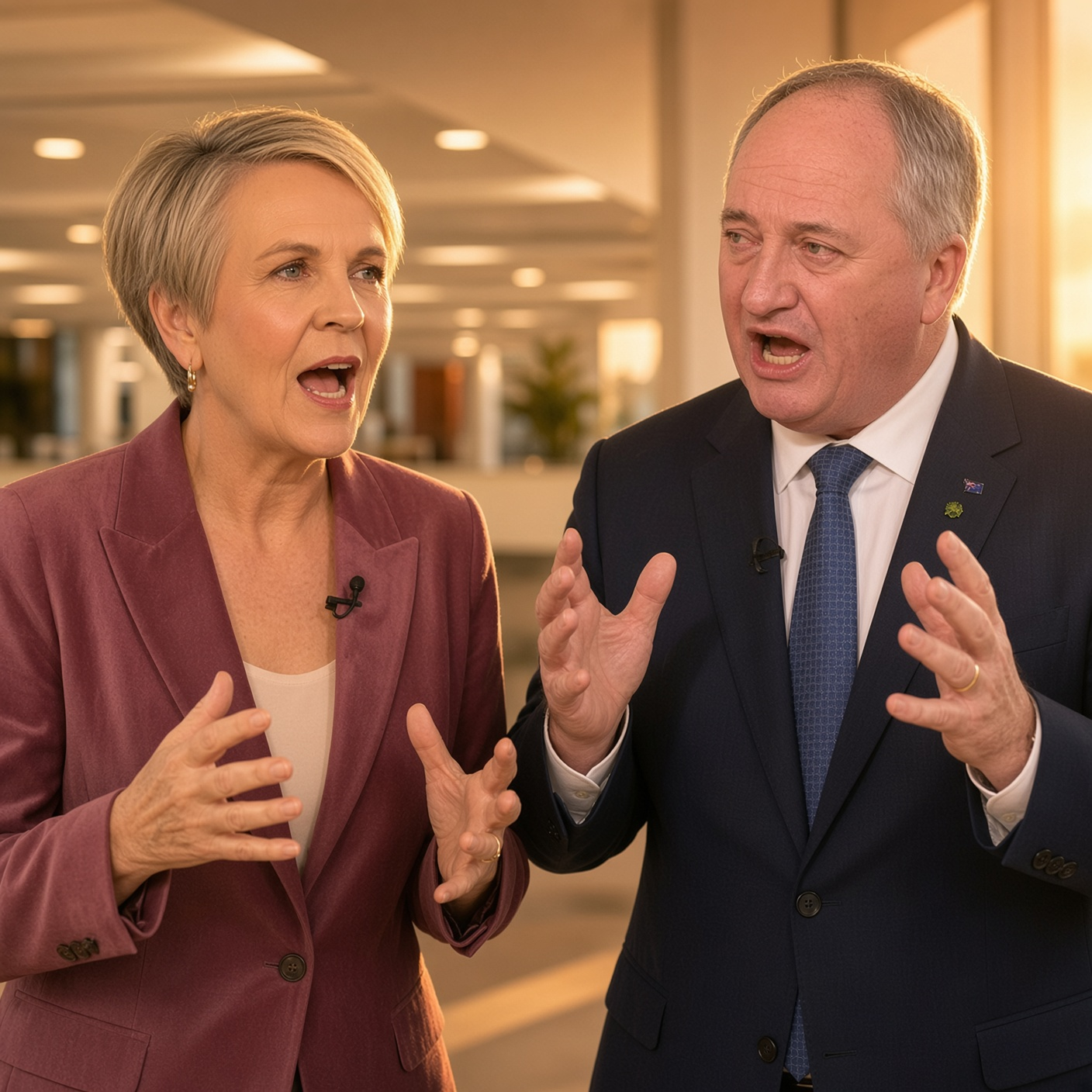
Social Services Minister Tanya Plibersek has rejected the idea that the proposal represents a genuine pay rise.
During a Sunrise debate with One Nation Treasury spokesman Barnaby Joyce, she accused the party of encouraging Australians to “raid” their retirement savings rather than supporting higher wages.
Plibersek warned that people taking the money now would be thousands of dollars worse off when they retire.
Treasurer Jim Chalmers has gone further, describing the policy as a direct threat to compulsory superannuation and warning an average worker could lose tens of thousands of dollars through forgone investment growth.
Chalmers has sought to turn the fight into a defining political divide ahead of the next federal election.
He told the Super Members Council summit this week that compulsory super was facing its biggest threat in four decades and described the coming election as an “existential moment” for the system.
That language is clearly political.
One Nation is not proposing to abolish the 12 per cent employer obligation, and nine percentage points would continue to be retained for participating workers.
But Labor’s underlying argument about compounding is real.
A dollar removed from long-term investment when somebody is 25 or 30 can represent several dollars of forgone wealth by retirement because the worker loses not only the original contribution but decades of potential investment returns on it.
Where the $25,000 warning comes from
The Super Members Council has modelled the effect on a median full-time worker using the One Nation option for the full three years.
It estimates that worker could finish retirement with approximately $25,000 less.
For a couple, the council puts the combined loss at more than $50,000.
Its modelling cited by the government suggests a typical 30-year-old might receive about $6,900 in additional after-tax cash over three years but lose more than $18,000 in future compounding on top of the contributions that were diverted.
Those numbers have become a central part of Labor’s attack.
They should also be placed in context.
The Super Members Council represents major super funds and has a clear institutional interest in preserving compulsory contributions inside the retirement system.
Its calculations are modelling, not a guaranteed prediction of what every participant would lose.
The outcome for an individual would depend on age, earnings, investment returns, how long the money otherwise remained invested and future super settings.
But the fundamental direction of the effect is difficult to dispute.
If less money remains invested in super today, all else being equal, the eventual balance will be lower.
Joyce says keeping a home matters more
One Nation accepts that trade-off.
Its argument is that retirement policy cannot be evaluated in isolation from what happens to households before they retire.
Joyce told Sunrise that losing a home could be far more damaging to long-term security than having a smaller super balance.
For someone close to defaulting on a mortgage or unable to meet rent, the promise of a larger retirement balance decades away may provide little immediate comfort.
One Nation says those workers should be trusted to make that calculation themselves.
Its underlying case is particularly strong where the alternative to using the extra cash is accumulating high-interest debt, falling into arrears or losing stable housing.
A retiree who owns a home outright can require considerably less income than somebody entering retirement as a renter.
That is why the growing connection between housing and retirement has become a much larger political issue across One Nation and sections of the Coalition.
But the proposal is considerably broader than an emergency mortgage-rescue measure.
Eligibility under One Nation’s published policy is based on paying rent or a mortgage, not on proving a household is about to lose its home.
A person does not have to meet the severe-financial-hardship rules that currently govern some forms of early super access.
That is one reason critics argue the policy could shift a significant amount of money out of long-term savings even for households that are under pressure but not in financial crisis.
Existing hardship rules are much tighter
Australians can already access super before the normal retirement conditions in limited circumstances.
Severe financial hardship is one example.
For most people below preservation age, eligibility generally requires receiving a qualifying government income-support payment continuously for 26 weeks and being unable to meet reasonable and immediate family living expenses.
The normal severe-hardship release is generally restricted to between $1,000 and $10,000 and can usually only occur once in a 12-month period.
Compassionate grounds provide another route for specified expenses, including some medical costs and circumstances involving a person’s home.
Early access is therefore possible today, but the rules are deliberately narrow.
That makes it misleading to treat One Nation’s proposal as merely a simpler version of a benefit already routinely available to anybody paying a mortgage.
It would create a much wider entitlement linked to ordinary housing costs rather than severe hardship.
Current early withdrawals can also attract more tax
The existing tax treatment is different as well.
The Australian Taxation Office says super released because of severe financial hardship does not receive a special hardship tax rate.
It is generally taxed as a normal super lump sum.
For people under 60, the taxable component is commonly taxed at rates between 17 and 22 per cent, depending on circumstances.
One Nation proposes a different treatment for its three-percentage-point payment: the standard concessional contribution tax of 15 per cent for most participants, with no additional ordinary income tax on the payment.
That would make the policy more generous than simply expanding the current hardship-release rules.
It also raises a budget question because workers on higher marginal rates would receive a tax advantage on money that becomes immediately available for household spending.
Inflation may be the harder economic question
The retirement-balance argument concerns what happens decades later.
The inflation argument concerns what could happen almost immediately.
Money sitting inside a super fund is generally invested in financial assets.
Money deposited into a household bank account can be spent on groceries, rent, services, fuel or other consumption.
If millions of eligible households opted into the proposal, billions of dollars that would otherwise remain invested could instead move into current spending.
Several economists have warned that could increase demand at a time when inflation remains a major economic problem.
Judo Bank chief economic adviser Warren Hogan has argued that increasing household spending power is unlikely to solve a cost-of-living problem caused partly by too much demand relative to available supply.
He warned the policy could provide immediate relief to participants while contributing to higher prices later.
Super industry organisations have made the same argument and say stronger inflation could also keep interest rates higher, potentially eroding some of the mortgage relief the proposal is designed to provide.
One Nation disputes that assessment and has argued the inflation effect would be limited.
But Joyce faced difficult questioning on ABC’s 7.30 after acknowledging the party had not produced comprehensive modelling of the policy’s inflationary or retirement effects.
Asked repeatedly to quantify the outcome, he pushed back against demands for precise forecasts.
That absence of modelling remains one of the proposal’s biggest weaknesses as scrutiny intensifies.
A near-$4.8 trillion system is now part of the political battlefield
The argument matters because compulsory super is no longer a relatively small addition to Australian wages.
APRA says total superannuation assets reached $4.767 trillion at June 30, 2026, up 9.5 per cent over the previous year.
Employer contributions totalled $164.4 billion in the year to June.
The system is both a retirement program and one of the largest pools of investment capital in the Australian economy.
Changes to contribution flows therefore have consequences extending beyond the balance of one worker’s account.
Super funds invest heavily in shares, property, infrastructure, credit and overseas markets.
Labor argues the compulsory nature of the system is one of the reasons Australians have accumulated such substantial retirement assets and future reliance on the Age Pension is expected to decline.
One Nation sees the same scale and reaches a different conclusion.
If trillions of dollars belong to workers, Hanson and Joyce argue those workers should have greater control over when a small portion of future contributions is useful to them.
The political argument is really about when financial security matters most
The strongest argument against the One Nation plan is straightforward.
Workers who take money now will have less invested for retirement, and the younger they are, the greater the potential cost of lost compounding.
Adding more disposable income to the economy could also intensify inflation.
The strongest argument for it is equally straightforward.
Retirement wealth has limited value to a household that cannot keep a roof over its head today.
For some people, using an extra $44 or $82 a week to remain current on housing costs could be rational even if it reduces their eventual super balance.
The more difficult issue is whether government should create a broad tax-advantaged entitlement for millions of renters and mortgage holders or preserve access only for tightly defined hardship.
That is a substantially different debate from the slogans now being used by both sides.
Labor’s description of the proposal as simply “raiding” existing retirement savings obscures the fact that One Nation would leave existing balances untouched and make participation voluntary.
One Nation’s presentation of the scheme as an easy pay boost understates the genuine long-term cost of taking three percentage points out of investment for three years.
And describing the $4,300 household benefit as tax-free is incorrect: under One Nation’s own design, it would generally be taxed at 15 per cent.
Australians would therefore be making a real trade.
More money now.
Less money invested for later.
The political fight will be over whether that trade should remain largely prohibited in order to protect people from short-term decisions — or whether households under unprecedented housing pressure should finally be trusted to make it themselves.






