Andrew Hastie has declared Pauline Hanson “not fit to govern this country” as an increasingly bitter dispute over a One Nation cartoon repeatedly describing the Liberal frontbencher as a “traitor” develops into a direct attack on Hanson’s prime ministerial ambitions.
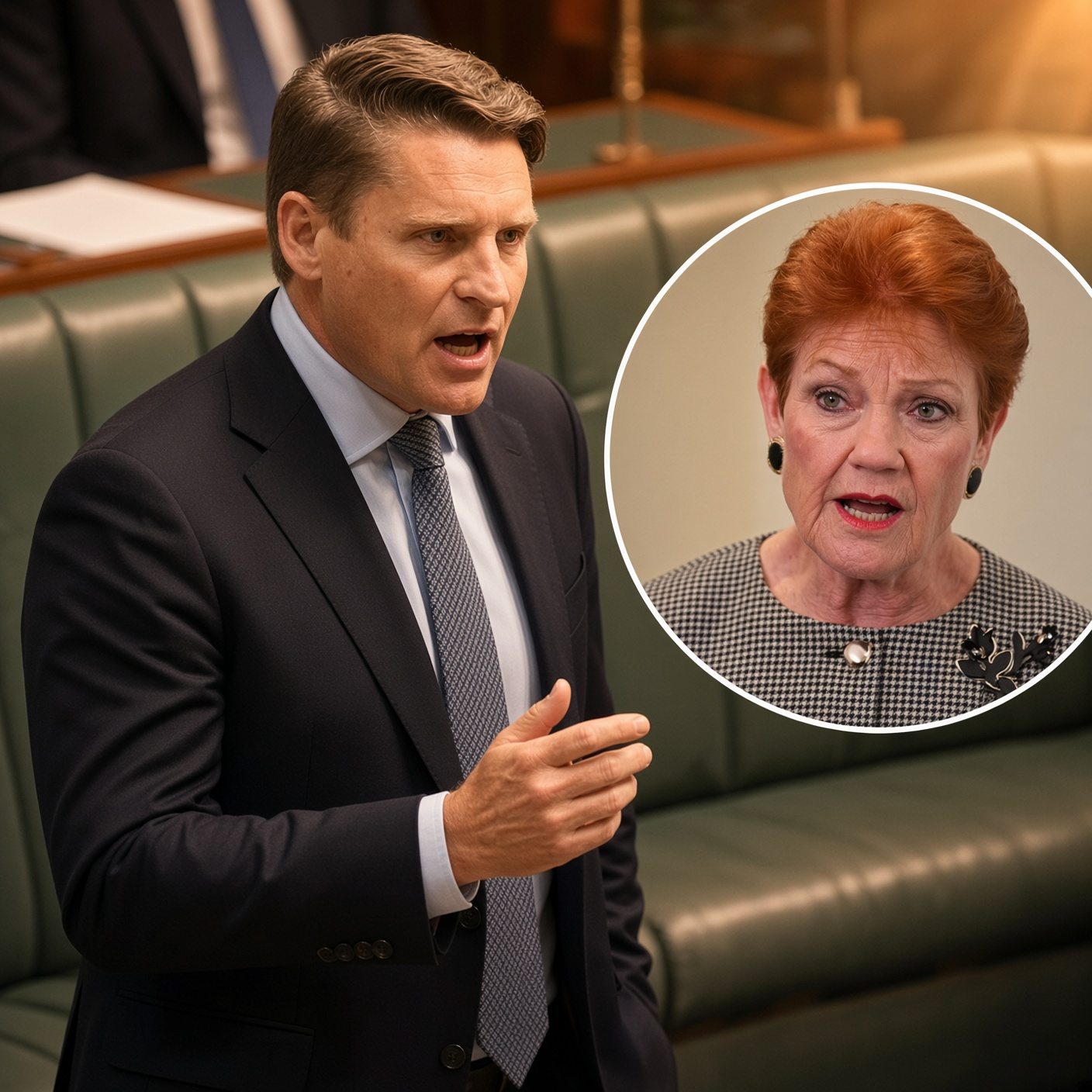
The former SAS captain has accused Hanson of refusing to take responsibility for material published through her own social media account, saying her response has exposed weakness and poor judgement in someone who has publicly said she believes she could lead Australia.
Hanson insists she has never personally called Hastie a traitor.
But she has refused his demand to remove the animated One Nation video in which the word is repeatedly applied to him.
That distinction — between the words Hanson personally spoke and material she chose to publish — now sits at the centre of one of the most personal political fights in Canberra.
Hastie says Hanson had two choices
Hastie’s ultimatum was straightforward.
He said Hanson could either stand behind the accusation contained in the cartoon and explain why she believed he was a traitor to Australia, or delete the video.
She did neither.
During an interview with News24 on September 9, Hastie said that response showed Hanson to be “weak” and “glass-jawed”.
He argued those qualities disqualified her from being a future prime minister.
By Thursday morning, his criticism had hardened further.
Hastie said Hanson was not fit to govern Australia and accused the cartoon of casting a much broader slur on veterans who believe Australian troops should be held to high standards of battlefield conduct.
The argument is particularly personal because Hastie spent almost 13 years in the Australian Defence Force and served on combat operations in Afghanistan before entering Parliament.
He says questioning his loyalty to Australia crosses a line that ordinary political insults do not.
“Words have meaning,” he told News24.
Hastie said he could ignore insults directed at him personally, but being portrayed as disloyal to his country was fundamentally different.
The video calls Hastie a ‘traitor’ eight times
The dispute centres on a nine-minute animated video titled Don’t Be Hastie, which was posted through Hanson’s X account on July 23.
Hastie says the word “traitor” appears eight times in the cartoon, along with the insult “gutless maggot”.
The cartoon targets several aspects of his political record, including his involvement in the Ben Roberts-Smith defamation case and his position on controversial hate-speech legislation.
Hanson has repeatedly stressed that she did not personally utter the word “traitor”.
She described the production as satire and rejected Hastie’s demand that she take it down.
She has also accused him of making a mountain out of a molehill.
Asked about the increasingly hostile exchange, Hanson told media she would not call him a traitor but was prepared to use a different blunt insult instead.
That has not satisfied Hastie.
His position is that a political leader cannot avoid responsibility for a message simply because it appeared in a cartoon posted to their account rather than coming directly from their mouth.
He says Hanson must either defend what the video says or remove it.
Why Ben Roberts-Smith is at the centre of the dispute
Much of the hostility traces back to Hastie’s role in the long-running litigation involving former SAS soldier and Victoria Cross recipient Ben Roberts-Smith.
Hastie served alongside Roberts-Smith and was subpoenaed to give evidence during Roberts-Smith’s defamation proceedings against Nine newspapers.
Hastie has repeatedly stressed that appearing in court was not an optional political intervention.
He was subpoenaed, took an oath and gave evidence.
He says refusing to comply would have placed him in contempt of court and that his actions reflected his belief in the rule of law.
Roberts-Smith lost the civil defamation case in 2023 after the Federal Court found, applying the civil standard of the balance of probabilities, that several serious allegations published about him had been substantially proven.
The distinction between that civil case and the current criminal proceedings is critical.
Roberts-Smith was arrested in April 2026 and charged with five counts of the war crime of murder arising from alleged incidents in Afghanistan between 2009 and 2012.
He denies the charges.
Those criminal allegations remain before the courts and have not resulted in a conviction.
The criminal standard is also different from that applied in the earlier defamation proceedings.
Hanson has been a prominent supporter of Roberts-Smith and has argued that he has been treated unfairly.
Hastie says One Nation has gone much further by turning hostility towards witnesses into a political campaign.
Hastie says the attack reaches beyond him
The former soldier argues the issue is no longer just about his reputation.
He has pointed to other SAS veterans who gave evidence under oath and asked whether One Nation believes they should also be regarded as traitors.
For Hastie, that creates a serious question about the message being sent to current and former Defence personnel.
If soldiers believe reporting suspected misconduct or complying with a court subpoena could later result in them being publicly branded disloyal to Australia, there is a risk witnesses will be discouraged from coming forward.
That concern has begun attracting support from politicians who agree with Hastie on very little else.
Greens senator David Shoebridge said he fundamentally disagreed with much of Hastie’s politics but could not understand an attack on someone for entering court and telling the truth as they understood it.
Independent senator and Army veteran Jacqui Lambie went further.
She described the cartoon as disgusting and said Hanson was behaving like a coward by attacking a veteran who had served in Afghanistan.
Lambie warned veterans considering supporting One Nation to think carefully about what the episode demonstrated.
Senior Liberals join the demand to remove the video
Opposition Leader Angus Taylor has now publicly called on Hanson to remove the cartoon.
Taylor stopped short of endorsing every insult Hastie has directed at Hanson, but said his colleague had served Australia with distinction as an SAS officer and the video should come down.
Shadow defence minister James Paterson has also condemned the material.
He argued that describing someone with Hastie’s military record as a traitor was among the gravest accusations that could be made against an Australian veteran.
Labor’s Tanya Plibersek has separately said public life should retain respect for people who have risked their lives serving the country.
The cross-party reaction has changed the political character of the story.
What began as a fierce argument between two competing conservative forces is increasingly becoming a debate about the limits of political attack.
Barnaby Joyce drawn into the fight
Hastie has also accused Barnaby Joyce of being a “lying coward” after Joyce initially backed Hanson’s assertion that she had never called Hastie a traitor.
Joyce later said he had not previously seen the cartoon and had personally never described Hastie that way.
He has said he does not regard Hastie as a traitor and has indicated he is prepared to speak with him.
Hastie has nevertheless argued that senior One Nation figures cannot simultaneously distance themselves from the accusation while continuing to stand behind the publication containing it.
For him, the problem is institutional responsibility rather than proving which politician physically spoke each word.
The row is happening in Hastie’s political backyard
The intensity of the dispute cannot be separated from what is happening electorally in Western Australia.
One Nation has openly identified Hastie’s federal seat of Canning as a target.
The threat became considerably more credible after the party’s breakthrough victory in the Secret Harbour state by-election.
Secret Harbour sits largely inside Canning.
One Nation’s primary vote surged dramatically there, while the Liberals finished third.
Hastie retained Canning at the previous federal election with a margin of about 6.6 per cent, but has repeatedly warned his own party that it cannot afford to concede disaffected conservative and outer-suburban voters to Hanson.
He has described the contest with One Nation in existential terms for the Liberal Party.
Earlier this week he warned that the Liberals risked becoming “extinct” if they surrendered political ground on issues including housing and immigration.
The cartoon battle therefore sits inside a much larger struggle for control of the Australian right.
Hanson wants to persuade voters that One Nation can replace a Coalition they see as weak or compromised.
Hastie is attempting to prove the opposite: that One Nation may be effective at generating anger and online attention but lacks the discipline and judgement required to govern.
Hanson really has raised the prospect of becoming prime minister
That is why Hastie’s comments about Hanson’s suitability for the prime ministership are politically relevant rather than hypothetical mockery.
Earlier this year, as One Nation surged in national polling, Hanson was asked whether she wanted the top job.
She said she would not reject it and believed she had the ability to be prime minister.
She has also considered the possibility of moving from the Senate into the House of Representatives, where Australian prime ministers sit by longstanding convention.
More recent polling has kept the idea in national discussion.
The News24/YouGov Pulse conducted from September 1 to 8 put One Nation on 30 per cent of the primary vote, ahead of Labor on 26 per cent and the Coalition on 18 per cent.
Albanese still led Hanson 51–40 when respondents were asked who they preferred as prime minister, and Labor remained ahead of One Nation after preferences.
Those figures do not mean Hanson is close to forming government.
Australia’s preferential electoral system, the geographical distribution of One Nation support and the need to win lower-house seats create substantial obstacles.
But her party’s rise means questions about leadership standards can no longer be dismissed as purely theoretical.
Hastie rules out a courtroom fight
Despite earlier suggestions he was prepared to make the dispute costly, Hastie has now ruled out pursuing Hanson through the courts.
He says the fight will be political.
That potentially makes the confrontation more consequential.
Rather than disappearing into a defamation proceeding, the dispute is likely to become part of One Nation’s campaign against Hastie in Canning and the Liberal Party’s wider attempt to halt Hanson’s advance.
Hastie has vowed to fight One Nation all the way to the next federal election.
He says his military service taught him to tolerate pressure and to fight hard when necessary.
Hanson, meanwhile, has shown no indication she intends to retreat by taking down the cartoon.
The argument now comes down to responsibility
There is an obvious factual distinction at the heart of the dispute.
Hanson can accurately say there is no verified public recording of her personally standing before a microphone and calling Hastie a traitor.
Hastie can equally point to a video she published through her political platform in which the accusation appears repeatedly.
The unresolved argument is what responsibility a leader bears for political content distributed in their name.
Hanson’s defence is that satire should not be treated as a literal personal declaration.
Hastie’s response is that calling a veteran a traitor is too serious to hide behind the label of comedy.
That disagreement is unlikely to be settled by another round of insults.
But as Hanson asks Australians to consider One Nation as a party capable of governing and Hastie fights to prevent it replacing the Liberals as the dominant force on the right, both politicians have made the cartoon a test of something larger.
For Hanson, it is a test of whether provocative political communication that has helped build One Nation’s enormous online following can survive greater scrutiny as the party moves closer to the mainstream.
For Hastie, it is a test of whether he can confront One Nation directly without strengthening the party he is trying to defeat.
The nine-minute cartoon may have started as satire.
It is now part of a much more serious fight over military service, the rule of law, political responsibility and who is capable of leading Australia.






