Barnaby Joyce has moved to put clear political distance between One Nation and Germany’s Alternative für Deutschland after the far-right party recorded a historic election victory that has shaken German politics and reignited comparisons between populist movements across Western democracies.
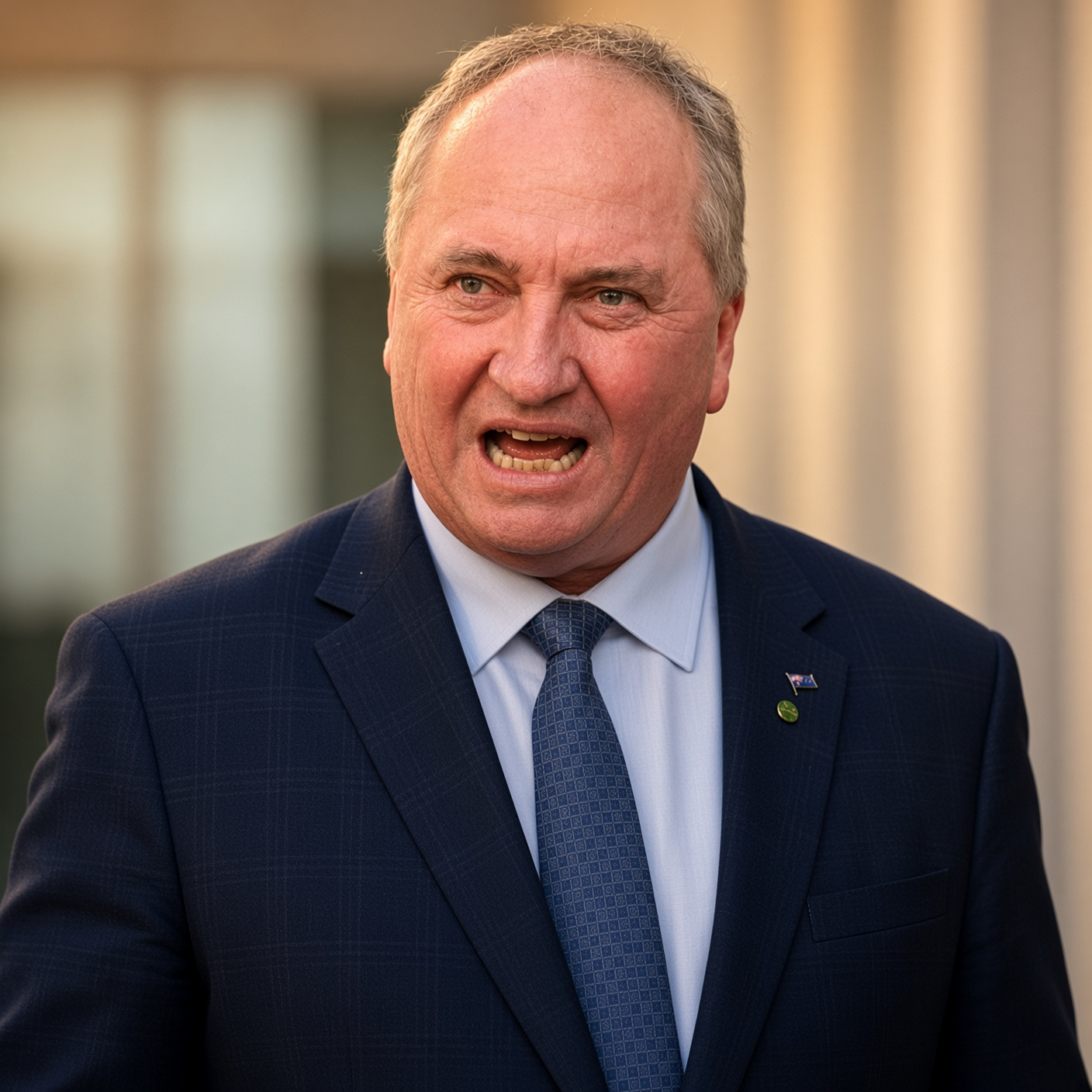
The One Nation MP and former deputy prime minister rejected suggestions his party should view the AfD as a political model after the German party secured an extraordinary result in the eastern state of Saxony-Anhalt.
Asked whether One Nation was taking anything from the AfD’s breakthrough, Joyce was blunt.
“We are not the AfD,” he said, describing it as a fundamentally different political organisation.
While Joyce said he was comfortable with comparisons between One Nation and some conservative or populist movements overseas, he drew a much harder line when the discussion turned to Germany.
He said the AfD “starts to ring alarm bells” for him and invoked his own family’s history of fighting fascism.
The intervention is significant because both One Nation and the AfD are benefiting from voter frustration over immigration, living standards and established political parties, making international comparisons increasingly common as support for populist parties grows.
Joyce’s message is that similarities in voter dissatisfaction do not mean the parties themselves are ideologically interchangeable.
AfD records historic result in Saxony-Anhalt
The political earthquake Joyce was responding to occurred in Saxony-Anhalt’s state election on September 6.
Official preliminary results show the AfD won 44.3 per cent of the party-list vote, a rise of more than 22 percentage points compared with the previous state election.
It won 39 of the 83 seats in the new state parliament, leaving it only three seats short of an outright majority.
The conservative Christian Democratic Union suffered a devastating reversal, securing 24 per cent of the party-list vote and only 15 seats.
The result represented the AfD’s strongest state election performance and put a far-right party closer to controlling a German state government than at any time in the post-war era.
Despite its commanding first-place finish, governing remains difficult because Germany’s mainstream parties have maintained a political “firewall” against entering coalitions with the AfD.
That leaves the party needing either a dramatic breakdown in that consensus or support from individual MPs if it is to turn its 39 seats into control of the state government.
The result nevertheless gives the AfD enormous political influence and sends a warning to Chancellor Friedrich Merz ahead of further state elections and the next federal contest.
The party has also been polling strongly at the national level, reinforcing concerns that Saxony-Anhalt may not be an isolated regional revolt.
Why the AfD carries a different political baggage
The reason Joyce rejected the comparison so emphatically lies partly in the official treatment of the AfD inside Germany.
Saxony-Anhalt’s domestic intelligence service has classified the AfD’s state organisation as a confirmed right-wing extremist endeavour.
The agency says the state branch’s political activity attacks essential principles of Germany’s constitutional democratic order, including human dignity and parliamentary democracy.
It has documented statements by party officials concerning migrants, Muslims and other minority groups, as well as what authorities describe as ethnonationalist ideas about who properly belongs to the German nation.
The AfD disputes accusations that it represents a threat to democracy and presents itself as a legitimate democratic response to failed migration, economic and European policies.
But its Saxony-Anhalt branch exists in a legal and historical environment very different from the one surrounding One Nation in Australia.
That distinction was at the heart of Joyce’s reaction.
He described fascism as a “disgusting, horrendous thing” and said it had nothing to do with One Nation or anything he would participate in.
Joyce contrasted the AfD with other right-wing political figures overseas whom he regards more favourably.
He spoke positively about Italian Prime Minister Giorgia Meloni and said he did not regard Britain’s Nigel Farage as dangerous.
He also treated the American MAGA movement as fundamentally conservative rather than placing it in the same category as the German party.
That amounts to an attempt to define the international political family One Nation believes it belongs to.
The party wants to be seen as nationalist, conservative and anti-establishment without accepting the far-right extremist label attached to the AfD by German authorities.
Russia is another major dividing line
The AfD’s position on Russia and Ukraine is also attracting increasing scrutiny.
The party favours restoring closer relations with Moscow, ending sanctions imposed following Russia’s invasion of Ukraine and cutting German support for Kyiv.
Its position is particularly consequential because Germany has become one of Ukraine’s most important European supporters.
A party sympathetic to Moscow gaining state-level political power has therefore raised security concerns as well as ideological ones.
German observers have questioned what access AfD officials could receive to sensitive domestic security information if the party eventually takes control of a state government.
Joyce’s rejection of the AfD comparison therefore extends beyond immigration policy.
One Nation may share parts of the broader populist criticism of high migration, political elites and established institutions, but Joyce is signalling that Australians should not automatically place the party alongside every movement described as populist or far-right in Europe.
The comparison is politically sensitive in Australia
The debate comes at a particularly sensitive moment for One Nation.
The party has been recording some of the strongest polling in its history.
The latest News24/YouGov Pulse, conducted from September 1 to September 8, put One Nation on 30 per cent of the primary vote, ahead of Labor on 26 per cent and the Coalition on 18 per cent.
That means international comparisons that once appeared largely academic now carry greater political significance.
Prime Minister Anthony Albanese has already sought to place One Nation within a global rise of what he calls “hard-right populists”.
Speaking at Queensland Labor’s state conference on August 30, Albanese warned that such movements were promoting dangerous and divisive politics and told Labor supporters they had a duty to defeat them.
He then specifically accused One Nation of failing to offer serious answers to Australia’s problems.
One Nation strongly rejects that characterisation and argues Labor is deliberately attempting to stigmatise voters who are concerned about immigration, housing, living costs and the direction of the country.
The AfD election result makes that argument harder to separate from the international political debate.
Supporters of Labor’s warning will point to Europe as evidence that populist movements can become substantially more radical as they grow.
One Nation can respond that lumping together every anti-establishment or immigration-reduction party ignores enormous differences in history, ideology and policy.
Joyce’s comments are clearly designed to strengthen the latter argument.
Similar frustrations do not produce identical parties
There are genuine similarities in the political conditions helping parties such as One Nation and the AfD.
Both have benefited from declining trust in mainstream political organisations.
Both attract voters who believe immigration has been too high.
Both have found support among sections of the electorate worried about living standards, housing pressures and a political system they believe does not listen to them.
Recent analysis of the German election suggests the AfD also benefited from economic insecurity, declining industrial confidence and resentment in areas of the former East Germany that continue to feel left behind decades after reunification.
Those broad themes can sound familiar in Australia, particularly in outer-metropolitan and regional areas where One Nation has been increasing its vote.
But that does not make the two parties equivalent.
German politics is shaped by the country’s Nazi history, its constitutional protections against extremist movements, reunification and its position at the centre of European security.
The AfD has also adopted policies and rhetoric on Russia, German historical memory and ethnic identity that go substantially beyond the policy debate surrounding One Nation in Australia.
That is why a simple label such as “far-right surge” can conceal as much as it explains.
A warning for Australia’s political debate
The German result nevertheless offers lessons for both sides of Australian politics.
AfD’s success demonstrates how quickly an established party system can become unstable when large groups of voters believe mainstream governments are failing to respond to their concerns.
Attempts by German parties to isolate the AfD have not prevented it from growing. On the other hand, the scale and nature of the AfD’s more extreme positions explain why mainstream parties remain reluctant to normalise it.
Australia now faces its own version of that strategic dilemma as One Nation rises.
Labor is increasingly choosing direct confrontation.
The Coalition must decide whether to compete with One Nation, cooperate with it in some areas or try to win back its voters without adopting all of its policies.
One Nation, meanwhile, has a different challenge.
The larger it becomes, the less it can control comparisons with populist movements overseas and the more pressure it will face to define where its ideological boundaries lie.
Joyce has now attempted to draw one of those boundaries unmistakably.
He is willing to identify with parts of the international conservative and populist movement.
He is not willing to identify One Nation with the AfD.
The German party’s historic election victory may have demonstrated the electoral power of voter anger, but for Joyce it also demonstrated the political line he does not want One Nation to cross.






