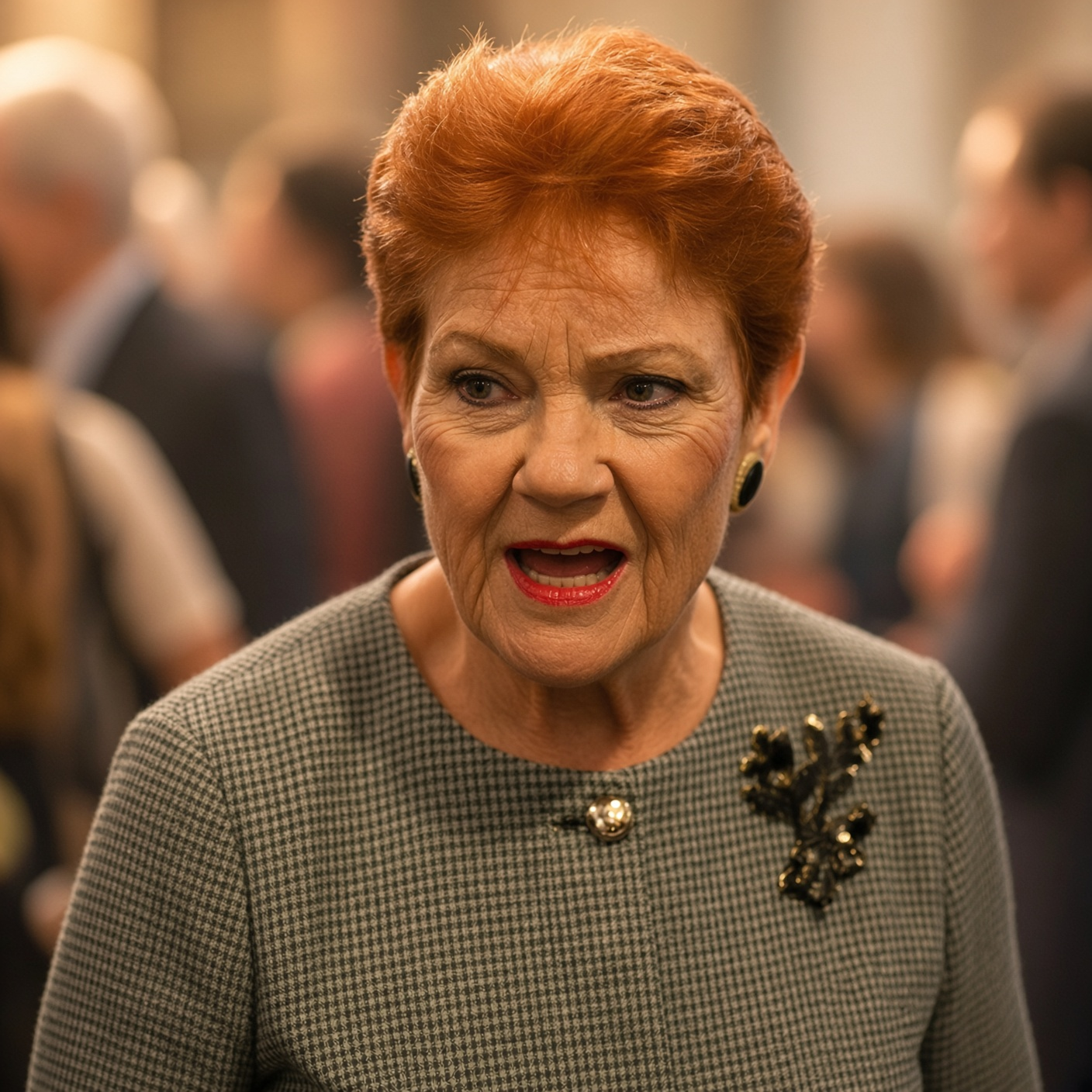
Pauline Hanson has defended One Nation’s plan to let renters and mortgage holders redirect part of their compulsory superannuation into take-home pay, insisting the policy would give struggling households “breathing room” without fuelling inflation.
But the economic argument surrounding the proposal has intensified after One Nation’s Treasury spokesman Barnaby Joyce acknowledged the party has not modelled its potential impact on either inflation or Australians’ eventual retirement balances.
Under the proposal, Australians paying rent or a mortgage would be able to opt into a scheme allowing three percentage points of their future compulsory super contributions to be redirected into their current income for up to three years.
Employers would still pay the full 12 per cent Superannuation Guarantee required under existing law.
The difference would occur after that money reached the worker’s super fund.
If a member chose to participate, the fund would redirect three percentage points back to them, while at least nine percentage points would remain invested for retirement.
The redirected amount would receive the concessional 15 per cent tax treatment proposed by One Nation rather than being taxed at the worker’s ordinary marginal income-tax rate.
No money already accumulated in the worker’s super account would be withdrawn.
Hanson says that distinction makes the proposal fundamentally different from allowing Australians to empty their existing retirement accounts.
For a full-time worker earning about $90,500 a year, One Nation calculates the policy would provide approximately $2,300 in additional disposable income each year, or about $44 a week.
A working couple earning a combined $168,000 could receive about $4,300 a year, or roughly $82 a week.
Hanson argues that amount could help households pay rent, mortgages, electricity bills, groceries or medical costs at a time when many Australians are struggling with higher living expenses.
She has described the policy as a way of allowing workers greater control over money earned on their behalf.
But describing the proposal simply as a three per cent pay rise risks obscuring where the money comes from.
The employer would not be increasing the worker’s wage by three per cent.
The additional take-home income would come from compulsory retirement savings that otherwise would have remained invested inside superannuation.
The immediate financial benefit is therefore paired with a future cost: less money being invested and fewer years of compound investment returns on those contributions.
The policy has now become the centre of an increasingly heated argument about whether providing short-term relief during a cost-of-living crisis would create larger economic problems later.
Hanson insists the inflation impact would be neutral.
She argues the money already belongs to workers and that redirecting some of it from super into their household budget does not amount to the government creating new money.
Joyce has made a similar case.
He has argued that a renter receiving additional money does not necessarily increase their rent payment and that households under genuine financial pressure may use the extra income to meet costs they already face rather than dramatically expanding discretionary consumption.
He has also suggested take-up would be concentrated among people who genuinely needed help rather than every eligible renter and mortgage holder automatically joining the scheme.
However, economists critical of the proposal say the relevant inflation question is not whether new money has literally been created.
It is whether money that would otherwise have remained locked inside long-term investments is instead shifted into household cash flow and becomes available for current spending.
Judo Bank chief economic adviser Warren Hogan has warned the proposal would provide a short-term benefit to households while potentially worsening the cost-of-living problem over time.
His argument is that increasing disposable income across a large number of households could strengthen demand at precisely the moment monetary policy is attempting to weaken it.
That concern is particularly relevant because Australia’s inflation fight is not over.
The Reserve Bank left the cash rate at 4.35 per cent in August after increasing rates three times earlier in 2026.
The RBA says inflation remains too high and that aggregate demand needs to remain subdued to reduce pressure on the economy’s productive capacity.
Annual CPI inflation was running at 3.5 per cent in July, still above the midpoint of the Reserve Bank’s 2 to 3 per cent target range.
The bank has warned that inflation risks remain tilted to the upside and has left open the possibility of further rate increases if those risks materialise.
Against that backdrop, a policy that transfers money from compulsory saving into present-day spending is inevitably attracting scrutiny.
But the actual size of any inflation effect remains uncertain.
It would depend on how many eligible Australians opted in, how much they redirected, what they did with the money and whether spending elsewhere changed as a result.
A household that used the entire benefit to reduce mortgage principal would affect demand differently from one that spent the extra income on goods and services.
That uncertainty makes modelling especially important.
On Tuesday, Joyce acknowledged One Nation had not conducted economic modelling of the proposal’s impact on inflation or retirement incomes.
That means Hanson’s assertion that the plan would be inflation-neutral has not yet been supported by a published One Nation economic assessment.
It also means claims from opponents that the measure would substantially increase inflation remain forecasts rather than an observed outcome.
The Association of Superannuation Funds of Australia has issued one of the strongest criticisms.
ASFA chief executive Mary Delahunty described the policy as “economically disastrous”, arguing that increasing money available for current spending would push prices higher while simultaneously weakening retirement outcomes.
The Super Members Council has also modelled a significant long-term cost.
Its analysis estimates that a typical 30-year-old full-time worker earning about $90,500 and using the scheme for the full three years would receive approximately $6,900 in extra cash during that period.
But it estimates that worker could eventually retire with about $25,000 less in superannuation, with more than $18,000 of the difference reflecting compound returns that the redirected contributions would otherwise have earned.
For a couple, the council says the combined retirement effect could exceed $50,000.
Those figures are not government costings.
The Super Members Council represents not-for-profit super funds and is an outspoken opponent of policies allowing broader early access, so its modelling should be understood in that context.
The precise loss for an individual would depend heavily on age, investment performance, salary growth and how long the money would otherwise have remained invested.
A worker close to retirement would sacrifice far fewer years of compounding than somebody in their twenties or thirties.
That is one reason the policy presents such a stark trade-off.
For a household at risk of missing a mortgage payment today, an estimated reduction in wealth several decades from now may feel less urgent than keeping a roof over its head.
Hanson has explicitly made that argument.
She says she would rather Australians receive help now if they were approaching the point of losing their home or being unable to meet essential bills.
Joyce argues people should be trusted to make that calculation themselves.
Labor’s position is almost the exact opposite.
Treasurer Jim Chalmers says compulsory preservation is one of the foundations of Australia’s superannuation system and that allowing broad access for ordinary living expenses would weaken retirement security.
Health Minister Mark Butler has also criticised the policy, pointing to the experience of the pandemic-era early-release scheme and warning that money removed from super today can have much larger consequences decades later.
The debate is especially significant because Australia’s retirement savings pool has grown to extraordinary scale.
Australian Prudential Regulation Authority figures show total superannuation assets reached $4.77 trillion at June 30, 2026, up 9.5 per cent over the year.
The system’s legislated objective is to preserve savings to provide income for a dignified retirement, alongside government support, in an equitable and sustainable way.
Existing law nevertheless recognises that there are circumstances where immediate financial need can outweigh preservation.
Australians can already gain early access to super under limited conditions including severe financial hardship, certain medical circumstances and compassionate grounds.
Those rules can include access to prevent foreclosure or the forced sale of a person’s principal home.
The existing system, however, deliberately sets a high threshold.
One Nation’s policy would be much broader.
A renter or mortgage holder would not necessarily need to be on the verge of foreclosure, satisfy existing severe-hardship tests or establish a specific exceptional expense before accessing the proposed three-percentage-point diversion.
That is why the argument is about more than emergency financial assistance.
It challenges the principle that compulsory super should normally remain inaccessible until retirement.
Deputy Liberal leader Jane Hume has declined to endorse One Nation’s proposal and has questioned practical details, including how funds would administer it and how payments would interact with contribution rules.
The Coalition itself is also debating broader superannuation reform, with some Liberal figures arguing the system should give Australians greater flexibility around housing.
But One Nation’s proposal goes further by allowing redirected contributions to support ordinary household cash flow rather than being tied solely to purchasing a home.
Several administrative questions also remain unresolved.
Legislation would need to establish exactly who qualified, how rental or mortgage status was verified, whether participation could be paused and restarted, how tax rules would operate and what disclosure super funds would need to give members about the future financial cost.
There is also the question of how many Australians would actually take up the option.
That number matters enormously to any credible inflation forecast.
If only households experiencing acute financial stress participated, the macroeconomic impact could be modest.
If millions of eligible workers redirected the full amount for three years, the flow of money from long-term saving into current household income would be much larger.
At present, neither scenario has been formally costed by One Nation.
That leaves the party’s central claim — that Australians can gain meaningful immediate relief without increasing inflation — at the heart of an unresolved economic argument.
The short-term benefit is straightforward and measurable: for an average full-time worker, about $44 extra a week.
The long-term consequences are much harder to calculate.
They involve investment returns that have not yet occurred, future Age Pension expenditure, household spending decisions and the response of an economy in which the Reserve Bank is actively trying to restrain demand.
For Hanson, the principle is individual choice.
For Labor and the super industry, the principle is preservation.
And after Joyce’s admission that One Nation has not yet modelled the policy’s broader economic effects, the political fight is now increasingly about a third issue: whether Australians should be asked to make that choice before the full cost has been quantified.






