Australia risks surrendering a major economic and strategic opportunity in artificial intelligence if its electricity system cannot keep pace with an extraordinary expansion in power-hungry data centres, according to a prominent defence and space analyst.
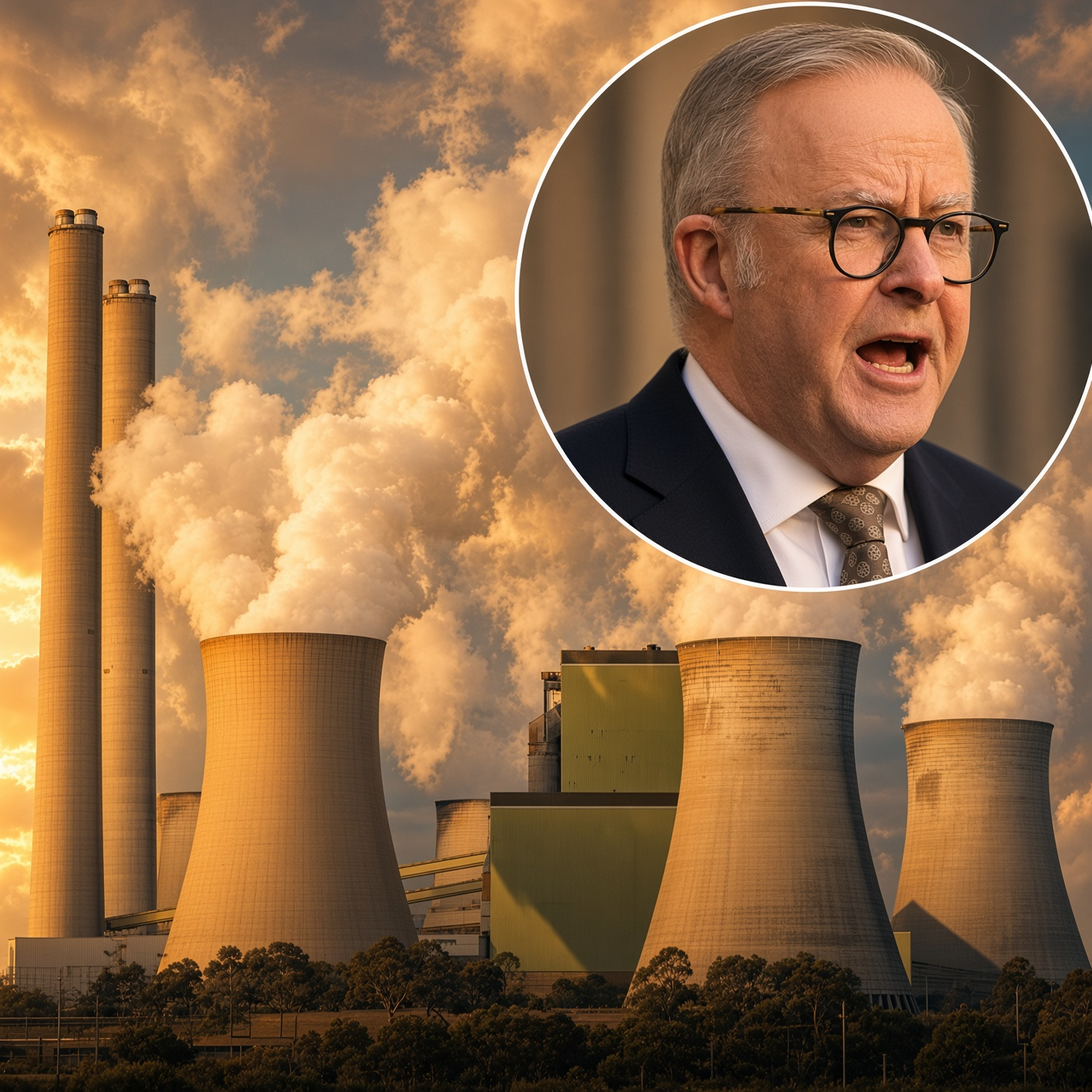
Dr Malcolm Davis, a senior analyst in the Australian Strategic Policy Institute’s Defence Strategy Program, has warned that access to large volumes of reliable electricity is becoming inseparable from a country’s ability to compete in AI.
His assessment is stark.
“If we can’t do that then our economy becomes a third-rate economy because we’re not able to use AI effectively,” Davis told news.com.au.
He argues that Australia should be prepared to reconsider nuclear power and even explore cooperation with the United States, Japan and European partners on the emerging concept of putting computing infrastructure in space.
The warning lands in the middle of a much broader argument about one of Australia’s fastest-growing areas of investment.
AI systems require enormous quantities of computing power. Delivering that computing power requires data centres filled with high-performance processors, cooling equipment and networking hardware operating around the clock.
The electricity implications are becoming difficult to ignore.
A joint outlook published by Oxford Economics Australia and the Australian Energy Market Operator in August forecasts national data-centre electricity consumption rising from about 5.2 terawatt hours in the 2026 financial year to 15.8 TWh by 2030.
By 2036, the central forecast reaches 34.3 TWh.
That represents more than a sixfold increase in roughly a decade and turns what was once a specialist infrastructure industry into a major issue for Australia’s energy system.
The forecasts also become more uncertain after 2030 because dozens of proposed projects must still clear financing, planning, construction and grid-connection hurdles.
Even so, the direction is clear: AI and cloud computing are creating a new category of industrial-scale electricity demand just as Australia is attempting one of the largest transformations of its power system in its history.
That is the core of Davis’s concern.
His warning should not be confused with an official forecast that the Australian economy is heading for disaster. Davis specialises in defence strategy, future warfare, military technology, space policy and security rather than macroeconomic forecasting or electricity-market modelling.
His argument is a strategic one: economies that cannot provide abundant computing power risk losing productivity, investment and national-security advantages to countries that can.
Australia’s latest economic data also presents a more complicated picture than the most dramatic descriptions suggest.
The Australian Bureau of Statistics reported that GDP increased by 0.4 per cent in the June quarter and by 2.1 per cent over the year.
GDP per capita was effectively unchanged during the quarter and was 0.7 per cent higher than a year earlier.
Productivity remains a genuine weakness. GDP per hour worked was down 0.2 per cent over the year to June, while the ABS described overall economic growth as subdued.
Those figures support concerns about Australia’s long-term productivity challenge, but they do not establish that economic collapse is inevitable.
In fact, several economic assessments argue that data centres could become a major source of investment rather than a threat — provided the energy and infrastructure problems are managed.
Westpac senior economist Pat Bustamante estimates Australia’s data-centre investment pipeline could exceed $155 billion, equivalent to about 5.6 per cent of one year’s GDP.
Because many of the high-value computer components will be imported, Westpac estimates the net domestic boost would be considerably smaller than the headline investment figure — around $75 billion, or about 2.8 per cent of GDP as the projects are rolled out.
The bank estimates the construction and investment phase could temporarily support about 400,000 jobs when direct and wider economic effects are included.
Deloitte Access Economics has separately argued that Australia could become a major Asia-Pacific digital infrastructure hub, potentially generating a large economic windfall if sufficient compute, energy, connectivity and skilled labour can be assembled.
The debate, therefore, is not really about whether data centres are good or bad for Australia.
It is about whether the country can build them quickly enough to capture the economic opportunity without allowing them to overwhelm electricity networks, increase household bills, intensify water shortages or crowd out other industries.
Australian energy regulators have already begun responding.
The Australian Energy Market Commission warned earlier this year that rapidly connecting very large data-centre loads without appropriate standards could create risks for grid stability.
In August, the AEMC recommended that data centres should effectively bring their own clean, firmed energy, operate flexibly when the power system is under pressure and pay the appropriate costs associated with their connection.
The principle behind the recommendation is straightforward: the AI investment boom should not leave existing electricity customers worse off.
The Albanese government has adopted a similar approach.
In July, Prime Minister Anthony Albanese announced national AI standards that are intended to create mandatory requirements for large data centres.
Under the proposed framework, operators would be legally required to underwrite new electricity supply, meet their share of grid-connection costs, reduce electricity consumption when necessary to support system stability and minimise their use of water.
The government also established an Office of AI inside the Department of the Prime Minister and Cabinet to coordinate policy across government.
Labor’s position is that Australia should welcome international AI investment while ensuring new facilities add energy capacity rather than simply compete with households and existing businesses for the electricity already available.
Industry and Innovation Minister Tim Ayres has argued that new data centres should be linked to investment in additional renewable generation and transmission.
Davis believes Australia should keep a much wider range of energy options open.
He has specifically advocated nuclear generation as a potential source of the large amounts of dependable electricity required by future AI infrastructure.
That would require a fundamental policy and legal change.
Commercial nuclear power remains prohibited under Commonwealth legislation, including provisions of the Australian Radiation Protection and Nuclear Safety Act 1998 and the Environment Protection and Biodiversity Conservation Act 1999.
There are bills before Parliament seeking to remove those restrictions, but they have not become law.
The Albanese government remains opposed to nuclear generation and argues that renewables backed by storage, transmission and firming provide a more economical path to expanding electricity supply.
The data-centre boom is giving that long-running political argument a new dimension.
Previously, the nuclear debate was dominated by questions about replacing ageing coal generators, emissions reduction and household electricity prices.
AI adds a new question: what happens if electricity demand grows much faster than previously expected?
Data centres are unusual loads because they can require hundreds of megawatts — and in the largest proposed campuses potentially far more — while expecting extremely high reliability.
They cannot simply stop computing every time renewable generation falls or the grid becomes congested.
Operators therefore need combinations of generation, storage, firming, network capacity and back-up systems capable of keeping sophisticated hardware running continuously.
Australia’s challenge is compounded by geography.
Many data centres want to locate near Sydney and Melbourne because that is where customers, fibre-optic connections, cloud infrastructure and skilled workers are concentrated.
Yet much of Australia’s new renewable generation is being built far from those metropolitan centres.
Moving large quantities of electricity across that distance requires transmission infrastructure that itself takes years to plan and construct.
The Australian Energy Market Commission has warned that poorly integrated data-centre growth could therefore affect both grid security and consumer bills.
The industry argues the problem can be solved if developers pay for the generation and network investment their facilities require.
Some operators are already signing long-term renewable power agreements that help finance new wind, solar and storage projects.
The policy question is whether voluntary arrangements are enough as the scale of the sector accelerates.
The government has decided they are not, which is why it intends to put national data-centre obligations into law.
Davis is also looking beyond terrestrial power generation altogether.
He has suggested Australia should investigate cooperation with allies on orbital computing — essentially placing specialised computing infrastructure in space.
The idea sounds futuristic, but it is no longer purely theoretical.
China launched the first 12 satellites in its planned Three-Body Computing Constellation in May 2025. The project aims to process data in orbit rather than sending enormous amounts of raw information back to Earth before computation begins.
Shanghai has since announced another project known as Xingshu, or Star Hub, which developers ultimately envisage expanding to roughly 1,000 satellites.
Professor Seyedali Mirjalili, an artificial intelligence specialist at Torrens University Australia, says orbital computing has potential advantages because space offers abundant solar energy and avoids some of the competition for land, water and grid electricity faced by terrestrial facilities.
But he has also emphasised the enormous technical obstacles.
Launching computing hardware into orbit is expensive. Radiation can damage electronics. Physical maintenance is extraordinarily difficult, and cooling powerful processors in a vacuum presents a major engineering challenge.
There is also no certainty that orbital data centres will become commercially competitive with facilities on Earth.
For defence planners, another problem emerges if economies and military forces become dependent on computers in orbit: those systems become strategic targets.
Satellites can be disrupted by cyber attacks, electronic warfare, anti-satellite weapons, hostile spacecraft or simply space debris.
Davis’s interest in orbital computing therefore reflects both sides of his professional expertise. He sees computing capacity as a source of national power, but also as critical infrastructure that would need to be defended.
China’s progress is particularly important in that context.
The AI competition between major powers is increasingly about more than which country develops the best software model.
It now includes semiconductor manufacturing, electricity generation, data centres, transmission networks, undersea cables, skilled workers and potentially launch capacity.
A country can possess talented researchers and sophisticated AI software yet still be constrained if it cannot provide the physical infrastructure required to train and operate increasingly powerful models.
That is the broader warning Australia must consider.
The country has significant advantages: political stability, large amounts of land, deep capital markets, abundant renewable resources, strong links to the United States and Asia, established cloud infrastructure and a growing pipeline of data-centre projects.
But those advantages do not automatically guarantee success.
Electricity projects, transmission lines, planning approvals and skilled construction work all take time. AI investment is moving on a much faster cycle.
Global technology companies can choose between jurisdictions, and countries across Asia, North America, Europe and the Middle East are competing aggressively for the same investment.
For Australia, the risk is therefore less dramatic but more concrete than an imminent economic disaster.
The country could possess a potentially enormous AI opportunity and still fail to capture enough of it because the physical infrastructure arrives too slowly.
Equally, racing to approve data centres without matching them with new electricity, water and network capacity could transfer costs onto households and other industries.
The challenge is to avoid both outcomes.
Australia’s AI future will not be determined solely by algorithms or software developers. Increasingly, it will depend on power stations, batteries, transmission lines, cooling systems, construction workers and the speed at which governments can coordinate them.
That is why a debate that appears to be about data centres has become a much larger argument about Australia’s productivity, energy system and place in the global technology race.
Davis’s “third-rate economy” warning represents the hardest-edged version of that argument.
Whether Australia ultimately needs nuclear reactors, orbital computers or a vastly expanded renewable system remains contested.
What is becoming much harder to contest is the scale of the electricity challenge ahead.






