Pakenham has emerged as one of the most combustible electorates in Australian politics, combining the country’s highest reported mortgage arrears with an ultra-marginal Labor seat and a rapidly expanding One Nation campaign determined to turn economic frustration into votes.
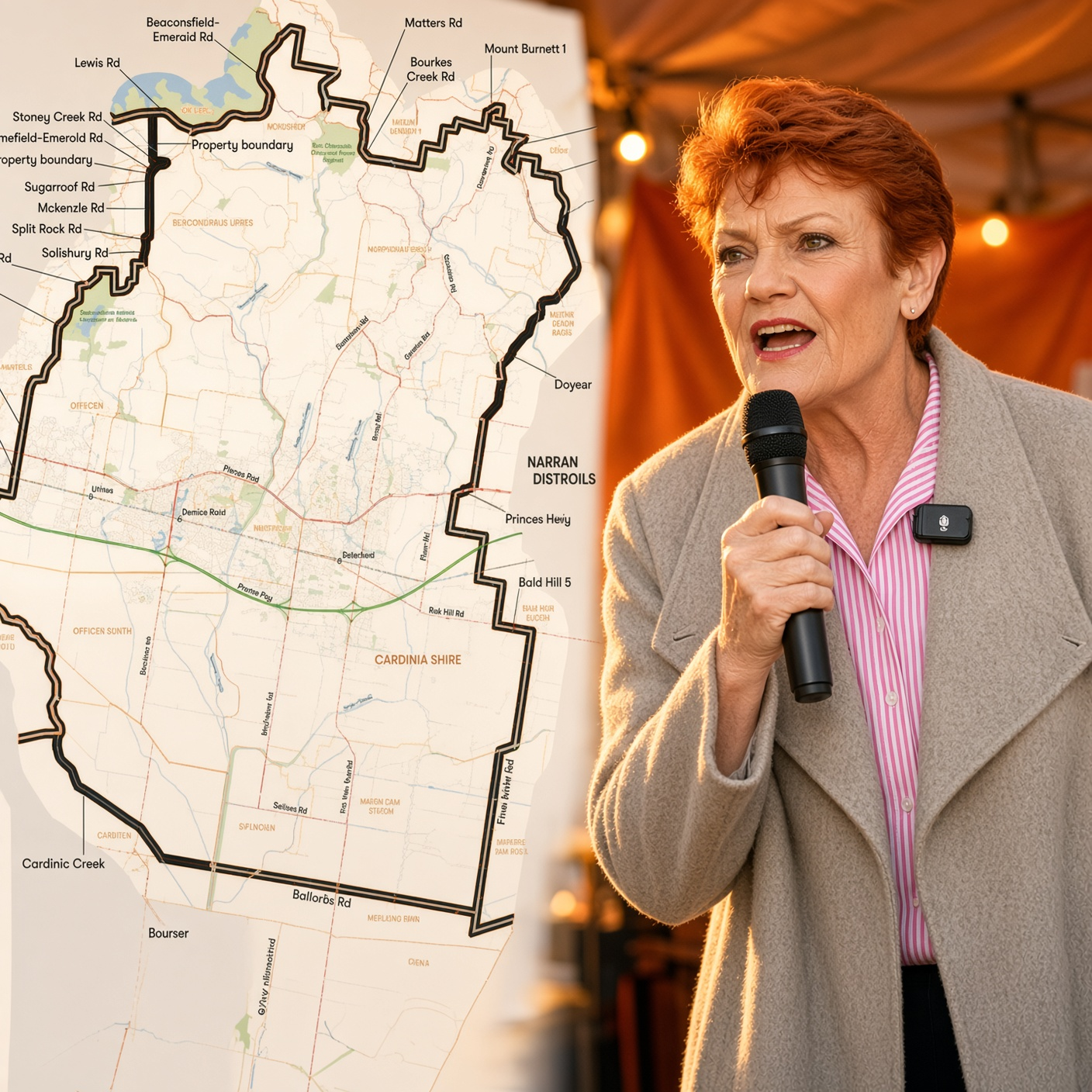
The fast-growing community on Melbourne’s outer south-eastern fringe is now being treated as political ground zero ahead of Victoria’s November election, with Pauline Hanson personally campaigning in the area and her Victorian leader Warren Pickering contesting the lower-house seat.
For One Nation, the attraction is obvious.
Pakenham contains almost every ingredient the party believes is driving its recent surge: heavily mortgaged households, rapid population growth, cost-of-living pressure, concerns about local infrastructure and crime, and voters who have become increasingly sceptical of both Labor and the Liberals.
Fresh housing data has added another layer to that political pressure.
Figures from S&P Global Ratings show postcode 3810, covering Pakenham and nearby localities, recorded the highest mortgage arrears rate in Australia as of June 30.
About 2.88 per cent of loans were in arrears, putting Pakenham ahead of other heavily stressed mortgage-belt areas including Constitution Hill in western Sydney, Point Cook in Melbourne’s west and Baulkham Hills in Sydney’s north-west.
The figures do not mean every homeowner in Pakenham is in financial difficulty, and postcode-level arrears data can fluctuate because of smaller loan samples.
But they provide a striking measure of the pressure facing a community that was once promoted as part of Melbourne’s affordable housing frontier.
For years, outer-growth suburbs offered younger households and first-home buyers an opportunity to enter the property market while remaining within commuting distance of the city.
That affordability often came with large mortgages, long commutes and heavy dependence on household income remaining stable.
Those same characteristics have become vulnerabilities as interest rates, energy bills, groceries, insurance and other household expenses have risen.
S&P Global has identified areas such as Pakenham, Point Cook and Hoppers Crossing as locations where large-scale housing expansion attracted many buyers because homes remained relatively affordable compared with inner Melbourne.
Many newer owners entered the market with smaller deposits and have had less time to build equity.
When property values soften, refinancing becomes more difficult and selling a home to escape financial pressure can become less attractive if owners have little equity remaining.
Victoria has also been recording particularly high mortgage arrears compared with other states, creating an economic backdrop that is increasingly difficult for the state government to separate from the election campaign.
That is where One Nation sees an opportunity.
Political strategist and RedBridge director Kos Samaras has previously described areas like Pakenham as natural territory for the party because of the concentration of working families under financial pressure and a broader perception among some voters that their quality of life is not improving.
The argument is not simply that mortgage stress automatically produces a One Nation vote.
Rather, economic pressure can make voters more receptive to parties promising dramatic changes to migration, energy policy, government spending, crime and the political system itself.
One Nation is now attempting to convert that mood into a lower-house breakthrough in Victoria.
Warren Pickering, the party’s Victorian leader and state president, will contest Pakenham at the November 28 state election.
One Nation describes the former soldier as having experience in farming, construction and mining and has positioned him as the public face of its attempt to build a much larger Victorian parliamentary presence.
Hanson has reinforced the importance of the seat by appearing alongside Pickering during campaigning in Pakenham.
The party has been holding events, speaking directly to voters and placing issues such as energy prices, law and order and cost of living at the centre of its message.
The location could hardly be more favourable for a political upset.
Pakenham is held by Labor, but only just.
At the 2022 Victorian election, Labor’s Emma Vulin received 33.84 per cent of first-preference votes, compared with 32.43 per cent for Liberal candidate David Farrelly.
After the full distribution of preferences, Vulin finished with 19,587 votes to Farrelly’s 19,280.
That was a difference of only 307 votes, leaving Labor with 50.39 per cent against the Liberals’ 49.61 per cent.
One Nation was a minor player in that contest.
Its candidate received just 1,321 first preferences, or 3.40 per cent of the vote.
The political landscape of 2026 is markedly different.
One Nation’s support has risen sharply across several parts of Australia, while both major parties have faced growing competition from voters willing to abandon long-standing political loyalties.
The party’s performance in South Australia earlier this year demonstrated that its polling surge could translate into substantial votes at an actual state election.
More recently, One Nation’s victory in the Secret Harbour by-election in Western Australia showed the party could capture a lower-house seat in a suburban area previously regarded as Labor territory.
Pakenham now offers another test — and potentially an even more important one.
Unlike a by-election, Victoria’s November poll will determine who forms government across the state. One Nation candidates will therefore be competing in an environment where voters are choosing not simply a local representative but the direction of Victoria for the next four years.
Statewide polling indicates the election is already highly volatile.
A RedBridge poll published in August put the Coalition on 30 per cent of the primary vote, Labor on 23 per cent and One Nation on 22 per cent, with the Greens on 14 per cent.
On a conventional Labor-Coalition two-party-preferred calculation, the poll had the Coalition leading 57 per cent to 43 per cent.
Those are statewide figures rather than polling specifically conducted in Pakenham, and they should not be interpreted as a prediction of the result in the seat.
They do, however, illustrate the unusual electoral environment confronting the major parties.
ABC analysis of the Victorian contest has identified Pakenham as one of the seats Labor is in serious danger of losing, along with other outer-suburban and regional electorates where financial pressure, infrastructure and crime have become major concerns.
The retirement of sitting MP Emma Vulin adds another element of uncertainty.
Vulin announced last year that she would not seek re-election in 2026.
That removes the advantage of a sitting Labor member who has spent a parliamentary term building local recognition and means voters will be choosing between a new set of contenders.
Open seats can be particularly volatile when the existing margin is already less than one percentage point.
The result could also expose a three-way battle that is becoming increasingly important across Australian politics.
Historically, a voter dissatisfied with a Labor state government might have been expected to move primarily towards the Liberals or Nationals.
The rise of One Nation means that assumption can no longer be taken for granted.
The party is increasingly attempting to establish itself as the first-choice opposition for voters in outer suburbs and regional communities rather than merely a minor party whose supporters eventually direct preferences to the Coalition.
That poses a threat to Labor, but it can be equally dangerous for the Liberals.
If One Nation takes a large share of anti-government first preferences, the order in which candidates finish becomes crucial under Victoria’s preferential voting system.
A major One Nation surge could theoretically put the party into the final count against Labor, eliminate the Liberals first or produce complicated preference flows that are difficult to predict months before polling day.
Conversely, One Nation could attract enough disaffected voters to weaken Labor while ultimately helping the Liberal candidate through preferences.
No reliable seat-level polling currently establishes which of those scenarios is most likely.
What can be said with greater confidence is that Pakenham’s economic profile makes it an unusually receptive environment for an anti-establishment campaign.
Residents in Melbourne’s outer suburbs often face a particular combination of pressures.
Housing may have been cheaper than in inner-city Melbourne when they purchased, but households can carry substantial debts relative to income.
Rapid population growth can also leave roads, schools, health services and public transport struggling to keep pace with demand.
Pakenham’s growth has prompted substantial government investment, including new rail infrastructure, schools and the developing Pakenham Community Hospital.
Labor argues those investments demonstrate that the area has not been neglected.
But infrastructure spending does not necessarily neutralise political frustration when households feel their own finances are deteriorating.
For voters worried about meeting the next mortgage repayment, the existence of a new station or road project may not outweigh the immediate pressure on the family budget.
One Nation’s challenge is to convince those voters that their problems are the result of government choices rather than broader economic forces and that its policies would materially improve their circumstances.
Labor and the Liberals, in turn, must persuade voters that they can deliver practical results without the disruption associated with a rapidly expanding minor party.
Crime is likely to form another major front in the contest.
Pickering and One Nation have increasingly emphasised community safety in their Victorian campaign, while ABC analysis has identified crime and local infrastructure among the issues hurting Labor in Pakenham.
Energy policy is also becoming prominent.
Hanson and Pickering have announced support for delaying the closure of the Loy Yang coal-fired power station and removing Victoria’s prohibition on nuclear energy, positioning energy reliability and household power prices as major election issues.
Those positions will appeal strongly to some voters but could repel others, demonstrating why One Nation’s rapid rise does not automatically guarantee victory.
Pakenham is also a diverse and fast-changing community rather than a uniform political bloc.
Voters who share frustration over mortgage payments may hold very different views on migration, nuclear power, climate policy or Hanson herself.
That makes descriptions such as “classic One Nation territory” useful as political analysis but not as a declaration that the electorate belongs to the party.
There are still nearly three months before Victorians vote.
Candidates will face greater scrutiny, policies will be tested and political circumstances can change quickly.
One Nation’s support in Victoria has already moved between polls this year, illustrating how volatile the electorate remains.
But Pakenham’s underlying conditions are harder to change before November.
It remains an electorate decided by only a few hundred votes last time, without its sitting member seeking another term, in a state where One Nation has become a significant political force and in a postcode now sitting at the top of Australia’s mortgage arrears table.
That combination explains why Hanson is spending political capital there.
If One Nation can move from 3.4 per cent of Pakenham’s primary vote in 2022 to winning the seat four years later, it would represent an extraordinary transformation in Victorian politics.
It would also send a message well beyond the state’s borders: financially pressured outer-suburban electorates once fought almost exclusively between Labor and the Coalition may now be open to a third competitor.
If One Nation fails, Pakenham will still provide an important test of how deep the party’s new support really runs when voters face a full general election rather than a protest-friendly by-election.
Either way, the electorate has become much more than one marginal seat on Melbourne’s fringe.
For Labor, the Liberals and One Nation, Pakenham is now a test of whether Australia’s mortgage-belt frustration is capable of reshaping the political map.






