The Coalition and One Nation have turned Australia’s illicit tobacco crisis into a new political battleground, trading accusations over who has done the serious policy work as both parties promise to slash the tax on legal cigarettes in an attempt to take customers and profits away from organised crime.
The similarities between their headline policies are striking. One Nation wants to cut the tobacco excise by 75 per cent and freeze indexation for three years. The Coalition has gone slightly further, promising an 80 per cent reduction if it wins the next federal election.
But Opposition Leader Angus Taylor insists the resemblance ends there.
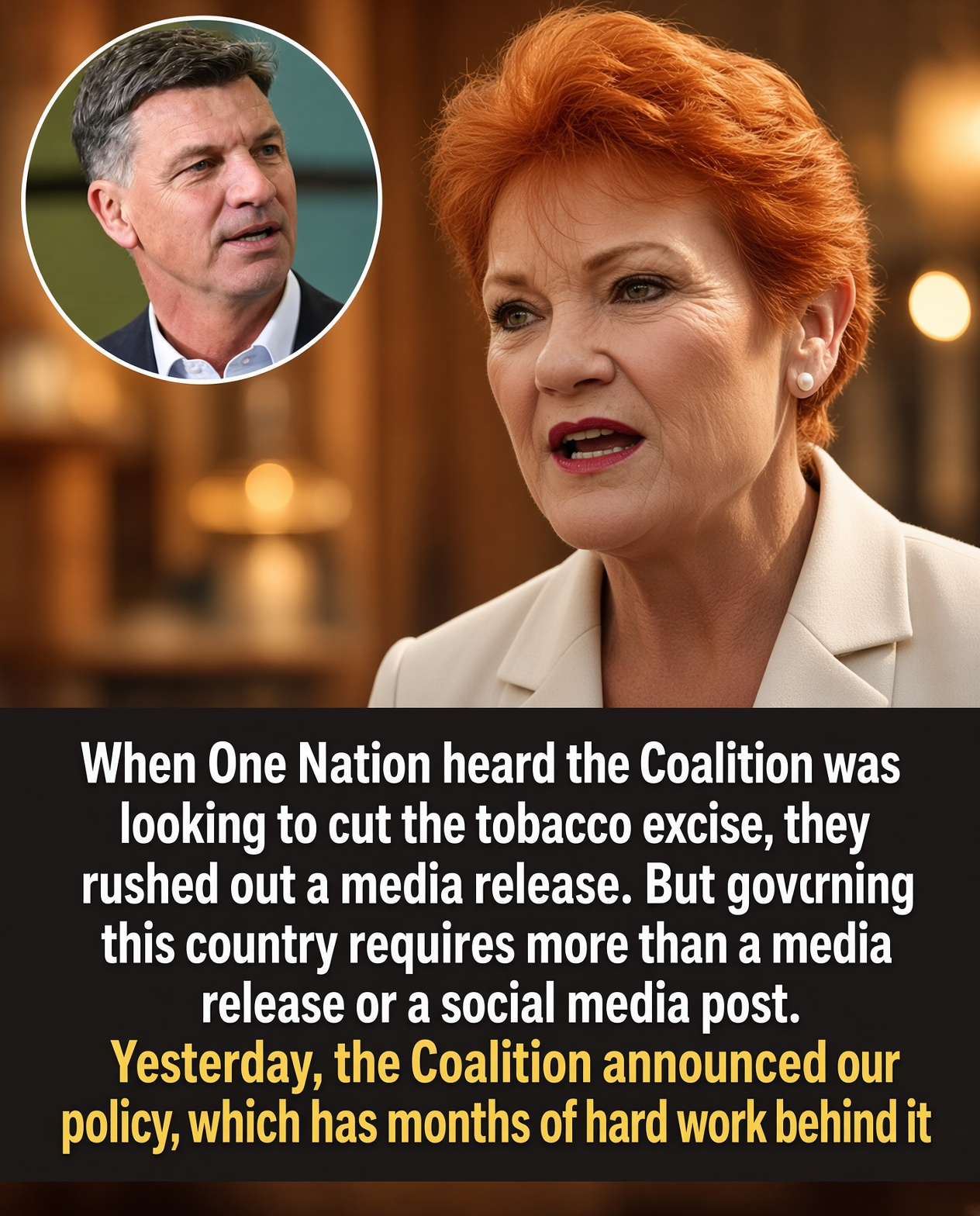
In a speech in Sydney on Friday, Taylor argued that One Nation had moved too quickly after learning the Coalition was considering a major excise reduction, while claiming his own team had spent months developing a broader package covering tax, enforcement, vaping regulation and public education.
“You’ve got to do the hard work,” Taylor said, before accusing One Nation of rushing out a media announcement rather than developing what he described as a complete plan for government.
It was an unusually direct attack on another party competing for many of the same disaffected voters, and it exposed the increasingly complicated relationship between the Coalition and Pauline Hanson’s resurgent One Nation.
One Nation figures have pushed back by noting they publicly announced their 75 per cent proposal more than two weeks before the Coalition formally unveiled its 80 per cent plan.
The dispute leaves Australians with two competing conservative policies built around the same controversial proposition: that legal cigarettes have become so expensive that the price gap with illicit tobacco is now helping criminal organisations build a vast black market.
What One Nation is proposing
Pauline Hanson announced One Nation’s latest tobacco policy on August 18, arguing that decades of increasingly high excise had reached the point of diminishing returns.
The party wants the excise reduced by 75 per cent and indexation frozen for three years. It says the change would bring taxation closer to levels seen about a decade ago and substantially reduce the retail price of legal cigarettes.
Using prices examined by the ABC, a legal packet costing about $42.60 — including roughly $30.50 in tobacco excise — could fall to about $21.20 under a 75 per cent excise reduction, assuming other components of the price remained broadly unchanged.
That would put legal cigarettes much closer to illicit packets commonly sold for about $15 to $20.
One Nation argues that narrowing that gap would make buying regulated cigarettes from legitimate retailers more attractive and reduce the extraordinary margins available to criminal syndicates.
Its proposal also includes stronger border enforcement, faster action against retailers selling illegal tobacco and tougher penalties for people involved in trafficking and tobacco-related violence.
Hanson has framed the policy as a law-and-order measure rather than an attempt to encourage smoking, arguing that Australia’s current tax settings have transferred a lucrative consumer market from legitimate businesses to organised crime.
One Nation had previously advocated a smaller excise reduction before moving to the 75 per cent figure, something Coalition figures have seized on when arguing their rivals had not undertaken sufficient modelling before announcing the policy.
Coalition goes further with an 80 per cent cut
The Coalition unveiled its own plan on September 3 after months of signalling that the excise would need to be substantially reduced.
Its proposal would cut tobacco excise by 80 per cent, reducing the tax component of a standard packet of 20 cigarettes from about $30 to about $6.
That does not mean a packet would retail for $6. Manufacturing, distribution, retailer margins and GST would remain. The objective is instead to make the final legal price competitive with cigarettes sold on the black market.
The Coalition says modelling undertaken with the independent Parliamentary Budget Office indicates an 80 per cent reduction would narrow the price gap sufficiently to move substantial numbers of consumers back into the legal market.
It says the excise rate would be reviewed after two years to determine whether the illicit market had been suppressed and whether further adjustment was required.
The tax cut is only one part of the Coalition package.
It has also promised a $200 million national law-enforcement surge targeting illegal tobacco retailers, criminal supply chains and imported products. Australian Border Force, the Australian Federal Police, the Australian Criminal Intelligence Commission and AUSTRAC would all be expected to increase their focus on the industry.
The Coalition would also legalise and regulate nicotine vapes and nicotine pouches for adults, moving away from Labor’s pharmacy-centred vaping model.
Under its proposal, vapes would attract an excise of 50 cents per millilitre of e-liquid, while nicotine pouches would be taxed at 2.5 cents per milligram of nicotine.
A further $60 million over three years would fund a national public-information campaign highlighting the health dangers of smoking and the links between illegal tobacco sales and organised crime.
It is those additional elements that Taylor points to when rejecting accusations that the Coalition has simply adopted One Nation’s position.
In his September 4 speech, he said a government needed more than a tax cut and argued the Coalition had assembled a multi-pronged response after consulting experts and commissioning policy work.
A political fight over who copied whom
The timing has nevertheless created an obvious political problem for the Coalition.
One Nation announced its 75 per cent cut first. Just over two weeks later, Taylor unveiled an 80 per cent reduction.
Shadow Treasurer Tim Wilson has rejected suggestions the Coalition increased its proposed cut simply to outbid One Nation, saying the opposition had been examining the illicit tobacco market for months and had always intended to combine excise reform with stronger enforcement.
Coalition figures also point to a taskforce led by Mary Aldred and former senator Richard Colbeck and to work undertaken before One Nation’s August announcement.
Taylor’s version of events is that One Nation learned the Coalition was preparing a large tax cut and moved quickly to get its proposal into the public domain.
That claim is politically significant but cannot be independently established merely from the timing of the announcements.
What is clear is that both parties had been publicly discussing major reductions before September, and both now see tobacco policy as an opportunity to attack Labor over organised crime while competing against each other for voters frustrated with the major parties.
The rivalry has become particularly important as One Nation attempts to expand beyond its traditional protest-vote base and present itself as a party capable of developing detailed economic and law-and-order policies.
For Taylor, demonstrating that the Coalition can produce more comprehensive and rigorously modelled proposals is therefore part of a wider political strategy — not merely a dispute about cigarettes.
The black market has become impossible to ignore
Behind the political contest is a genuine and rapidly growing organised-crime problem.
Illegal cigarettes are now readily available in many Australian cities and regional centres, frequently sold through convenience stores and tobacconists at a fraction of the legal price.
The trade has also become associated with violent competition between criminal groups.
Victoria has experienced a prolonged series of arson attacks on tobacco retailers, while law-enforcement agencies have linked illicit tobacco profits to other criminal activities including drug trafficking and money laundering.
The Coalition says government estimates place organised-crime profits from illicit tobacco at between $4.1 billion and $6.9 billion.
A recent Parliamentary Library analysis described the market as a serious threat to government revenue, smoking-reduction efforts and community safety, while noting that Australian Border Force does not believe product seizures alone can solve the problem.
The Senate Legal and Constitutional Affairs References Committee also released a report in August recommending that the government immediately pause further tobacco excise increases until there had been a meaningful reduction in the illegal market.
The committee went further, recommending a reduction in excise as part of a broader package involving enforcement, border modernisation, public education and improved access to less harmful nicotine alternatives.
However, it stopped short of endorsing either the Coalition’s 80 per cent cut or One Nation’s 75 per cent figure. Instead, it recommended that the precise rate be determined through an independent review with publicly released modelling.
Greens senators dissented from that approach, warning that reducing cigarette prices could reverse decades of public-health gains.
The statistics tell two different stories
One reason the debate has become so heated is that recent official statistics appear, at first glance, to point in different directions.
The Australian Bureau of Statistics has developed experimental estimates using nicotine metabolites detected in wastewater. Those estimates suggest total tobacco consumption has risen in recent years as falling legal sales have been more than offset by illicit products.
The ABS estimated that illicit sources accounted for about 80 per cent of nicotine consumption in 2025.
That figure has been heavily cited by the Coalition.
But the ABS itself labels the methodology experimental and notes that its estimates differ from other studies. The Illicit Tobacco and E-cigarette Commissioner, for example, previously estimated the illicit share of the tobacco market at around 50 to 60 per cent in 2024-25.
The latest National Drug Strategy Household Survey presents another important piece of evidence.
It found the proportion of Australians aged 14 and over who smoke daily fell from 8.3 per cent in 2022-23 to a record-low 5.6 per cent in 2025.
That is roughly 1.3 million daily smokers, compared with about three million in 2001.
At the same time, 34 per cent of people who smoke told the survey they had purchased illicit tobacco in the previous three months or were currently smoking illicit products.
The two datasets are not necessarily contradictory because they measure different things using different methods. One estimates quantities of nicotine consumed through wastewater analysis; the other asks individuals about their smoking behaviour.
But the difference makes sweeping political claims difficult to sustain.
The evidence clearly shows a major black market exists. It also shows the prevalence of daily smoking has continued to decline. What remains contested is how much of the illicit market was caused by high excise and what would happen to smoking rates if legal cigarettes suddenly became much cheaper.
Labor warns cheaper cigarettes could come at a health cost
The Albanese government has rejected the Coalition and One Nation approach and continues to favour stronger enforcement rather than a dramatic reduction in cigarette taxation.
Health Minister Mark Butler described the Coalition announcement as irresponsible and challenged Taylor and Shadow Health Minister Anne Ruston to demonstrate what an 80 per cent price intervention would do to smoking rates.
Butler pointed to the experience of Canada in the 1990s, where governments reduced tobacco taxes in an effort to combat smuggling. He argued the policy was followed by increased smoking, particularly among younger people, while the illicit market later returned.
Public-health organisations have made a similar argument, warning that price is one of the strongest influences on whether people begin smoking and whether existing smokers try to quit.
The Coalition counters that Australia has reached a point where an extremely high legal price no longer delivers the expected deterrent because illegal cigarettes are widely available at much lower prices.
That is the central policy question neither political slogan can resolve on its own.
If a large tax reduction successfully moves existing smokers from criminal suppliers to legitimate retailers without materially increasing smoking, it could weaken organised crime while restoring government revenue.
If cheaper legal cigarettes attract new smokers, reduce quitting or encourage former smokers to return, the health costs could be severe even if the black market shrinks.
And if criminal suppliers simply cut their prices further, Australia could end up with both cheaper legal tobacco and a continuing illicit market.
For now, the political battle is being fought over who has the more credible answer.
One Nation says it forced the major parties to confront a tobacco tax regime that has helped create a vast illegal market. Taylor says his Coalition has produced the more serious plan by combining a bigger excise cut with detailed enforcement, regulation and modelling.
Labor says both are taking a dangerous gamble with one of Australia’s most successful public-health policies.
The argument over who did the “hard work” may dominate the immediate political headlines. The more consequential question is whether any government can make legal tobacco competitive with the black market without making smoking itself more attractive again.






