Why Fact-Checking Has Become One Of The Most Powerful Forces In Modern Politics
Politics has always involved competing ideas.
Different visions.
Different priorities.
Different interpretations of the same problems.
But in the digital age, another battle has become just as important.
The battle over facts.
Not simply what politicians believe.
But whether voters believe the evidence supporting those beliefs.
That reality has become increasingly visible as major political speeches are now routinely followed by fact-checking articles, expert analysis and competing interpretations from journalists, researchers and advocacy groups.
Recent attention surrounding Pauline Hanson’s National Press Club speech illustrates this trend. Following her address, media organisations, commentators and political analysts examined claims relating to immigration, climate policy, energy prices, multiculturalism and economic management. The discussion quickly expanded beyond the speech itself and into a broader debate about evidence, public trust and political communication.
Fact-checking has become increasingly influential because modern political debates often involve complex issues.
Energy markets.
Climate science.
Housing affordability.
Migration levels.
Government spending.
These topics rarely have simple explanations.
They involve large datasets, competing expert opinions and long-term trends that can be difficult for voters to evaluate independently.
As a result, fact-checking organisations and news outlets attempt to compare political claims against available evidence.
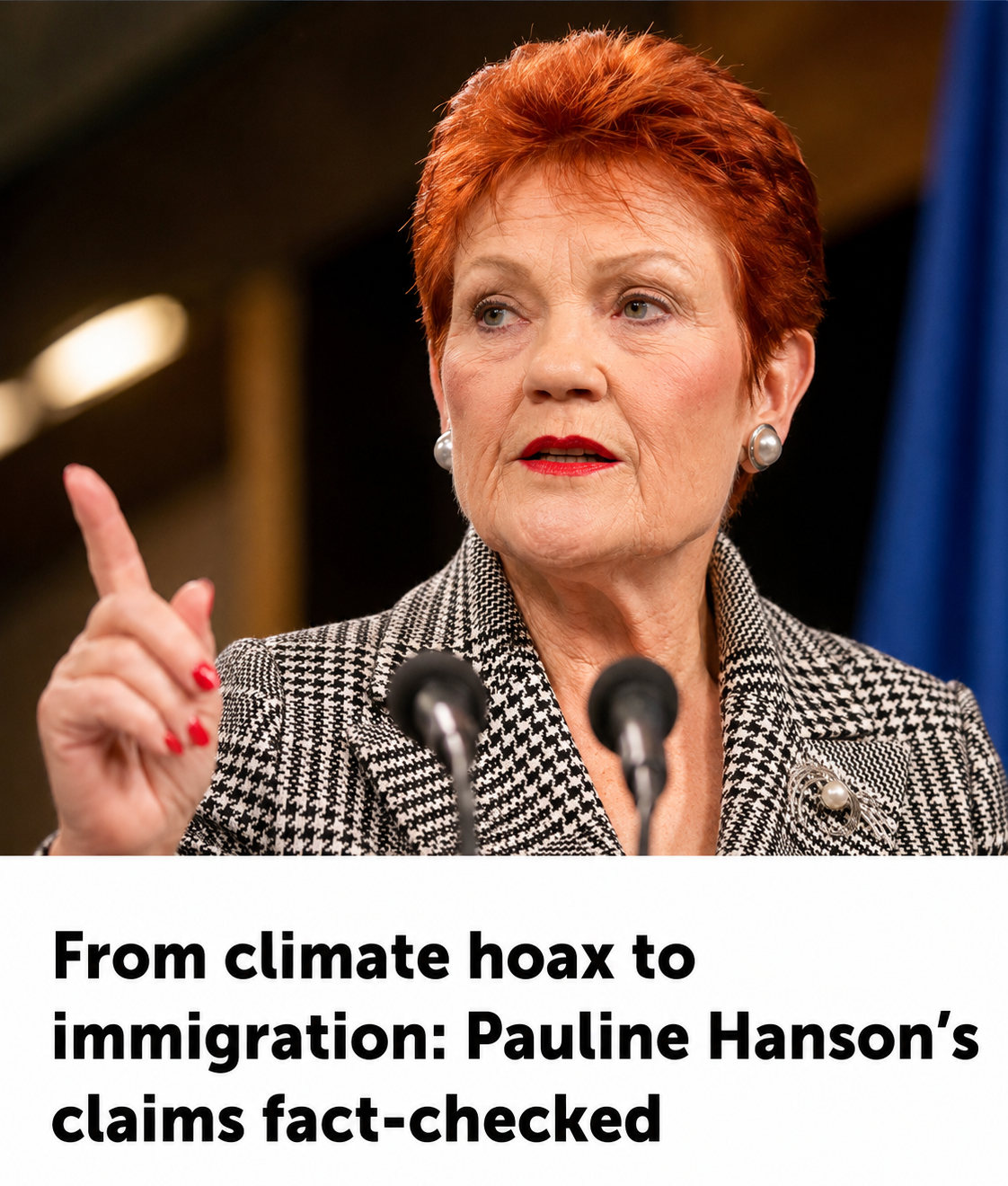
Supporters argue that this helps improve public understanding.
Critics sometimes argue that fact-checking itself can reflect editorial judgments or assumptions.
The tension between those perspectives has become part of modern democratic life.
One challenge is that not every political statement can be verified in the same way.
Some claims are factual.
For example, a statement about migration numbers, government spending or electricity generation can often be checked against official data.
Other statements are predictive.
Claims about what may happen in the future are inherently harder to verify because they involve forecasts rather than established facts.
Still others are value judgments.
Whether a policy is fair, effective or desirable often depends on personal beliefs as much as objective evidence.
These distinctions are important because political debates frequently mix all three categories together.
A politician may present factual information, predictions and opinions within the same argument.
Fact-checkers can assess some elements directly.
Others remain matters of interpretation.
The rise of social media has made this process even more significant.
Political messages can now reach millions of people almost instantly.
Supporters share them.
Opponents challenge them.
Journalists analyse them.
Researchers scrutinise them.
The public is often exposed to multiple competing versions of the same story within hours.
This environment creates both opportunities and challenges.
Access to information has never been greater.
At the same time, the sheer volume of information can make it difficult to determine which sources deserve trust.
Studies examining misinformation and fact-checking have noted that modern information environments require citizens to evaluate evidence from a wide variety of sources while navigating conflicting claims and interpretations.
The debate surrounding climate change provides a useful example.
Political leaders often present very different explanations for rising energy prices, environmental policies and economic costs.
Some focus on emissions reduction policies.
Others focus on fossil fuel supply.
Others emphasise international energy markets.
Each perspective may highlight different evidence while reaching different conclusions.
This helps explain why climate policy remains one of the most contested areas of public debate.
Immigration debates reveal similar complexities.
Migration can influence housing demand, labour markets, economic growth and population trends.
Different groups often interpret the same statistics through different political lenses.
As a result, arguments about migration frequently become arguments about values as well as numbers.
The growing popularity of fact-checking reflects a broader issue.
Public trust matters.
Citizens want confidence that political decisions are based on accurate information.
Governments want credibility.
Oppositions want accountability.
Media organisations want audiences to view them as reliable.
Each participant has incentives to shape public understanding.
That makes independent verification increasingly valuable.
Yet fact-checking is not a substitute for democratic debate.
Evidence can inform decisions.
It cannot eliminate disagreements about priorities, values or policy goals.
Two people may accept the same facts while supporting entirely different solutions.
That is a normal feature of democratic politics.
The real importance of fact-checking lies elsewhere.
It helps establish a common foundation from which debates can occur.
Without shared facts, meaningful political discussion becomes far more difficult.
As political communication continues evolving, voters are likely to encounter even more claims competing for their attention.
The challenge will not simply be finding information.
It will be deciding which information deserves confidence.
That may be one of the most important political skills of the modern era.






