Thousands of high school and university students across Australia are preparing to walk out of classes later this month as part of a coordinated national protest targeting Pauline Hanson and her political party, One Nation.
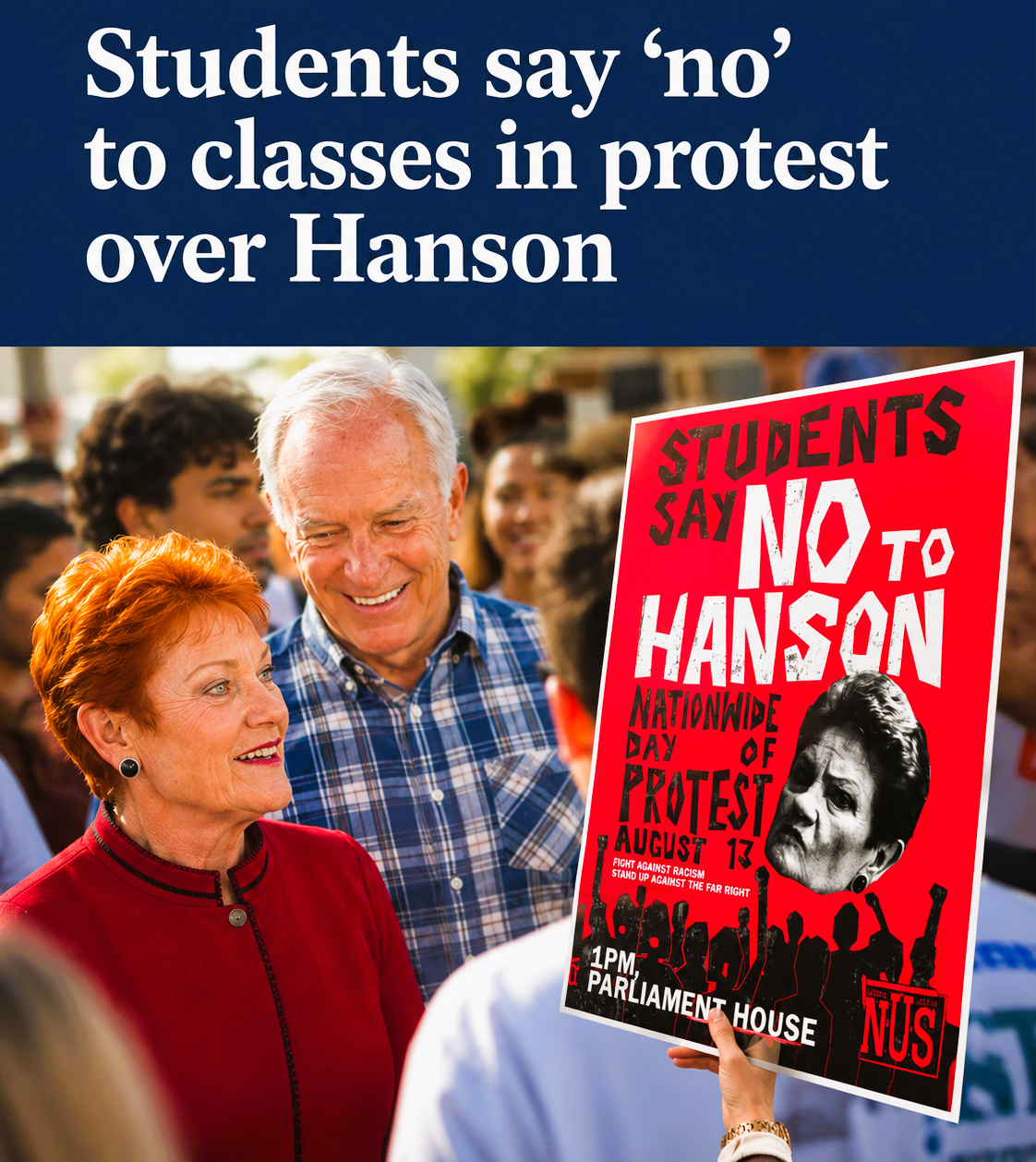
The campaign, organised under the banner Students Say No to Hanson, is scheduled to take place on 13 August, with demonstrations planned in Adelaide, Melbourne, Sydney, Brisbane, Canberra, Perth, Wollongong and Newcastle. Organisers say the movement is intended to mobilise young Australians who oppose Pauline Hanson’s political agenda and what they describe as the growing normalisation of One Nation within Australian politics.
In South Australia, students from several high schools and universities are expected to gather outside Parliament House in Adelaide during school hours, meaning many participants will miss classes to attend the rally.
Among the schools reportedly expected to have students participating are Adelaide High School, Adelaide Botanic High School and University Senior College, while university students from Adelaide University and Flinders University have also indicated they intend to join the demonstration.
Organisers say the protests are a response to what they believe is the increasing influence of One Nation and Pauline Hanson on national political debate.
Jordan Armstrong, a protest organiser associated with Socialist Alternative, said the rallies were designed to demonstrate opposition to Hanson’s political positions and argued that her views had increasingly been given a platform by mainstream political institutions.
“The reason why we’re doing this protest is to have an expression of the millions of people across this country who are absolutely appalled by Pauline Hanson’s political stances,” Armstrong said.
In Victoria, student organiser Jules Arpula said participants viewed the demonstrations as part of a broader campaign against what they described as far-right politics.
She argued that students felt a responsibility to publicly oppose Hanson and One Nation, drawing comparisons with anti-Hanson protests that took place during the late 1990s when One Nation first emerged as a significant force in Australian politics.
The campaign has attracted support from a number of university-based activist organisations, including Socialist Alternative branches at Adelaide and Flinders universities, along with several other left-wing student groups across Australia.
Organisers say they expect thousands of students nationwide to participate in coordinated demonstrations throughout the day.
The planned walkout has also generated controversy after representatives from One Nation reportedly attempted to attend one of the protest planning meetings.
According to reports, two One Nation staff members were recognised by organisers and asked to leave the meeting before discussions continued. The incident has since become another point of disagreement between organisers and the party.
South Australian One Nation state president Carlos Quaremba said his party respected the right of Australians to protest but criticised organisers for refusing to engage directly with party representatives.
“They’re more than welcome to protest,” Quaremba said, adding that he believed the organisers were “not interested in debating” but were instead focused on promoting their own political views.
Education authorities have also weighed in ahead of the demonstrations.
South Australian Education Minister Lucy Hood said regular school attendance remained important but acknowledged that participation in protests ultimately rested with families.
“School is the best place for a child to be during the school week,” Hood said, while adding that whether a student attends the rally is “a matter for an individual parent to decide”.
In Victoria, the Department of Education similarly reminded schools that normal attendance expectations would continue to apply and that any absences would be managed under existing school attendance policies.
The demonstrations come at a time when One Nation has been enjoying renewed political momentum.
Recent opinion polling has suggested the party has significantly increased its primary vote, while Pauline Hanson has expanded One Nation’s organisational presence into states including Victoria ahead of the November state election.
Earlier this week, Hanson launched the party’s Victorian campaign, introducing Warren Pickering as state leader alongside the first group of election candidates. That campaign launch itself became controversial after journalists from the ABC, The Guardian and The Age were barred from attending the press conference, prompting widespread debate over media access and political accountability.
Supporters of the student protests argue that growing support for One Nation makes public demonstrations more important than ever.
They contend that young Australians should actively oppose policies they believe threaten multiculturalism, social inclusion and equal rights.
Supporters also point to previous student-led campaigns on climate change and other social issues as examples of young people participating in democratic debate through peaceful protest.
One Nation supporters, however, argue that the demonstrations unfairly target a democratically elected political party and reflect increasing political activism within schools and universities.
They maintain that disagreements over immigration, cost-of-living pressures and national identity should be resolved through public debate and elections rather than campaigns aimed at isolating particular political movements.
The planned rallies have also reignited discussion about the role of political activism in education.
While Australian students have a long history of participating in demonstrations on issues ranging from climate policy to education funding, critics argue that encouraging students to miss classes for political protests raises questions about balancing civic participation with educational responsibilities.
Supporters counter that peaceful protest has long formed part of Australia’s democratic tradition and gives young people an opportunity to express views on issues they believe will shape their future.
For now, schools across the country are preparing for possible student absences while organisers continue promoting what they hope will become one of the largest coordinated youth protests against Pauline Hanson and One Nation in recent years.
Whether the demonstrations influence public opinion or the broader political debate remains uncertain, but they have already highlighted the increasingly polarised attitudes surrounding One Nation’s resurgence and the growing willingness of politically engaged students to take their views beyond the classroom and into the public square.