Anthony Albanese’s controversial podcast appearance is continuing to create problems for the federal government, with Foreign Affairs Minister Penny Wong pressed in a tense live television exchange over whether Labor would have shown the same forgiveness to a conservative prime minister.
The confrontation came as the government attempted to draw a line under Albanese’s crude remarks about Kylie Minogue, his sex life with wife Jodie Haydon and a gift presented by Japanese Prime Minister Sanae Takaichi.
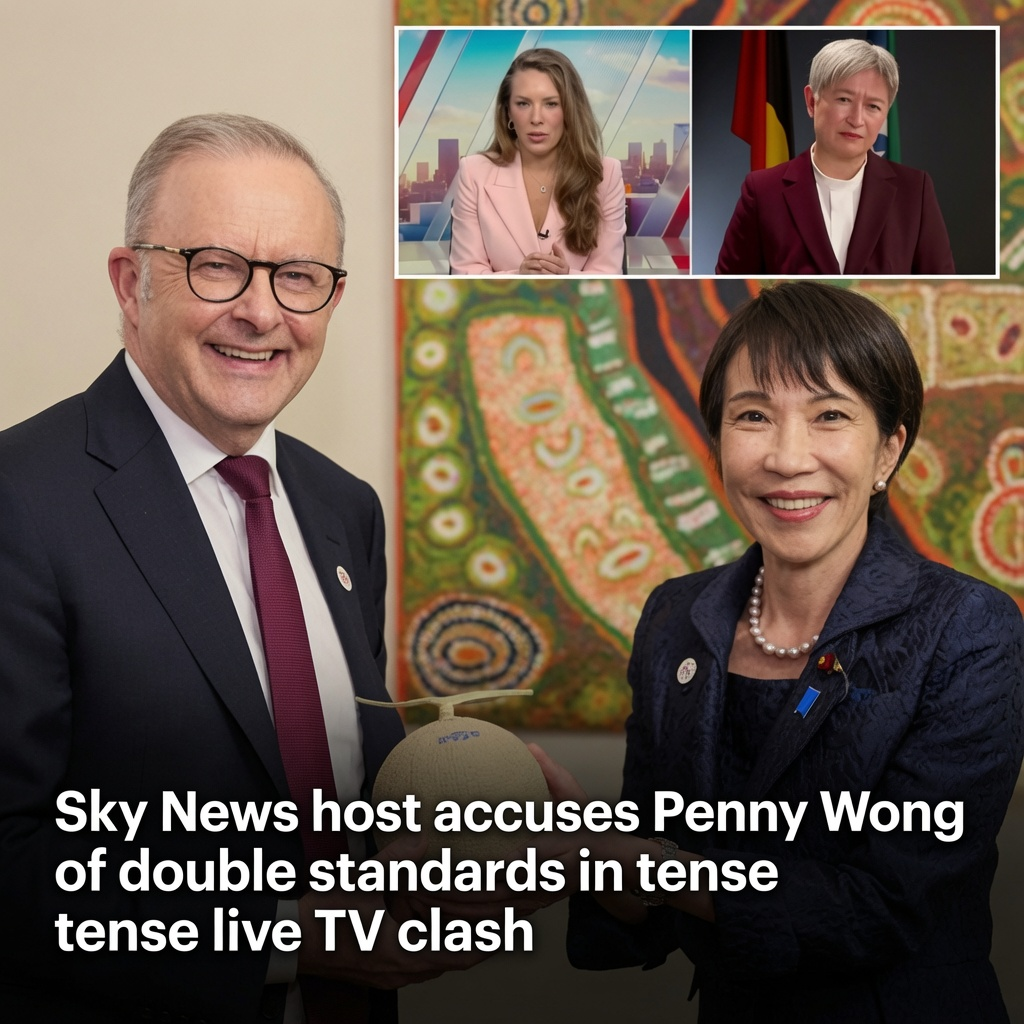
Appearing on Sky News Australia, Wong repeatedly pointed to the Prime Minister’s public apology and insisted the matter had been dealt with.
But host Laura Jayes challenged the Foreign Minister on a question that has increasingly become central to the political fallout: would senior Labor figures have reacted so calmly if a conservative prime minister had made the same comments?
“Do you understand that many would expect that you might have a different reaction and perhaps be less understanding if this was a conservative Prime Minister making those comments?” Jayes asked.
Wong responded by appealing to the importance of accepting an apology.
“I think if someone apologises unequivocally, I try to tell my children you should be gracious when someone apologises,” she said.
It was a carefully controlled answer, but it did little to end the wider argument about political double standards that has followed Albanese since his appearance on comedian Nikki Osborne’s Bush Deep podcast.
Wong says no concerns raised by Japan or DFAT
Jayes also questioned Wong about Albanese’s remarks concerning Japanese Prime Minister Sanae Takaichi and a prized melon presented during her visit to Australia in May.
During the podcast, Albanese recalled the diplomatic gift and said he had received “a couple of melons”, accompanied by a gesture that critics interpreted as sexual innuendo.
Wong said no concerns had been raised with her by the Department of Foreign Affairs and Trade or by her Japanese counterparts.
“The Prime Minister has made his apology, public, and clear, and I think the matter has been resolved,” she said.
There is an important factual detail behind the controversy.
The official Japanese Prime Minister’s Office record of the May 4 summit dinner states that Takaichi presented Albanese with a Shizuoka-grown Crown Melon. The gift marked Japan’s resumption of Crown Melon exports to Australia.
In other words, the official Japanese account describes one melon, not “a couple of melons”.
That discrepancy has intensified criticism of Albanese’s podcast performance because it has led opponents and commentators to argue that the Prime Minister deliberately altered the story to create a sexual joke.
The original diplomatic exchange had carried considerably more substance than the podcast retelling suggested.
Takaichi’s three-day visit to Australia was part of a significant strengthening of the Australia-Japan relationship, with discussions and agreements covering defence, critical minerals, energy and economic security. Albanese spoke at the time about the “deep and trusted ties” between the two countries.
The melon itself was not a random novelty gift. Japanese Crown Melons are highly prized produce, and the presentation was connected to renewed market access for exports to Australia.
Australia, in turn, presented Takaichi with a framed AC/DC drum skin signed by members of the band.
Against that diplomatic background, critics say Albanese’s decision to turn the gift into a suggestive anecdote was particularly ill-judged.
The government’s defence is straightforward: the Prime Minister has apologised, no diplomatic complaint has been raised with the Foreign Minister and there is no evidence of a formal rupture with Tokyo.
Politically, however, the absence of a diplomatic protest does not automatically end the domestic controversy.
‘Sexist, misogynistic, in bad taste, cringy — or all of the above?’
Jayes directly asked Wong how she would characterise the podcast performance.
Was it “sexist, misogynistic, in bad taste, cringy, or all of the above?”
Wong laughed during the exchange and again returned to Albanese’s “unequivocal apology”, saying the matter was now closed.
That reluctance to attach a label to the Prime Minister’s conduct is precisely what has kept the double-standards argument alive.
Labor has spent years placing the treatment of women, workplace culture and respectful political conduct near the centre of its public identity.
Senior Labor figures have frequently criticised political opponents over language or conduct they considered demeaning towards women. The Albanese government has also repeatedly promoted its record on women’s representation, gender equality and women’s safety.
That history means Labor ministers now face a difficult test of consistency.
They can accept Albanese’s apology and argue that a mistake should not define a prime minister. But critics are asking whether the same generosity would have been extended to a Liberal or National leader who publicly participated in a game involving which prominent Australian woman he would “shag, marry or date”.
The question becomes even more difficult because Albanese did not merely sit through an awkward question and refuse to engage.
When Osborne asked him to choose between Kylie Minogue, Nicole Kidman and Rhonda Burchmore, the Prime Minister initially noted his recent marriage to Haydon.
But he eventually selected Minogue.
“Oh, Kylie, clearly,” Albanese said.
When the host pressed him on whether he would marry, date and have sex with Minogue, Albanese agreed to “all of the above” and described the Australian pop star as “terrific”.
The Prime Minister was also asked an intimate question about his relationship with Haydon.
Albanese joked that a South Sydney Rabbitohs victory was “always a good aphrodisiac”.
These were not comments made during a parliamentary debate or a hostile media ambush. Albanese had chosen to appear in a comedy podcast environment designed to produce informal, provocative and potentially viral exchanges.
That context explains the tone. It does not necessarily remove the political consequences.
Albanese has admitted the remarks were inappropriate
The Prime Minister has not attempted to defend the Kylie Minogue comments as acceptable.
He issued what he described as an unequivocal apology after the podcast triggered widespread criticism.
“The comments were inappropriate and I apologise unequivocally,” Albanese said.
That admission is important because it narrows the political argument.
The dispute is no longer primarily about whether the comments crossed a line. The Prime Minister himself has accepted they were inappropriate.
The remaining questions concern judgment, the response of senior Labor figures and how long a public apology should be expected to settle a controversy involving the nation’s leader.
Acting Prime Minister Richard Marles defended the government’s broader record, arguing Labor had a strong history of elevating women.
Critics, including Coalition politicians, have instead focused on what they describe as silence or caution from Labor women who have previously been outspoken about inappropriate conduct by political opponents.
That is why Wong’s interview mattered.
As Foreign Affairs Minister, she was in a unique position to address the Japan dimension of the controversy. As one of the government’s most senior and prominent women, her personal assessment of Albanese’s comments was also politically significant.
Wong chose not to condemn the Prime Minister beyond acknowledging his apology.
Her position was that the apology should be accepted and the matter closed.
Jayes’ questioning exposed the vulnerability in that approach: voters are entitled to ask whether Labor has always applied that principle so readily when the politician apologising sits on the other side of the chamber.
The problem with trying to declare a controversy ‘closed’
Governments regularly attempt to end damaging stories by declaring that a minister or leader has apologised and the matter is resolved.
Sometimes it works.
But political controversies rarely end simply because the government at the centre of them announces they are over.
The durability of a story depends on whether new facts emerge, whether the opposition can sustain public interest and, most importantly, whether the incident connects with a broader perception voters already hold.
For Albanese, the podcast controversy risks becoming part of a larger debate about political judgment and the standards expected of a prime minister.
His supporters may view the appearance as an unsuccessful attempt to show a more relaxed and human side of the nation’s leader. Politicians increasingly appear on podcasts, entertainment programs and non-traditional media precisely because those formats can reach voters who do not watch press conferences or parliamentary coverage.
There is a clear political incentive to participate.
Traditional interviews tend to focus on interest rates, budgets, foreign policy, immigration and government failures. Comedy podcasts offer politicians an opportunity to display personality and build a connection with audiences in a less adversarial environment.
But the informality carries risk.
A prime minister does not cease to be prime minister when a podcast microphone is switched on.
Remarks that might pass unnoticed between private citizens can become national headlines when made by the head of government. A joke involving the leader of a close strategic partner can also be examined through a diplomatic lens, even if no formal complaint is ever made.
Albanese’s appearance demonstrated the danger of a politician becoming too comfortable with the format.
He was asked deliberately provocative questions and, rather than consistently maintaining a boundary, joined the conversation.
The result was an apology, days of negative headlines and senior ministers being required to answer questions about his comments instead of the government’s policy agenda.
The Japanese gift adds a more serious dimension
The Kylie Minogue exchange has attracted much of the public attention because of the explicit language involved.
But the Takaichi comments create a different problem.
Japan is one of Australia’s closest strategic and economic partners. The bilateral relationship has become increasingly important as both countries respond to regional security pressures and seek more resilient supply chains for energy and critical minerals.
During Takaichi’s May visit, the two governments highlighted defence cooperation, economic security and a shared commitment to regional stability.
In that context, critics argue that a suggestive joke connected to the Japanese Prime Minister should be judged differently from banter about an Australian celebrity.
There is currently no public evidence that Takaichi or the Japanese government has lodged a formal protest over Albanese’s comments.
Wong’s statement that neither DFAT nor her Japanese counterparts had raised concerns with her is therefore significant and should not be ignored.
At the same time, diplomatic relationships are not normally conducted through public demands for apologies over every offensive or embarrassing remark.
The absence of an official complaint cannot, by itself, establish what Japanese officials privately thought of the episode.
Claims that the incident has already damaged the bilateral relationship would go beyond the available evidence. Claims that the comments are irrelevant because no complaint has been made would also oversimplify the issue.
The verified position is narrower: Albanese made the remarks, the official Japanese record says Takaichi presented him with one Shizuoka-grown Crown Melon, the Prime Minister has apologised for inappropriate comments arising from the podcast, and Wong says no concern has been raised with her by DFAT or Japanese counterparts.
Why the double-standards question may outlast the podcast
The government’s greatest political risk may not be the original comments.
It may be the perception that political standards change depending on who has broken them.
Australians have watched years of fierce arguments about parliamentary culture, sexism and the language used by public figures. Politicians from all major parties have demanded resignations, apologies and accountability from opponents.
That creates a public record against which every new controversy is judged.
Jayes’ question to Wong went directly to that record.
If a conservative prime minister had made the same remarks, would Labor have accepted an unequivocal apology and encouraged Australians to be gracious?
Wong did not directly answer the hypothetical.
Instead, she defended the principle of accepting an apology.
That may be a reasonable personal position. Politically, Labor will now be expected to demonstrate the same standard the next time an opponent makes an inappropriate remark and apologises.
This is how relatively small controversies can produce lasting consequences.
The podcast itself will eventually disappear from the daily news cycle. The quotes will become familiar. The immediate outrage will fade.
But the standard established in the government’s response can be recalled later.
Albanese wanted a relaxed podcast conversation. He ended up issuing an unequivocal apology.
Wong wanted to close the matter. She instead found herself explaining live on television why an apology should be accepted and why people should be gracious.
For a government already eager to move on, the exchange was another sign that the political consequences of Albanese’s podcast appearance are not entirely within Labor’s control.






