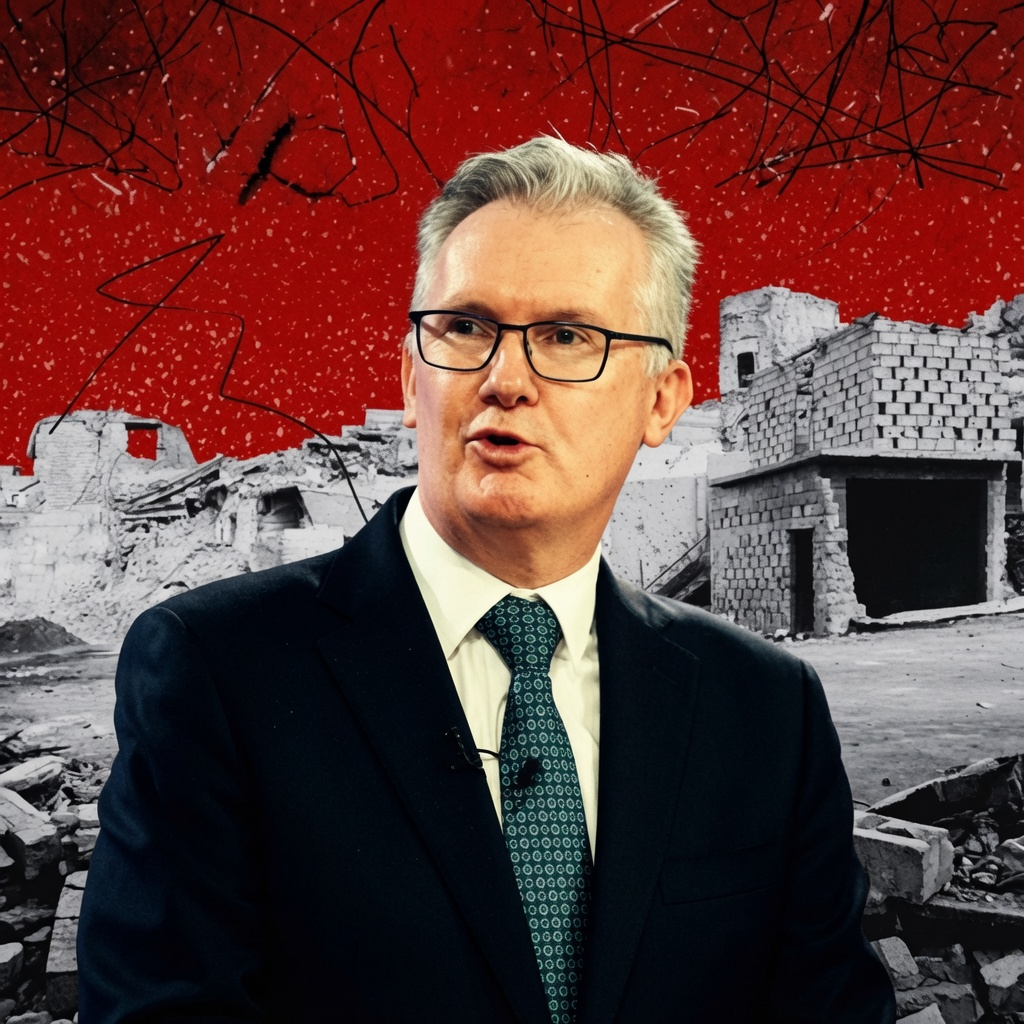
Home Affairs Minister Tony Burke has conceded the Albanese Government faces a “really tough” legal threshold if it seeks to temporarily prevent suspected Islamic State fighters from returning to Australia, as uncertainty grows over the fate of 13 Australian men detained in Iraq.
The admission has intensified an already politically charged debate over Australian citizens linked to Islamic State, following the return of several women from Syria and a series of arrests over alleged terrorism, slavery and crimes against humanity offences.
Speaking on Channel Seven’s Sunrise on Monday, Burke was pressed on whether he would use Australia’s temporary exclusion order powers to stop the 13 men from returning if they are released from Iraqi custody.
“It’s a really tough threshold to meet legally,” Burke said.
“Certainly, I’ve only had one time when the department said that the threshold was met, and I was able to put an exclusion order in. I did that straight away.”
The Home Affairs Minister said the government would use the legal powers available to it, but acknowledged a fundamental difficulty confronting Australian authorities: if a person remains an Australian citizen, the government cannot simply impose a permanent administrative ban preventing that citizen from ever returning home.
“If someone’s a citizen, eventually they can come back, but at the moment, every single one of these people is locked up, and I’ve got no problem with that,” Burke said.
“There are times when people are locked up around the world, and the Australian government takes steps to try to get them returned home – not with this.”
The government has made clear it will not provide repatriation or consular assistance designed to bring the men back to Australia if they are released. However, Burke’s comments expose the difference between refusing to help a person return and possessing the legal authority to stop an Australian citizen from returning indefinitely.
That distinction is now at the centre of the government’s latest ISIS-related headache.
Thirteen Australian detainees face review in Iraq
The 13 Australian men are being held in the Iraqi prison system after years of upheaval involving Islamic State detainees captured following the collapse of the terror group’s territorial caliphate in Syria and Iraq.
Their cases are reportedly being examined as authorities assess whether individual detainees were combatants or non-combatants. The review has raised the possibility that some could ultimately be released.
Not every Australian caught in the detention system has an identical background or set of allegations. One of the Australians identified in reporting on the group is Yusuf Zahab, who was taken to Syria as a child and whose family has long maintained he was not an ISIS fighter.
But serious allegations have also surrounded other foreign nationals who travelled into Islamic State territory, and the prospect of suspected fighters being released has generated immediate national security concerns in Australia.
Burke has adopted an uncompromising position on government assistance.
His message is that Canberra will not “lift a finger” to facilitate the return of people suspected of having aligned themselves with Islamic State.
Yet the legal question becomes considerably more complicated if an Iraqi authority releases an Australian citizen who then independently attempts to travel home.
What is a temporary exclusion order?
Australia introduced the temporary exclusion order regime in 2019 as part of a broader counter-terrorism framework designed to manage the return of Australians who may pose a terrorism risk after travelling overseas.
A temporary exclusion order, commonly known as a TEO, can prevent an Australian citizen aged 14 or older from returning to Australia unless the person is issued a return permit.
The system was not designed as a mechanism to permanently strip every suspected extremist overseas of the ability to enter Australia.
Instead, the legislation allows authorities to control the timing and circumstances of a person’s return when statutory national security requirements are satisfied.
Under the framework, the minister must consider that making an order would substantially assist in addressing the threat of terrorism from the individual, or the Australian Security Intelligence Organisation must have assessed the person as a direct or indirect risk to security.
Orders are also subject to legal safeguards and review mechanisms.
A return permit can impose conditions around how and when a person enters Australia. Once back in the country, other counter-terrorism, surveillance, investigation and criminal law powers may become relevant depending on the evidence available to authorities.
The distinction is important because suspicion, association with ISIS-controlled territory and evidence capable of supporting a criminal prosecution are not necessarily the same thing.
Australian police and prosecutors must establish alleged offences through evidence that can be used in court. Gathering that evidence from conflict zones in Syria and Iraq can be extraordinarily difficult years after the alleged conduct occurred.
Witnesses may be dispersed or dead. Records may be incomplete. Physical evidence may have been destroyed. Foreign intelligence can also present complications when authorities attempt to convert security information into admissible evidence for a criminal trial.
This is one reason the return of ISIS-linked Australians has remained a difficult legal and national security issue across successive governments.
ISIS bride returns have already fuelled controversy
The debate over the 13 men follows months of scrutiny surrounding Australian women and children who spent years in Syrian camps after the defeat of Islamic State’s territorial stronghold.
Two groups of women returned to Australia in May, with four women arriving on May 7 and a further group returning later in the month.
The returns were followed by major counter-terrorism operations and criminal charges.
In one case, Australian authorities charged two women with crimes against humanity offences involving allegations of slavery connected to their time in Syria.
Police alleged Kawsar Ahmad and Zeinab Ahmad exercised powers of ownership over a Yazidi woman while living in Islamic State-controlled territory. The allegations are before the courts and have not been proven.
Another returnee, Janai Safar, was arrested at Sydney Airport and charged with terrorism-related offences.
In late May, the Victoria Joint Counter Terrorism Team also charged a 34-year-old woman with allegedly entering and remaining in a declared area and being a member of Islamic State. The joint investigation involved the Australian Federal Police, Victoria Police and ASIO.
The arrests have allowed the Albanese Government to argue that returning Australian citizens are not automatically beyond the reach of the law and can face arrest where investigators believe sufficient evidence exists.
For critics, however, the cases have also reinforced concerns about why ISIS-linked Australians were able to return and whether the public was given enough information about government preparations, passport processes and security arrangements.
The government has repeatedly maintained it did not provide assistance to facilitate recent returns.
Prime Minister Anthony Albanese previously rejected suggestions that his government was actively repatriating the women, insisting there was “no assistance”.
Political scrutiny intensified after NSW Police confirmed authorities had been briefed about preparations connected to returning Australians.
Further questions emerged over the issuing of Australian passports and the level of information the government was prepared to release publicly.
The Department of Foreign Affairs and Trade later refused access to documents sought under Freedom of Information processes concerning passport checks, acknowledging relevant documents existed but arguing that disclosure was not in the public interest.
The last known Australian ISIS-linked woman in Syria
Burke is also facing questions over Hodan Abby, identified in recent reporting as the last known Australian woman linked to Islamic State who remains in Syria.
Abby had previously been subjected to a temporary exclusion order preventing her immediate return to Australia.
That restriction was later lifted and a return permit was issued, meaning she is now legally able to return under the conditions of the counter-terrorism framework.
The government says Australian security authorities are aware of her location.
Burke did not confirm whether Abby intends to travel to Australia, but suggested the arrests of other returnees could influence her decision.
“She may well,” Burke said when asked whether she intended to return.
“Having seen some people who returned be arrested on arrival at the airport, she’d be weighing up the different things that she’s done, and would be making a decision as to whether or not she in fact ever returns.”
Authorities have indicated that a high level of surveillance can be applied to individuals assessed as presenting a security concern.
That approach, however, carries its own practical consequences. Surveillance is resource-intensive and national security agencies must continuously prioritise risks across terrorism, espionage and foreign interference threats.
The return of additional ISIS-linked citizens could therefore create long-term demands on police and intelligence agencies even where an immediate criminal prosecution is not possible.
Citizenship creates a legal limit on permanent exclusion
The political pressure on Burke is being driven in part by a simple public question: why can the government not just ban suspected ISIS fighters from Australia?
The legal answer is more complicated than the political slogan.
Temporary exclusion orders were deliberately created as temporary risk-management measures. They allow the government to delay and control a return, rather than create an unrestricted ministerial power to permanently exile Australian citizens based solely on suspicion.
The regime has previously attracted scrutiny from parliamentary committees, legal groups and human rights bodies precisely because preventing a citizen from entering their own country is an extraordinary use of executive power.
At the same time, the laws were introduced because governments recognised the security risk posed by foreign fighters returning from conflicts involving terrorist organisations.
The result is a framework attempting to balance two competing pressures: protecting Australians from terrorism while ensuring coercive powers are exercised under defined legal thresholds and oversight.
Burke’s admission that the threshold is “really tough” highlights the tension within that system.
For the government, a lower threshold could make it easier to stop suspected extremists from travelling home. But dramatically expanding ministerial power to exclude Australian citizens would inevitably raise constitutional, legal and civil liberties concerns.
For the public, the immediate concern is whether existing laws are strong enough to deal with people suspected of voluntarily joining one of the world’s most brutal terrorist organisations.
Government faces a test if Iraqi detainees are freed
For now, the 13 Australian men remain in custody and Burke has stressed that the government is not seeking their release or return.
The more difficult test will come if Iraqi authorities free any of them.
Australian agencies would then need to assess each individual case, including citizenship status, intelligence holdings, possible criminal evidence and whether the statutory requirements for a temporary exclusion order are met.
If a TEO cannot legally be issued, the government may have to rely on surveillance, border processes and domestic counter-terrorism investigations should an individual make their way back to Australia.
Burke’s comments suggest the government is preparing the public for the reality that citizenship law and the strict threshold governing exclusion orders may prevent ministers from delivering an absolute guarantee that every suspected ISIS fighter can be permanently kept offshore.
That reality is unlikely to end the political argument.
After months of controversy over ISIS-linked women returning from Syria, passports being issued, Freedom of Information disputes and serious criminal charges against several returnees, the prospect of suspected male fighters potentially being released from Iraqi prisons has opened a new front in the debate.
The government insists it will provide no assistance to bring the men home and will use every lawful national security power available.
But Burke has now publicly acknowledged the limit at the heart of those powers: suspicion of ISIS involvement does not, by itself, give an Australian government an unlimited legal right to permanently exile one of its own citizens.
If any of the 13 men are released, that distinction could quickly move from a difficult legal principle to a major national security and political test for the Albanese Government.






