One Nation leader Pauline Hanson has recorded a podcast interview with controversial British activist Tommy Robinson during a visit to the United Kingdom, reigniting debate over political engagement with divisive public figures just weeks after Robinson became the centre of another Australian media controversy.
The recording took place while Hanson was attending a major conservative political gathering in London, where she has been meeting with politicians, commentators and campaigners from Britain and other countries.
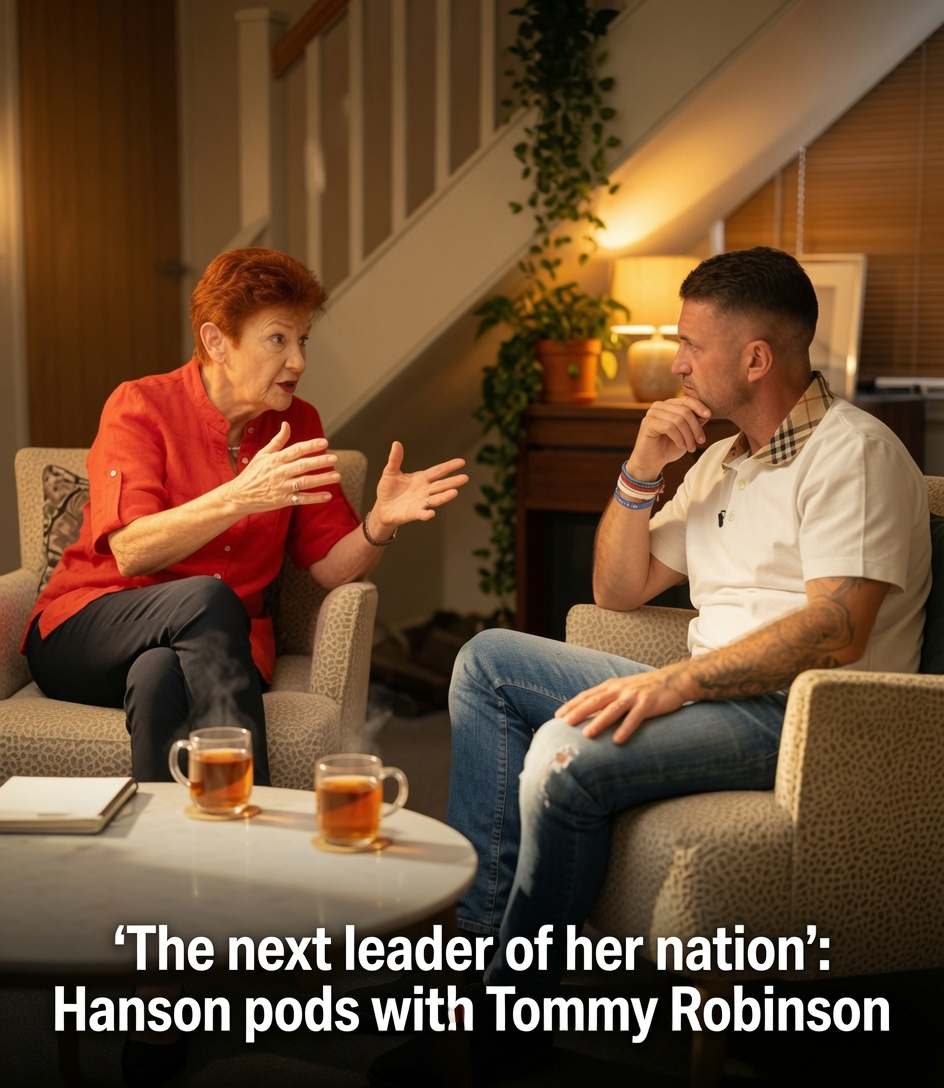
The interview has attracted significant attention because it comes only a fortnight after broadcaster Karl Stefanovic became embroiled in controversy following his own interview with Robinson, an episode that generated widespread discussion across Australian media and politics.
Robinson, whose real name is Stephen Yaxley-Lennon, has long been one of Britain’s most controversial political activists. He has built a substantial online following through campaigns focused on immigration, multiculturalism and crime, while also attracting repeated criticism from political leaders, anti-racism organisations and civil liberties groups over his rhetoric and public campaigning.
During Hanson’s visit, Robinson praised the Australian senator, reportedly describing her as one of the “bravest ladies on the planet” and suggesting she possessed the qualities required to lead Australia.
The comments quickly circulated online, adding further attention to an interview that was already likely to provoke strong reactions because of Robinson’s polarising public profile.
Hanson has never shied away from controversial political conversations. Throughout her parliamentary career she has consistently argued that politicians should be willing to engage with people holding different or unpopular views rather than avoiding difficult discussions altogether.
Her decision to sit down with Robinson is therefore consistent with an approach that has characterised much of her political career, particularly on issues relating to immigration, national identity, freedom of speech and border security.
Supporters of Hanson argue that conducting interviews with contentious figures should not automatically be interpreted as endorsing every opinion expressed by those guests. Instead, they contend that open discussion allows audiences to hear arguments directly and reach their own conclusions.
Critics take a different view.
Many argue that providing a platform to highly controversial personalities risks amplifying extremist viewpoints, regardless of whether the interviewer explicitly agrees with those opinions. That debate has become increasingly prominent as podcasts and independent online media have grown in influence, allowing political figures to reach audiences outside traditional broadcasting environments.
Hanson’s latest interview arrives against the backdrop of continuing discussion about freedom of expression and the responsibilities of public figures when selecting guests for interviews or public appearances.
Unlike conventional broadcast television, podcast platforms generally offer longer conversations with fewer editorial constraints, enabling guests to explain their positions in greater depth while also giving interviewers greater flexibility in the subjects they choose to explore.
That format has become increasingly popular among politicians seeking to communicate directly with supporters without the time limitations typically imposed by television or radio interviews.
For Hanson, podcasting has become an important extension of her political communication strategy.
She has regularly used long-form interviews to discuss issues ranging from immigration and economic policy to energy security, cost-of-living pressures and Australia’s international relationships.
Her visit to Britain also reflects growing cooperation between conservative political movements in several Western democracies.
International conferences held in London frequently attract politicians, academics, journalists and campaigners representing a wide range of centre-right and conservative viewpoints. These events provide opportunities for networking, policy discussions and exchanges of ideas on issues including national sovereignty, economic reform, migration, free speech and cultural identity.
Hanson has attended similar international events previously, arguing that Australia can benefit from understanding political developments occurring in comparable democratic nations.
Her supporters believe such visits strengthen relationships with like-minded policymakers overseas and expose Australian audiences to debates taking place beyond the domestic political landscape.
Opponents, however, argue that associations with figures such as Robinson risk distracting from substantive policy discussions and may create unnecessary political controversy.
The latest podcast recording illustrates how quickly those competing perspectives can collide in today’s highly interconnected media environment.
Social media platforms have accelerated the speed with which interviews, speeches and political commentary circulate internationally, often generating immediate reactions well before audiences have viewed the full conversation.
That dynamic has made guest selection almost as newsworthy as the content of many political interviews themselves.
For Hanson, the decision to interview Robinson is likely to reinforce her reputation among supporters as a politician willing to engage with controversial issues regardless of public criticism.
For her detractors, however, it is expected to raise renewed questions about the boundaries between open political dialogue and providing legitimacy to highly divisive public figures.
The reaction to Hanson’s podcast reflects a much broader discussion taking place across democratic societies about the balance between free expression, political engagement and the responsibility of public figures.
In recent years, podcasts have become one of the fastest-growing sources of political commentary. Unlike traditional television interviews, which are typically limited by strict time constraints and editorial formatting, podcasts often allow conversations to continue for an hour or more, giving guests greater opportunity to explain their positions in detail.
Supporters of the format argue that this encourages deeper discussion and reduces the likelihood that complex issues will be reduced to short sound bites. Critics counter that the absence of rigorous editorial oversight can also allow controversial claims to circulate with less scrutiny than would normally occur in mainstream broadcast media.
Those competing views have become increasingly relevant as politicians across the political spectrum embrace podcasts as an important way of communicating directly with voters.
For Hanson, whose political career has often been shaped by direct engagement with supporters rather than reliance on traditional media outlets, long-form interviews have become an effective platform for discussing issues that remain central to One Nation’s agenda.
Migration, national security, freedom of speech, cost-of-living pressures and government accountability continue to feature prominently in her public appearances, both in Australia and overseas.
The decision to interview Robinson therefore aligns with her broader strategy of engaging with international conservative figures whose views resonate with sections of her political base.
At the same time, the association is almost certain to attract criticism from political opponents, who argue that elected representatives should exercise caution when appearing alongside individuals whose public statements have generated significant controversy.
Robinson has remained one of Britain’s most polarising public figures for more than a decade. Throughout that period, he has faced legal proceedings, public criticism and repeated accusations that his activism fuels social division. He has consistently rejected those characterisations, maintaining that his campaigns are directed at issues of public safety, immigration policy and freedom of expression.
His supporters regard him as a campaigner prepared to raise subjects that they believe mainstream political institutions and media organisations avoid. His critics argue that his rhetoric has contributed to hostility towards minority communities and has deepened political polarisation.
Those sharply contrasting perceptions explain why interviews involving Robinson frequently become news stories in their own right, irrespective of what is actually discussed during the conversation.
Hanson’s appearance with Robinson also comes at a time when One Nation continues to position itself as a party challenging what it describes as the political establishment. Since entering federal politics nearly three decades ago, Hanson has consistently argued that mainstream parties have become disconnected from the concerns of ordinary Australians, particularly on immigration, national identity and regional economic issues.
Her supporters view that willingness to engage with controversial personalities as evidence of political independence. Critics argue it risks legitimising figures whose views remain well outside the political mainstream.
The differing reactions illustrate how political communication has evolved in the digital era. Increasingly, interviews are judged not only on their content but also on the identities of those involved, with social media amplifying debate long before audiences have had the opportunity to hear an entire conversation.
For Hanson, that environment is familiar. Few Australian politicians have generated as much sustained public debate over such a long period, and she has repeatedly demonstrated a willingness to enter politically contentious discussions despite anticipating criticism.
Whether the latest podcast ultimately strengthens or damages her political standing will largely depend on how audiences interpret the interview once it is released. Supporters are likely to see it as an example of open political discussion that should not be discouraged simply because a guest holds controversial views. Opponents are expected to argue that public figures carry a responsibility to consider the broader consequences of providing high-profile platforms to divisive activists.
Regardless of those differing perspectives, the interview has already succeeded in attracting considerable attention both in Australia and the United Kingdom. It also highlights the increasingly international nature of political debate, with online media allowing conversations recorded in one country to influence public discussion on the other side of the world within hours.
As podcasting continues to reshape political communication, episodes involving prominent and controversial personalities are likely to remain a recurring source of debate. Hanson’s latest recording with Tommy Robinson demonstrates how rapidly questions surrounding free speech, political engagement and media responsibility can intersect, ensuring that the discussion extends well beyond the interview itself.






