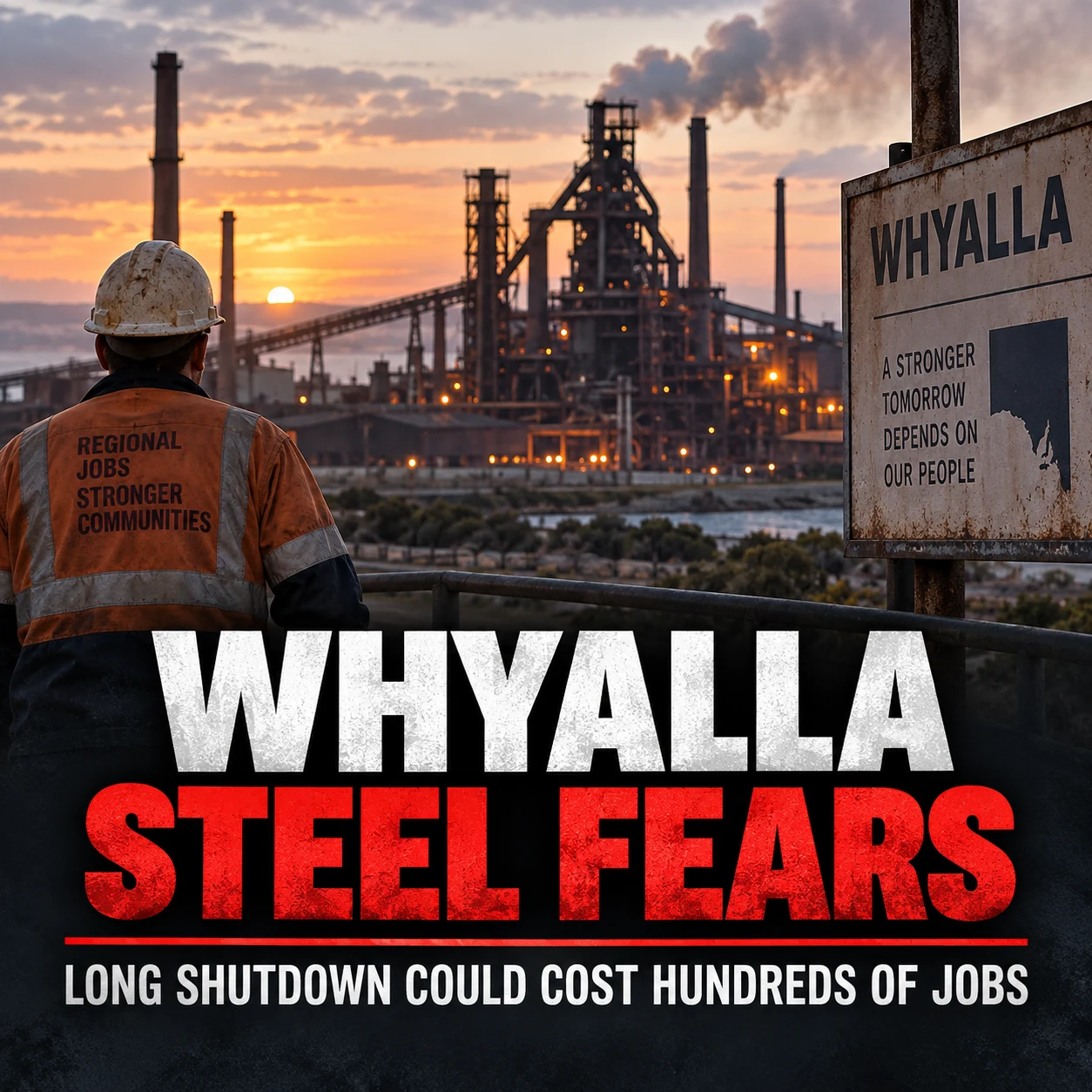
Whyalla could face a steelmaking gap of between two and four years after the closure of its ageing blast furnace, with hundreds of workers already losing their jobs and uncertainty hanging over contractors tied to the steelworks.
Administrators KordaMentha confirmed this week that efforts to restart the 60-year-old blast furnace had failed and that the furnace would not return to operation.
About 500 direct workers and 100 labour-hire workers are set to lose their jobs. The position of roughly 200 embedded contractors employed by outside companies remains uncertain, meaning the number of people affected could rise toward 800.
South Australian Premier Peter Malinauskas has cautioned against treating the higher figure as final because some contractors may have work elsewhere, but the scale of the disruption is already significant for a regional city where the steelworks is the largest employer.
ABC News reported that industry experts believe it could take two to four years before steelmaking resumes at Whyalla, depending on the sale process, new investment and the construction or commissioning of replacement iron-making infrastructure.
The shutdown marks the end of the existing blast furnace rather than the end of industrial activity at the site. Mining, port operations and other parts of the business are continuing, and the state and federal governments say they remain committed to maintaining sovereign steelmaking capability in Whyalla over the longer term.
The immediate challenge, however, is jobs.
The Australian and South Australian governments have announced a joint $10 million support package for affected workers, their families and the wider Whyalla community. A dedicated Worker Transition Centre has been established at the TAFE SA Whyalla campus to provide career advice, job-search assistance, training, financial information and wellbeing support.
The governments say affected employees will be supported to move into new work and build skills while the steelworks transitions to new ownership.
The shutdown follows years of operational and financial instability. The previous owner was placed into administration, and governments stepped in with funding to stabilise the site, maintain operations and support a sale process.
Federal Industry Minister Tim Ayres and South Australian ministers said the blast furnace had reached the end of its life after years of inadequate investment. Workers and technical teams had spent months trying to restore it, but administrators ultimately concluded the unit could not be brought back safely and reliably.
That decision changes the timetable for Whyalla’s future. Instead of keeping the old furnace alive while a new owner prepares a transformation, the region now faces a period in which iron and steelmaking at the site may be interrupted altogether.
Two bidders remain shortlisted in the formal sale process, while another party retains a right of last offer. The Commonwealth and South Australian governments have previously committed up to $1.9 billion to invest alongside a new owner in a modernised, lower-emissions steelworks.
That package includes up to $500 million from the federal Green Iron Investment Fund, alongside other Commonwealth and state support. The goal is not simply to rebuild the old operation, but to create a modern facility capable of producing lower-emissions iron and steel while preserving a strategic domestic manufacturing capability.
Whyalla steel is important beyond the city itself. The facility has supplied products used in Australian railways, bridges, buildings and other infrastructure. Governments have repeatedly described the steelworks as a sovereign capability because domestic steel production reduces dependence on overseas supply for critical construction and industrial needs.
But long-term strategy does not remove the short-term economic shock.
A large industrial employer supports much more than its direct workforce. Local contractors, transport operators, maintenance businesses, shops, landlords and service providers can all feel the effect when hundreds of pay packets disappear or become uncertain at the same time.
That multiplier effect is why the future of the 200 embedded contractors matters. Even if not all lose their jobs, a prolonged reduction in activity at the steelworks can weaken demand across the local economy.
The two-to-four-year estimate for a return to steelmaking also means Whyalla may have to manage a long transition rather than a short shutdown. Keeping skilled workers in the region becomes harder when people cannot see a clear date for industrial operations to resume.
Governments will therefore face pressure to connect displaced workers with infrastructure, mining, energy and construction projects while ensuring enough specialist skills remain available for the future steelworks.
The sale process is now central. A buyer will need to commit substantial capital, agree on the transformation plan with governments and make decisions about the technology used to replace the old blast furnace.
Officials remain publicly optimistic that steelmaking has a future in Whyalla. The federal and state governments say they are focused on securing a new owner committed to long-term Australian steel production, and the financial support already announced is intended to make that investment possible.
The scale of the workforce change is clearer when set against the steelworks’ existing employment base. Administrators said the direct workforce would fall from about 1,700 to around 1,200 after the 500 redundancies, while another 100 labour-hire positions would go. The uncertain position of roughly 200 embedded contractors means the immediate employment shock could extend well beyond the formally announced direct redundancies.
Premier Peter Malinauskas has urged caution around describing all 200 contractor roles as lost because some external firms may redeploy their workers to other projects. That is why the confirmed number is at least 600 affected direct and labour-hire workers, with the contractor impact still to be determined.
The blast furnace itself had been offline since April. Workers spent months trying to restart the 60-year-old unit, but KordaMentha ultimately concluded the recovery was no longer feasible and that continuing the attempt created unacceptable safety risks. Three employees were treated for injuries during restart work in July, adding urgency to questions about whether the old furnace could be safely brought back.
The decision also has a financial cost beyond wages. The South Australian government has estimated redundancy costs at roughly $60 million to $80 million. Those payments are important for workers leaving the business, but they also underline how expensive the transition has become before any new steelmaking technology is built.
The federal and state governments say the long-term plan remains a modern, lower-emissions steelworks rather than a retreat from steelmaking. Two bidders have been shortlisted in the administrator-led sale process, while another party retains a right of last offer. The governments have committed up to $1.9 billion to invest alongside a new owner in the transformation of the site.
That commitment sits inside a broader $2.4 billion Whyalla support package announced in 2025, which included money to stabilise the business during administration as well as future investment. The Commonwealth has also set aside up to $500 million from the Green Iron Investment Fund for the Whyalla transformation.
Those figures explain why the sale process is more than a normal corporate transaction. Any buyer is effectively entering a partnership with governments that want the site to keep making steel, preserve a pit-to-port industrial chain and transition toward newer technology. The public funding is intended to make that transformation commercially possible while protecting a capability governments describe as strategically important.
Whyalla’s importance to Australian manufacturing is substantial. Government material has described the steelworks as one of only two integrated steelmaking sites in the country, the only domestic producer of long steel products and a major supplier of structural steel used in rail, bridges, buildings, transmission infrastructure and other projects.
That strategic role is why a two-to-four-year gap matters nationally as well as locally. Australia can import steel, but relying more heavily on overseas supply can expose infrastructure projects to international price swings, shipping disruption and foreign production constraints. Maintaining domestic capability is partly an economic question and partly a resilience question.
The technology chosen by a new owner will shape the timetable. Replacing the old coal-fired blast furnace with modern iron-making and electric steelmaking equipment is a major engineering project. It requires design work, approvals, procurement, construction, commissioning and a reliable supply of energy and raw materials. Even with government backing, those stages cannot be compressed into a few months.
That is why industry experts are warning that steelmaking may not resume quickly. A new owner could keep mining, port and other activities operating while the replacement facility is developed, but the town may still experience a prolonged period without the scale of steelmaking activity that historically supported its workforce and local businesses.
For workers, the central challenge is whether they can find suitable employment without leaving Whyalla permanently. The federal and state governments have opened a Worker Transition Centre at the TAFE SA Whyalla campus and announced a joint $10 million support package covering career advice, job-search assistance, training, financial information and wellbeing services.
Those services can soften the shock, but they cannot by themselves replace hundreds of industrial jobs. If a future steelworks needs many of the same trades and technical skills, governments and a new owner will also have to think about how to retain or eventually bring back workers who may spend several years employed elsewhere.
That workforce question is especially important in specialist areas. Steelmaking depends on experienced operators, electricians, fitters, engineers, maintenance crews and contractors who understand the site. If too many leave the region during the gap, rebuilding physical infrastructure could prove easier than rebuilding the workforce needed to operate it.
For local businesses, the next several months may be as important as the long-term sale. A reduction in household income can affect retail spending, housing demand and service businesses well before a new owner makes investment decisions. Contractor firms may also need to find alternative work quickly if steelworks activity falls.
Whyalla has lived with uncertainty around the steelworks for years, but the latest decision is different because the old blast furnace is now finished. The debate is no longer about whether another repair can extend its life. The transition to a replacement system has become unavoidable.
For workers and residents, the question is therefore no longer whether the old blast furnace can be saved. It cannot. The question is how quickly a new steelmaking future can be built, whether the sale process can deliver a credible owner and investment plan, and how much of Whyalla’s workforce and industrial base can be protected during what could be several difficult years in between.