People sometimes joke that Melbourne is Greece’s second-biggest city.
The numbers are more complicated than the joke, and Athens and Thessaloniki can safely keep their official rankings.
But the basic point behind it is not nearly as ridiculous as it sounds.
Melbourne became home to one of the great Greek diaspora communities in the world.
Walk through parts of the city and that history is still visible in the churches, social clubs, football grounds, cake shops, family businesses and Greek signs that survived long after the first generation of postwar migrants unpacked their suitcases.
Greek is still one of the major languages spoken in Victorian homes.
Thousands of Melbourne residents were born in Greece, while many more identify with Greek ancestry through parents, grandparents and generations of family history built in Australia.
Victoria’s own government describes the Greek community as one of the largest outside Greece.
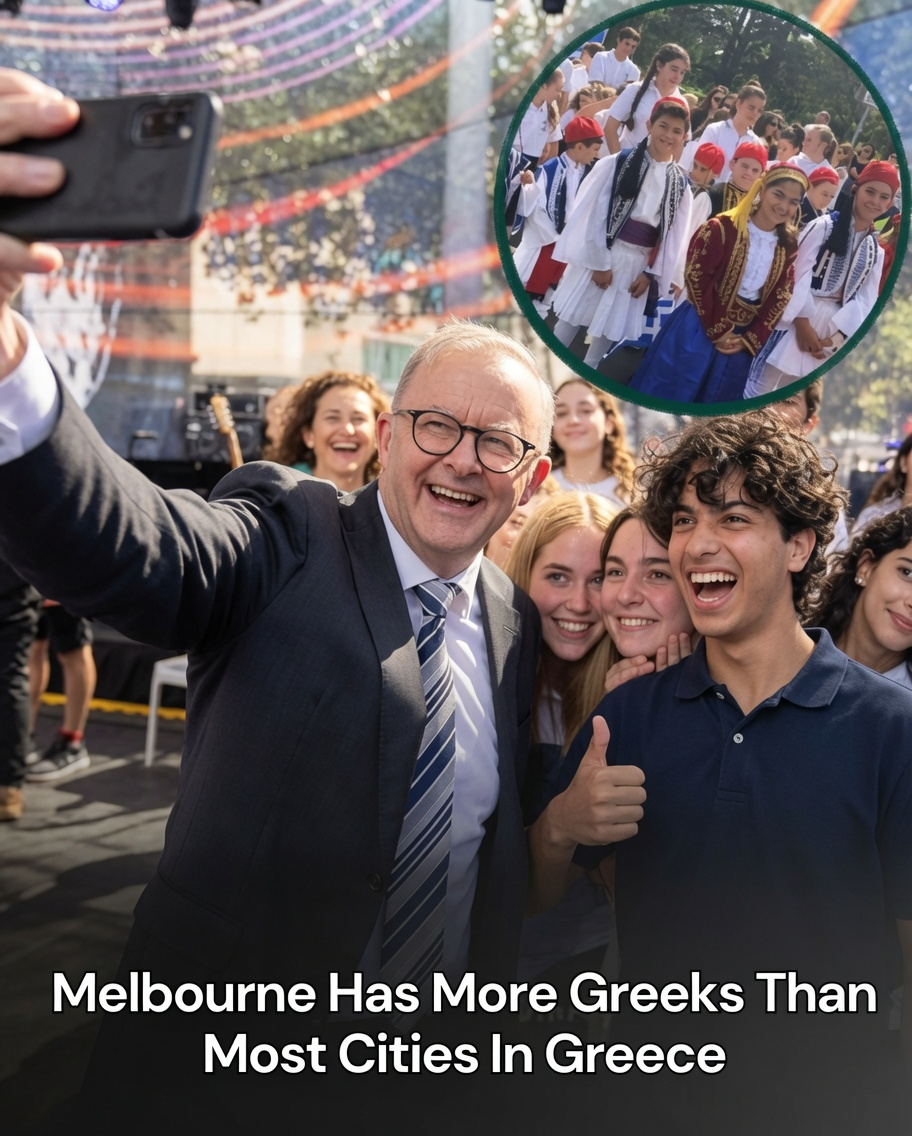
That did not happen because Melbourne was chosen at random by a few adventurous families.
It happened because two countries emerged from the Second World War facing very different problems.
Greece had been devastated.
Australia wanted people.
And once the first great postwar migration networks connected Greek villages to Melbourne suburbs, one relative followed another until a city on the opposite side of the world became unmistakably Greek.
The story started long before the great postwar migration
Greeks were arriving in Victoria well before the 1950s.
The state’s official community history traces the first wave of Greece-born migrants to the period between the 1840s and 1900.
Many came from the Ionian Islands.
Gold helped draw early migrants to Victoria, but those who stayed often moved into urban life and established themselves as shopkeepers, fishmongers and cafe owners.
By modern standards, the numbers were small.
Historical accounts estimate that only about 200 Greeks settled in Victoria between the 1840s and 1900.
But migration is rarely just a story about the first person who arrives.
It is also a story about the letter that person sends home.
The brother who hears there is work.
The cousin who is told a room can be found.
The friend who knows somebody who owns a shop.
Those early settlers began creating the human connections that later migration could follow.
Melbourne’s Greek Orthodox Community was established in 1897, giving the growing population an institution around which religious, cultural and community life could organise.
Before the giant postwar migration wave had even begun, the foundations of Greek Melbourne already existed.
Then Europe was torn apart.
Greece emerged from war into another period of violence and hardship
The Second World War was catastrophic for Greece.
The country was invaded by Axis forces in 1941 and endured occupation, hunger, destruction and mass death.
When occupation ended, peace did not simply return.
Political conflict intensified into the Greek Civil War, which continued until 1949.
For ordinary families, the consequences were immense.
Homes and communities had been damaged.
Economic opportunities were limited.
Rural areas struggled.
Families who had survived years of war and political violence faced the difficult task of building a future in a country still recovering.
Migration became an option.
For many, it became the option.
At almost exactly the same historical moment, Australia was looking at its own future and reaching a very different conclusion.
The country believed it needed a much larger population.
The phrase associated with the era was blunt: “populate or perish”.
Postwar Australia wanted workers.
It wanted people for factories, construction, infrastructure and a rapidly expanding economy.
The Commonwealth embarked on a vast immigration program that transformed the country.
Europe contained millions of people displaced by war or searching for economic opportunity.
Australia needed labour and population growth.
The two forces met.
Ships began carrying new Australians towards a country many passengers knew mostly through photographs, government information and the stories of people who had gone before them.
Among them were tens of thousands of Greeks.
The 1950s and 1960s changed Melbourne forever
The peak period of postwar Greek migration to Australia came during the 1950s and 1960s.
Research highlighted by the Greek Community of Melbourne notes that about half of the Greek migrants arriving in Australia during the peak postwar period settled in Victoria.
The state’s official community profile similarly identifies the 1950s, 1960s and early 1970s as the period when much of Victoria’s Greece-born population arrived.
Behind those neat historical dates were individual departures that were anything but neat.
Young men and women left villages where generations of their families had lived.
Some travelled alone.
Some came as married couples.
Some left parents behind believing the separation would last only a few years.
Many spoke little English.
The journey to Australia could take weeks by sea.
Melbourne was not a neighbouring European city where a migrant could easily return home for a holiday.
It was almost unimaginably far away.
For families without money for frequent international travel, migration could mean years before relatives saw one another again.
Some never did.
That distance helps explain the intensity with which migrant communities built new institutions in Australia.
A church was not simply somewhere to attend a religious service.
A social club was not merely somewhere to have a drink.
A Greek newspaper was not just another publication.
These things connected migrants to a language, a village, a family network and a world they had physically left behind.
In Melbourne, those networks became extraordinarily strong.
One family arrived, then another followed
Migration researchers often use the term “chain migration”.
It sounds bureaucratic.
The human reality was much simpler.
People preferred to move somewhere they knew somebody.
If a Greek migrant found work in Melbourne, secured accommodation and established a life, relatives and friends back home suddenly had a contact in Australia.
They had somebody who could explain the city.
Somebody who might help find a job.
Somebody who knew where Greek was spoken.
Somebody who could meet a new arrival.
Migration stopped being a leap into complete darkness.
The pattern repeated.
Family followed family.
Friends followed friends.
People from particular regions and villages in Greece often reconnected in Australia.
Melbourne’s Greek population grew not as a random collection of individuals but through dense networks of relationships.
Those relationships helped shape the geography of the city.
Greek communities became strongly associated with suburbs including Brunswick, Preston, South Melbourne and, later, Oakleigh and other parts of Melbourne’s south-east.
The exact centres of community life shifted as families became more prosperous and subsequent generations moved through the suburbs.
But the cultural footprint remained.
Businesses opened because there were customers who wanted familiar food and services.
Churches expanded because congregations existed.
Football clubs became gathering points.
Greek-language media connected households.
Community organisations preserved links with villages, islands and regions thousands of kilometres away.
A migrant arriving alone could gradually become part of a city within the city.
Greek Melbourne was built at work as much as it was built at home
The romantic version of migration history focuses on food, festivals and family celebrations.
The working life of the first postwar generation was often much harder.
Many migrants entered industrial and manual jobs.
They worked in factories, manufacturing, construction and other parts of the expanding postwar economy.
Others opened small businesses.
The Australian cafe, milk bar and fish-and-chip shop became deeply connected with Greek migrant entrepreneurship in many towns and cities.
Running a family business offered opportunity, but it also demanded extraordinary hours.
Parents worked while children helped.
Families saved.
Property was purchased.
Education became a priority for the next generation.
This pattern became familiar across postwar migrant Australia.
The first generation often accepted physically demanding work and long hours while measuring success partly through what their children would be able to do.
The child of a factory worker became a teacher.
The daughter of shopkeepers became a lawyer.
The son who translated official letters for his parents eventually entered business or public life.
Greek Australians became part of medicine, law, sport, politics, education, media and almost every other part of Australian society.
The community did not remain frozen in the 1950s.
That is one of the reasons Melbourne’s Greek identity survived.
It adapted.
The remarkable thing is how much survived into the next generations
Migration stories often contain a fear that culture will disappear.
The first generation speaks the language.
The second generation understands it but replies in English.
The third generation knows a handful of words and a collection of family recipes.
There are elements of that story in Greek Australia.
The Greece-born population is ageing.
Many of the migrants who arrived during the great postwar wave are now elderly or have died.
The number of people in Greater Melbourne who were actually born in Greece is far smaller than the wider population identifying with Greek ancestry.
According to the 2021 Census, 44,956 Greece-born people lived in Greater Melbourne.
But birth country tells only one part of the story.
Greek identity continued through Australian-born children and grandchildren.
In Greater Melbourne, more than 100,000 people nominated Greek ancestry in the 2021 Census data.
Across Victoria, more than 107,000 people were recorded as using Greek at home.
Greek remained one of the most commonly used languages other than English in the state.
Those figures help explain why Greek Melbourne still feels like a living community rather than a museum of postwar migration.
The language is still heard.
The churches still operate.
Greek community organisations still hold events.
Newspapers and media continue to serve Greek Australian audiences.
Greek football clubs remain embedded in Melbourne’s sporting history.
And food has become perhaps the most visible bridge between the community and the wider city.
In suburbs such as Oakleigh, Greek cafes, bakeries and restaurants are not historical exhibits.
They are busy businesses.
Families who arrived generations ago sit alongside newer migrants, tourists and Australians with no Greek ancestry at all.
The culture moved beyond the community without completely leaving it.
Melbourne’s connection with Greece became part of the city’s identity
The relationship became significant enough for Melbourne and Thessaloniki to establish sister-city ties.
That connection makes historical sense.
Thessaloniki is Greece’s second-largest city and one of its major cultural centres.
Melbourne, meanwhile, became one of the world’s most important centres of Greek life outside the Greek state.
Victorian governments have repeatedly celebrated the scale of the community.
During events marking 200 years of Greek independence in 2021, the Victorian Government described Melbourne as home to the world’s largest Greek population outside Greece itself and said almost 200,000 people of Greek ancestry called Victoria home.
The exact population figure changes depending on geography, Census year and whether a count measures ancestry, country of birth or language.
That is why claims such as “Melbourne is the second-biggest Greek city” should be understood as a popular expression rather than a literal demographic ranking.
Athens is in a category of its own.
Thessaloniki remains much larger than Melbourne’s Greek-ancestry population.
Other cities in Greece also complicate simplistic comparisons.
But correcting the joke should not obscure the extraordinary fact behind it.
A city approximately 15,000 kilometres from Athens developed a Greek community so large and culturally visible that governments, community organisations and generations of residents routinely describe Melbourne as one of the great Greek cities of the diaspora.
That is remarkable.
The story of Greek Melbourne is really the story of postwar Australia
There is a temptation to tell migrant history as a series of separate community stories.
The Greeks arrived.
The Italians arrived.
Other European communities arrived.
Later came refugees and migrants from Asia, the Middle East, Africa and across the world.
But these stories collectively explain how modern Australia was built.
Postwar migration changed the country’s population, economy, suburbs and understanding of itself.
Australia did not always make that transition gracefully.
Migrants experienced prejudice.
People were mocked for their accents, food and names.
Children sometimes felt pressure to become more Australian at school and more Greek at home.
The country was also dismantling the White Australia policy across the same broad historical era in which its population was becoming more culturally diverse.
Multicultural Australia was not created by a single government speech.
It was created slowly and often awkwardly in factories, schools, churches, sporting clubs and suburban streets.
Greek Melbourne is one of the clearest examples.
The first postwar migrants did not arrive knowing that their grandchildren would one day grow up in a city famous internationally for its Greek community.
They were trying to find work.
They were trying to build homes.
They were trying to send money to relatives.
They were trying to learn English while keeping enough Greek alive for their children to understand their grandparents.
History was built out of those ordinary decisions.
A Weet-Bix-simple fact hides generations of sacrifice
Today it is easy to turn Melbourne’s Greek identity into a fun fact.
“Did you know Melbourne is one of the most Greek cities outside Greece?”
It works because the distance makes the story sound impossible.
Greece is in the Mediterranean.
Melbourne is on the edge of south-eastern Australia.
Yet a person can stand in a Melbourne suburb, hear Greek spoken at the next table, buy traditional pastries, pass a Greek Orthodox church and watch a football club whose history reaches back into migrant community life.
None of that appeared overnight.
Behind the statistic were ships carrying people away from Europe after war.
There were parents left behind.
There were letters home.
There were migrants learning factory routines and English words at the same time.
There were families squeezing into houses while saving for something better.
There were community halls, churches and newspapers built because people were frightened of losing the world they had left.
Then there were children.
And grandchildren.
Eventually, Melbourne stopped being merely the place Greek migrants had moved to.
For generations of Greek Australians, it became home.
That is why the old joke survives.
Melbourne is not literally Greece’s second-biggest city.
It does not need to be.
The real story is better.
Thousands of kilometres from the Aegean, generations of migrants built one of the largest and most enduring Greek communities outside Greece.
They changed Melbourne in the process.
And more than half a century after the great postwar migration wave, you can still see, hear and taste the city they helped create.






