Political commentator Peter van Onselen has questioned whether Prime Minister Anthony Albanese’s government will ultimately be remembered alongside the great reforming Labor administrations of Australia’s past, arguing that ambitious slogans and short-term spending measures cannot substitute for transformational national reform.
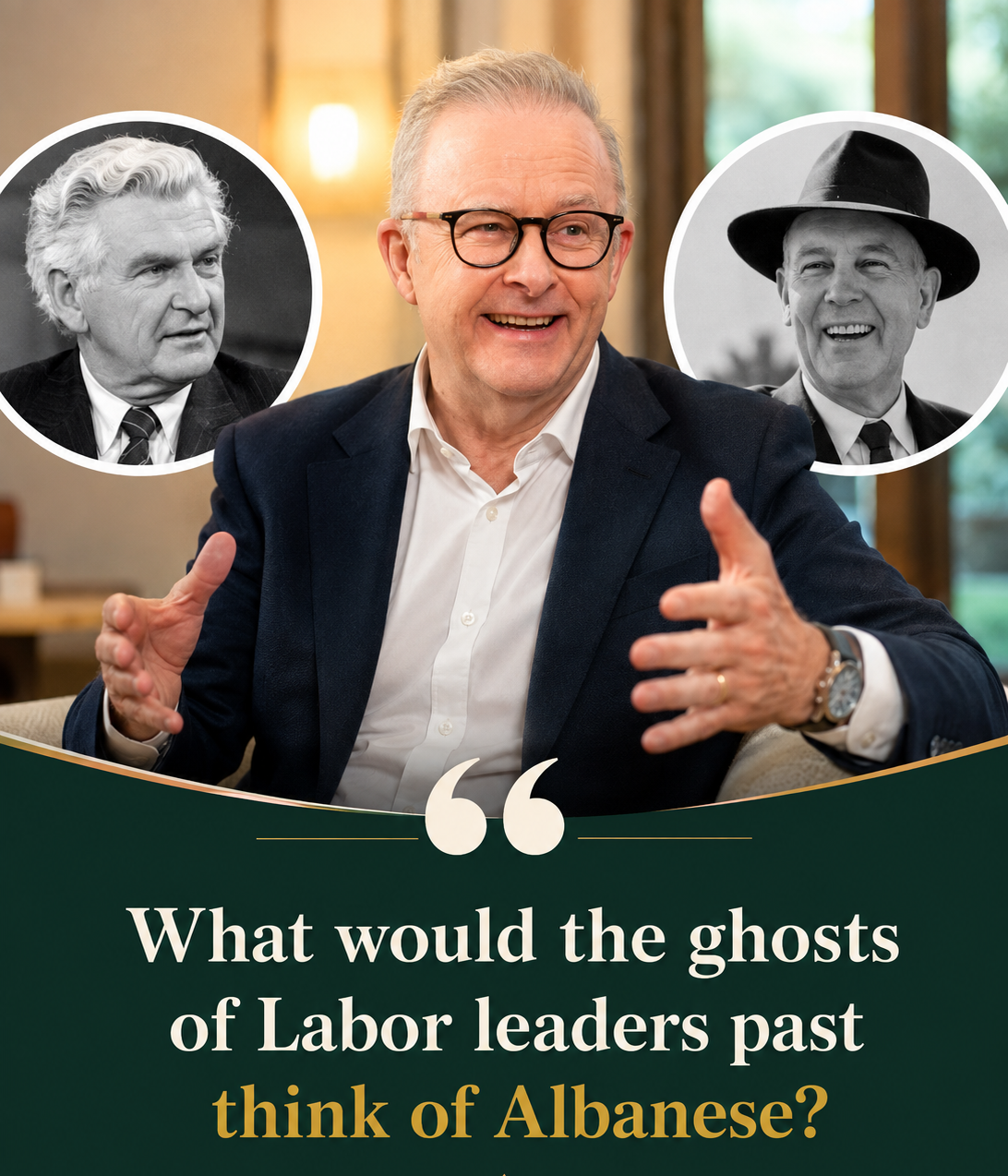
In an opinion column, van Onselen imagines how some of Labor’s most influential former leaders—including Ben Chifley, Gough Whitlam, Bob Hawke and Paul Keating—might assess the Albanese government’s record after more than four years in office.
His central argument is that earlier Labor governments fundamentally reshaped Australia’s economy and society through landmark reforms, while the current administration has yet to produce changes of comparable historical significance.
Van Onselen begins with Ben Chifley, widely remembered for overseeing Australia’s post-war reconstruction.
Chifley’s government launched the Snowy Mountains Hydro-Electric Scheme, pursued policies aimed at maintaining full employment and expanded Australia’s social welfare system during a period of significant economic transition.
According to the columnist, those achievements reflected a willingness to pursue nation-building projects whose impact extended well beyond a single parliamentary term.
The opinion piece then turns to Gough Whitlam, acknowledging that his government experienced severe economic difficulties but arguing it nevertheless introduced reforms that permanently altered Australian society.
Among those reforms were the expansion of universal health care, closer diplomatic engagement with China, greater investment in regional Australia and major changes across education and social policy.
Van Onselen argues that Whitlam’s legacy demonstrates how governments can leave a lasting mark despite political controversy and electoral defeat.
The strongest praise is reserved for Bob Hawke and Paul Keating.
The columnist describes their governments as responsible for some of the most significant economic reforms in modern Australian history, including floating the Australian dollar, deregulating the financial sector, reducing tariffs, introducing compulsory superannuation and opening Australia’s economy to greater international competition.
Those reforms, he argues, fundamentally reshaped Australia’s long-term economic performance and remain central to Labor’s modern reputation for economic management.
Against that historical backdrop, van Onselen contends the Albanese government has struggled to establish a similarly enduring reform legacy.
He argues that many of Labor’s signature initiatives have relied heavily on government spending, subsidies and political messaging rather than structural reform capable of permanently lifting productivity or economic growth.
The opinion piece cites initiatives such as the Future Made in Australia agenda and the Homes for Australia housing program as examples where large financial commitments have not yet produced outcomes matching their stated ambitions.
Housing policy features prominently in the critique.
Van Onselen argues that despite billions of dollars committed to increasing housing supply, approvals and construction activity remain below the pace required to meet Labor’s target of delivering 1.2 million new homes by 2029.
He suggests this gap between ambition and delivery illustrates a broader pattern of announcing major programs whose implementation has proven more difficult than anticipated.
The opinion article also criticises the government’s broader economic management.
It points to continued concerns over productivity, rising public expenditure, growing government debt and persistent cost-of-living pressures.
Van Onselen argues that these factors have weakened Labor’s claim to be following the economic reform tradition established by Hawke and Keating.
Climate and industry policy also receive attention.
The columnist questions Labor’s reliance on subsidies and market interventions to accelerate the transition to renewable energy, suggesting the approach places increasing pressure on taxpayers while leaving uncertainty about whether Australia’s 2030 emissions targets will ultimately be achieved.
He similarly argues that industrial relations reforms and expanding public sector expenditure may place further pressure on productivity over time.
The Albanese government rejects such assessments.
Labor maintains that its economic strategy has been designed to reduce inflation without triggering recession, rebuild real wages, support manufacturing, accelerate the clean energy transition and improve housing affordability while strengthening long-term economic resilience.
Ministers argue many of Australia’s structural challenges—including housing shortages, ageing infrastructure and weak productivity growth—developed over decades and require sustained policy responses rather than immediate results.
The government has also pointed to tax relief, investments in skills, renewable energy, infrastructure and social services as evidence of an active reform agenda.
Supporters argue those initiatives should be judged over the longer term rather than solely by short-term economic indicators.
Political analysts note that comparisons between governments from different eras are inherently difficult.
The Hawke and Keating governments operated during a period characterised by widespread economic deregulation, while contemporary governments face different challenges including population ageing, digital transformation, geopolitical competition, climate policy and housing affordability.
As a result, some observers argue that modern reforms may look very different from those undertaken during the 1980s and early 1990s.
Others nevertheless contend that lasting political legacies continue to depend on delivering reforms that produce measurable improvements in national productivity, living standards and economic competitiveness.
That broader debate sits at the centre of van Onselen’s commentary.
Rather than questioning Labor’s political longevity, the opinion piece asks whether the Albanese government will ultimately be remembered as a reforming administration or one that relied primarily on slogans, targeted spending programs and incremental policy adjustments.
The answer, the columnist suggests, will ultimately depend less on election victories than on whether future Australians identify reforms from the Albanese era that continue shaping the nation decades from now.






