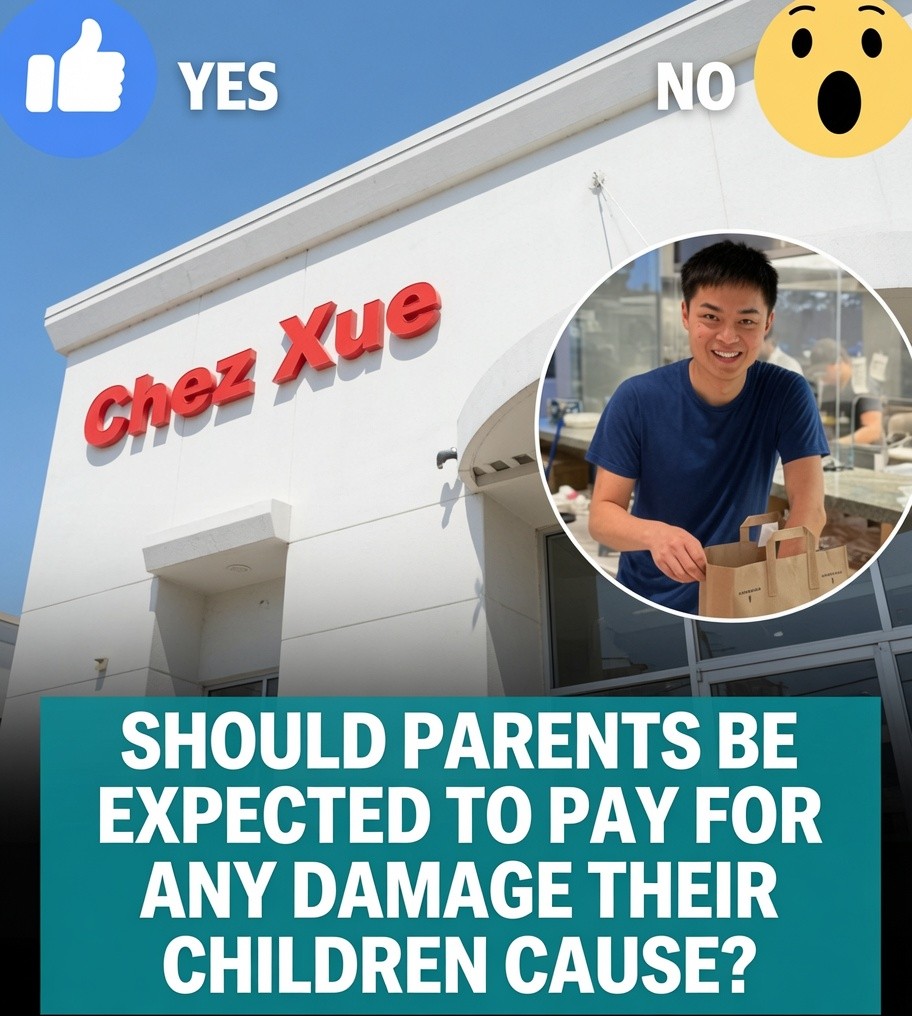
A restaurant’s blunt warning to parents has exploded into a global debate about children in public after one family was charged the equivalent of about $470 when their child smashed a payment machine.
The message from California Chinese restaurant Chez Xue is impossible to misunderstand.
“Please control your children.”
The family-friendly venue tells diners that its restaurant is “not a playground” and warns that children should remain seated and show respect to other guests and the dining environment.
Running around, shouting and making excessive noise with utensils will not be tolerated.
Guests who refuse to respect the policy may be asked to leave.
And if a child damages restaurant property, the business says the parents will be held financially responsible.
That final part has already proved expensive for several families.
In the most dramatic example disclosed by the restaurant, one family was charged US$327.03 after a child picked up a standalone credit card machine, dropped it on the floor and shattered its screen.
For Australian readers, the amount was reported at roughly A$470.
Another family was charged US$109.38 after a child carved into a custom tabletop with a utensil.
A third parent paid US$5.47 for a broken teacup.
The restaurant’s policy has since gone viral, attracting more than a million views and triggering the kind of online argument that quickly divides parents, hospitality workers and diners into opposing camps.
Some critics have described the approach as excessive and questioned whether restaurants should simply accept occasional breakages as part of serving families.
Others have been far less sympathetic.
Their argument is simple: if your child destroys somebody else’s property, you pay for it.
But the restaurant owner says the internet has misunderstood one crucial point.
He insists this is not a system of fines for children being children.
It is a demand for basic respect — and compensation when parents allow reckless behaviour to cause actual damage.
The policy begins with four words: ‘Please control your children’
Chez Xue is an upscale Chinese restaurant in Foster City, part of California’s San Francisco Bay Area.
Its owner, You You Xue, did not introduce the rule as an adults-only policy.
Children remain welcome.
The restaurant explicitly describes itself as family-friendly.
What Xue no longer accepts is the idea that “family-friendly” means staff and other diners must tolerate uncontrolled behaviour.
The notice asks parents to ensure their children remain seated and respectful.
It specifically identifies running around, shouting and making noise with utensils as behaviour that will not be tolerated.
The restaurant reserves the right to ask guests to leave.
It also states that parents will be financially liable for damage their children cause to restaurant property.
According to Xue, the policy was introduced after the behaviour of some children in the restaurant deteriorated over the previous year.
He said staff had repeatedly encountered children treating the dining room as though it were a play area.
Some ran through the restaurant while servers carried large bowls of hot soup.
Others were moving around near flaming clay pots and staff handling sharp knives.
Children had climbed on outdoor umbrellas.
Custom wooden tables had been damaged.
In one particularly confronting incident described by the owner, a parent changed a child’s nappy on a dining table beside other customers.
For Xue, the problem had moved beyond ordinary childhood noise.
It had become a question of safety, hygiene, property damage and whether parents were taking responsibility for their children in a shared public space.
“This is not a fine,” Xue said when explaining the policy.
“This is about basic respect.”
The $470 bill came after a payment machine was shattered
The incident attracting the most attention involved the restaurant’s credit card terminal.
According to Xue’s account, a parent handed the standalone payment machine to a child.
The child dropped it.
The screen shattered.
The restaurant charged the family US$327.03 to replace the damaged equipment.
Xue said the parents initially attempted to negotiate a lower amount because the machine was not new.
The restaurant maintained that the replacement cost should be paid.
Eventually, the family did so.
That story has become the headline example of Chez Xue’s policy, but it also demonstrates why the word “fine” can be misleading.
The restaurant was not claiming US$327 because a child shouted during dinner.
It was seeking the cost of replacing a piece of business equipment that had been physically broken.
The distinction is important.
A behavioural rule allows the restaurant to ask disruptive customers to leave.
Financial liability applies when property is damaged.
Xue has said accidental breakages are not the target.
The policy is aimed at damage caused through reckless behaviour or a failure to intervene when a child is clearly mishandling restaurant property.
That explanation has persuaded many people who initially reacted to headlines suggesting parents were being “fined” for having noisy children.
Still, not every case has been viewed as equally reasonable.
A broken teacup became the most controversial charge
Online reaction to the smashed payment machine was overwhelmingly unsympathetic towards the family.
The damaged tabletop produced a similar response.
Many users argued that carving into furniture was not a normal accident and that parents should expect to pay for deliberate or reckless damage.
The teacup was different.
When the restaurant disclosed that one parent had been charged US$5.47 for a broken cup, critics questioned whether the policy had gone too far.
Glassware and crockery break in restaurants.
Adults drop glasses.
Plates are chipped.
Cups are knocked from tables.
For many critics, those losses are ordinary costs of operating a hospitality business.
Charging a family a few dollars for a single broken teacup struck some people as petty.
Others defended the restaurant and argued the circumstances mattered.
If a cup slips from a child’s hand during a meal, that is one thing.
If a child is throwing or deliberately playing with restaurant property while a parent ignores the behaviour, that is another.
Xue has attempted to draw precisely that line.
He told People that the restaurant does not charge for accidents.
In his description, the relevant question is whether the damage resulted from reckless conduct.
That turns what appears to be a simple internet argument into a much more complicated question.
Who decides when childhood behaviour stops being accidental and becomes reckless?
At Chez Xue, the restaurant does.
Hospitality workers know why the policy has struck a nerve
For anyone who has worked in a restaurant, the debate is familiar.
A dining room is a public environment, but it is also a workplace.
Servers carry hot food.
Kitchen staff move quickly.
Broken glass can end up on the floor.
Tables are positioned to allow staff and customers to move through limited space.
A child suddenly running into a server is not simply irritating.
It can be dangerous.
A tray of cold drinks is one risk.
A bowl of boiling soup is another.
This is why the restaurant’s demand that children remain seated has received support from hospitality workers and etiquette experts.
Etiquette expert Jo Hayes backed the policy when speaking to news.com.au, arguing that restaurant staff should not be expected to add child-minding to their responsibilities.
She said parents have a responsibility to teach children appropriate behaviour and consequences when boundaries are crossed.
US etiquette expert Diane Gottsman made a similar point when discussing the policy.
Businesses are entitled to establish standards for customer conduct, she argued, particularly when behaviour affects hygiene or the experience of other diners.
The nappy-changing incident described by Xue provides an extreme example.
Few diners would knowingly choose to eat from a table where a child’s nappy had just been changed.
The table can be cleaned.
The restaurant can sanitise the surface.
But the behaviour still affects the perception of the venue and can drive other customers away.
From the restaurant owner’s perspective, allowing one family complete freedom can impose a cost on every other table in the room.
Parents say taking young children to restaurants is already difficult
The other side of the debate is less visible in the viral comments.
Dining with young children can be unpredictable.
A child who behaves perfectly at home can become overwhelmed in a crowded restaurant.
Meals can take longer than expected.
Children become tired.
Noise, unfamiliar food and waiting can produce meltdowns.
Parents may be attempting to calm one child while dealing with another.
For families, a strict demand that children “remain seated at all times” can sound unrealistic.
Young children move.
They make noise.
They occasionally knock things over.
A restaurant that describes itself as family-friendly should expect some of that.
Critics worry that policies such as Chez Xue’s can create an atmosphere in which parents feel watched from the moment they enter.
Instead of enjoying dinner, they may spend the entire meal terrified that a dropped cup will produce a bill.
There is also an obvious difference between a toddler becoming restless and an older child deliberately carving a table.
A rule that treats both situations identically would be difficult to defend.
But Xue says that is not how the policy operates.
The restaurant’s public explanation repeatedly distinguishes ordinary accidents from reckless damage.
The owner also insists he is not trying to remove children from the venue.
His frustration is directed primarily at parents who, in his view, watch serious misbehaviour and choose not to intervene.
The owner says some parents have ‘abdicated personal responsibility’
Xue’s criticism is not really aimed at children.
It is aimed at adults.
He believes the behaviour of children in his restaurant has worsened because some parents are unwilling to impose boundaries.
The restaurant owner described it as an abdication of personal responsibility.
That argument explains why the story has spread so far beyond one Chinese restaurant in California.
It touches a much broader cultural frustration.
People complain about children using tablets at full volume on planes.
They complain about children running through cafes.
Teachers increasingly discuss classroom behaviour and parental expectations.
Retail workers tell stories about damaged stock.
At the centre of many of these complaints is the same accusation: adults are expecting everyone else to tolerate behaviour they are unwilling to correct themselves.
Parents, understandably, often reject the generalisation.
Most spend enormous amounts of time teaching children how to behave.
They remove upset children from restaurants.
They apologise when something goes wrong.
They pay for damage without needing to be threatened with legal action.
Those parents can feel unfairly judged because of the behaviour of a small number of families.
Yet that may also explain why so many parents have supported Chez Xue.
They believe they are already doing the work.
They are frustrated when other adults do not.
The policy appears to be working
Whatever people think of the wording, Xue says behaviour at the restaurant has improved since the notice was introduced.
He told People that incidents of disruptive behaviour had dropped significantly.
Some parents have even used the policy as a teaching tool.
They show the notice to their children and explain the expectations before the meal begins.
That outcome is important because the restaurant’s objective was not to collect money from families.
A US$5 charge for a teacup does not transform the economics of an upscale restaurant.
Even US$327 for a payment terminal merely covers the replacement of damaged equipment, according to the owner’s account.
The real value of the policy is deterrence.
Parents know the restaurant expects them to intervene.
Children are told the dining room has rules.
Staff have a clear policy to point to when behaviour becomes disruptive.
And other diners know the venue is willing to protect the environment they paid to enjoy.
Xue has been encouraged enough by the response that he intends to introduce a similar policy at another restaurant he is preparing to open in Mountain View.
He has also expressed hope that other restaurants will adopt comparable standards.
Most of the internet appears to be siding with the restaurant
The policy may have been described as divisive, but the public reaction reported by several outlets has leaned heavily in one direction.
The original viral post attracted more than a million views.
Comments repeatedly defended the restaurant.
Many people drew a clear distinction between normal childhood behaviour and destruction of property.
A child talking loudly or becoming restless is one thing.
Smashing a payment machine or carving into furniture is another.
Supporters also argued that parents should remove children from public spaces when their behaviour becomes impossible to manage.
That does not mean families should be excluded from restaurants.
It means the right to use a shared space comes with an obligation to consider the people sharing it.
The strongest criticism has centred on minor breakages and the tone of the notice.
Words such as “WILL NOT BE TOLERATED” can appear hostile in a hospitality setting.
The demand that children remain seated “at all times” is also stricter than many parents would consider practical.
But Xue appears comfortable with the clarity.
His view is that ambiguity created the problem.
Staff should not have to negotiate basic standards every time a child runs through the restaurant or damages property.
‘Family-friendly’ may be getting a new definition
The Chez Xue controversy exposes a strange assumption in modern hospitality.
A restaurant can be family-friendly.
Or it can enforce strict behavioural standards.
Some people appear to believe it cannot do both.
Xue rejects that choice.
His restaurant welcomes families.
It also expects parents to control their children.
In fact, supporters of the policy argue that enforcing boundaries may make a restaurant more welcoming to families whose children are capable of behaving appropriately.
Parents do not only dine near adults without children.
They dine near other families.
A screaming or destructive child can ruin another child’s meal just as easily as it can disturb an adult couple.
The argument is therefore not necessarily children versus child-free diners.
It is about the rules of a shared space.
Restaurants already impose behavioural limits on adults.
An adult who screamed continuously, ran between tables or deliberately damaged furniture would almost certainly be asked to leave.
If that adult smashed a payment terminal, the restaurant would expect compensation.
Children obviously cannot be held to identical standards of maturity.
That is why their parents are present.
Chez Xue’s policy places the responsibility there.
The $470 question is simpler than the internet argument
The viral debate has expanded into an argument about parenting, children’s rights, hospitality and whether society has become less tolerant of families.
But the most famous incident at the centre of the story is surprisingly straightforward.
A restaurant had a payment machine.
A parent gave the machine to a child.
The child dropped it and shattered the screen.
The business sought US$327.03 for the damage.
Whether every reader agrees with the teacup charge is another question.
Whether every child can realistically remain seated throughout every restaurant meal is also open to debate.
But Xue says his policy is not designed to punish ordinary childhood mistakes.
It is designed to stop a dining room being treated like a playground and to make adults financially responsible when reckless behaviour destroys restaurant property.
The internet may continue arguing over whether the wording is too harsh.
Chez Xue, however, appears to have made its position permanent.
Children are welcome.
Families are welcome.
But if a child runs wild while a parent does nothing, the restaurant reserves the right to end the meal.
And if that child breaks a US$327 payment machine, the bill may include far more than dinner.






