Australia’s governing Labor Party has used its 50th National Conference in Adelaide to reflect on two defining political challenges facing the movement: the rapid rise of Pauline Hanson’s One Nation and the future of Indigenous constitutional recognition following the defeat of the Voice referendum.
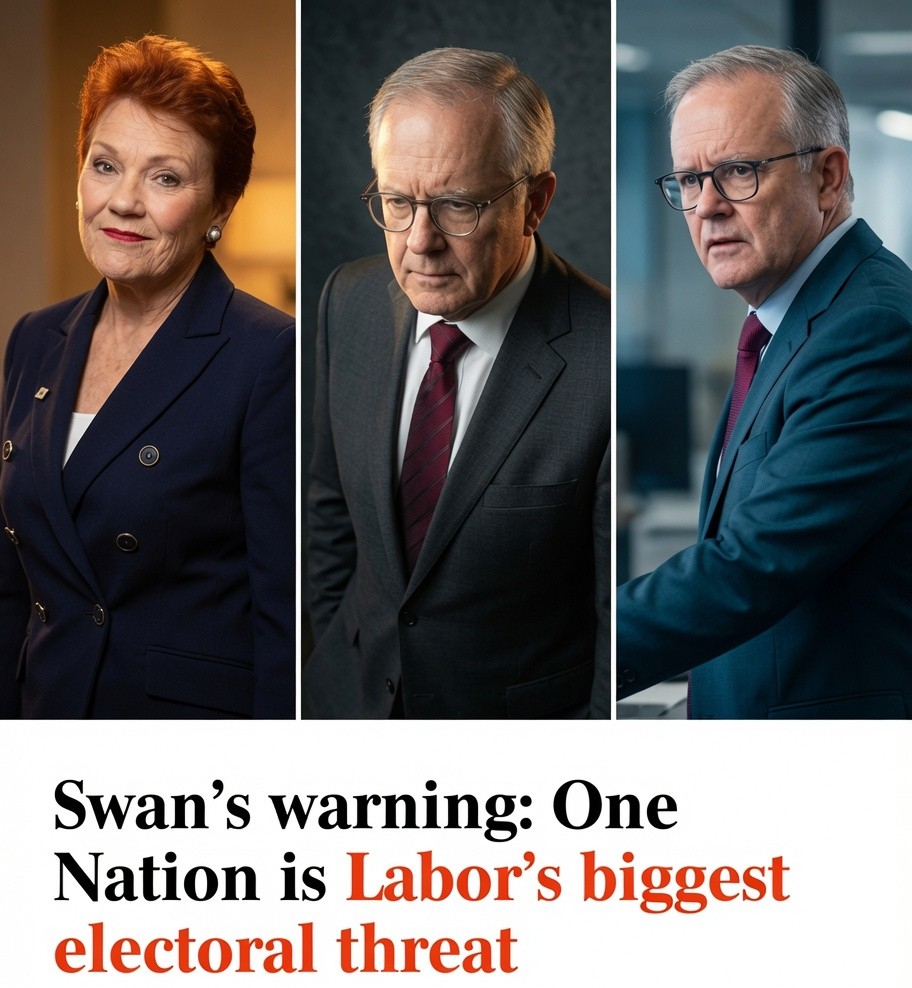
Former federal Treasurer and outgoing Australian Labor Party president Wayne Swan is expected to use his farewell conference address to warn delegates that One Nation—not the Coalition—has become Labor’s most significant electoral challenge.
Speaking ahead of a dinner at which he and former Indigenous Australians Minister Linda Burney are to receive ALP life memberships, Mr Swan argues Australia’s political landscape has shifted dramatically, with Pauline Hanson’s party now attracting growing support among voters frustrated by cost-of-living pressures and distrustful of traditional political parties.
According to Mr Swan, Labor can no longer assume that the Liberal-National Coalition represents its principal political opponent.
Instead, he believes the rise of right-wing populism presents a more immediate electoral challenge, particularly in outer suburban and regional communities where economic anxiety has intensified.
His warning reflects growing concern within Labor over polling showing One Nation has strengthened its support since the 2025 federal election, establishing itself as a significant force in Australia’s evolving political landscape.
Mr Swan reportedly plans to tell delegates that the “conservative mantle” has increasingly shifted towards Pauline Hanson, while also expressing concern about wealthy donors backing the party’s growing campaign resources.
He argues Labor must respond not only by opposing populist rhetoric but by continuing to address the economic pressures that have fuelled voter dissatisfaction.
The comments come as Prime Minister Anthony Albanese and senior ministers attempt to reinforce Labor’s economic credentials through a series of new policy announcements unveiled during the three-day conference.
Among the headline initiatives is an expansion of the Commonwealth Prac Payment program, extending weekly financial support to students undertaking mandatory placements across additional allied health professions.
Labor has also outlined proposals aimed at strengthening workplace protections, addressing cost-of-living pressures and continuing Australia’s transition towards a cleaner energy system.
While economic policy dominates much of the conference agenda, the gathering also provides an opportunity to reflect on one of Labor’s most significant political setbacks in recent years—the defeat of the 2023 referendum proposing an Aboriginal and Torres Strait Islander Voice to Parliament.
Former Indigenous Australians Minister Linda Burney, who led much of the government’s advocacy during the referendum campaign, says the outcome remains deeply disappointing but should not mark the end of constitutional reform.
“I think the Voice referendum was a devastating outcome, but it gives us a base to work from,” Ms Burney said ahead of the conference.
Although she stressed it was not her role to direct the Albanese Government’s future policy, she said she remained optimistic that constitutional recognition would eventually return to the national agenda.
“I have faith this issue will not go away. If not a Voice, then proper recognition of the whole story of this country in our Constitution would be most welcome,” she said.
Ms Burney’s remarks represent one of the clearest indications from a senior Labor figure that constitutional recognition remains a long-term aspiration despite the referendum’s failure.
The Indigenous Voice referendum, held in October 2023, proposed amending Australia’s Constitution to establish an advisory body representing Aboriginal and Torres Strait Islander peoples.
The proposal was defeated after failing to secure both a national majority and majorities in a majority of states, bringing to an end one of the most significant constitutional campaigns in recent Australian history.
Although the referendum result effectively closed the door on that specific constitutional amendment, many Indigenous leaders and constitutional experts have argued that broader questions surrounding constitutional recognition remain unresolved.
Recognition proposals have been discussed in various forms for decades and have included symbolic recognition, constitutional statements of acknowledgement, protections against racial discrimination and Indigenous representative bodies.
The Uluru Statement from the Heart, issued in 2017 following extensive consultations with Indigenous communities, called for three broad reforms: Voice, Treaty and Truth.
While the Voice proposal was rejected at referendum, discussions surrounding treaty processes and truth-telling initiatives continue in several Australian jurisdictions.
The conference also marks a significant personal milestone for both Mr Swan and Ms Burney.
They are set to receive national life membership of the Australian Labor Party, one of the organisation’s highest honours.
The recognition places them alongside a small group of distinguished Labor figures, including former prime ministers Gough Whitlam, Bob Hawke, Paul Keating, Kevin Rudd and Julia Gillard, acknowledging decades of contribution to the party and Australian public life.
Mr Swan served as Treasurer during the Rudd and Gillard governments, overseeing Australia’s economic response to the Global Financial Crisis and later becoming ALP national president.
Ms Burney made history as the first Aboriginal woman elected to the New South Wales Parliament before later becoming the first Aboriginal woman to serve as Australia’s Minister for Indigenous Australians.
Their recognition comes as Labor seeks to define its priorities for a new parliamentary term following its re-election to government.
Delegates attending the Adelaide conference are debating a wide range of policy issues, including taxation, energy security, artificial intelligence, industrial relations, housing affordability, climate policy and Australia’s foreign affairs.
Some proposals have generated vigorous internal debate, illustrating the broad spectrum of views within the party as it balances environmental ambitions, economic management and electoral strategy.
For Labor strategists, Mr Swan’s warning about One Nation reflects wider concern about political fragmentation.
One Nation has increasingly appealed to voters dissatisfied with major parties by focusing on issues including immigration, cost-of-living pressures, energy prices and government regulation.
The party’s improved electoral performance in recent contests has prompted both Labor and the Coalition to reassess how shifting voter loyalties could influence future federal elections.
Political analysts note that Australia’s electoral landscape has become considerably more fluid over the past decade.
Support for major parties has declined while minor parties and independents have expanded their influence across both houses of Parliament.
That trend has increased the importance of preference flows, regional campaigning and targeted policy announcements aimed at addressing community concerns over housing affordability, healthcare access and household budgets.
Against that backdrop, Labor’s national conference serves not only as a forum for setting party policy but also as an opportunity to define the government’s political strategy for the years ahead.
Wayne Swan’s warning and Linda Burney’s optimism capture two very different dimensions of that challenge.
One focuses on navigating an increasingly competitive political environment shaped by the rise of populist parties.
The other reflects Labor’s continuing belief that reconciliation and constitutional recognition remain unfinished national conversations despite the setback of the 2023 referendum.
Together, their messages underscore the balancing act confronting the Albanese Government as it seeks to respond simultaneously to immediate economic concerns while maintaining longer-term commitments on national identity, reconciliation and democratic reform.