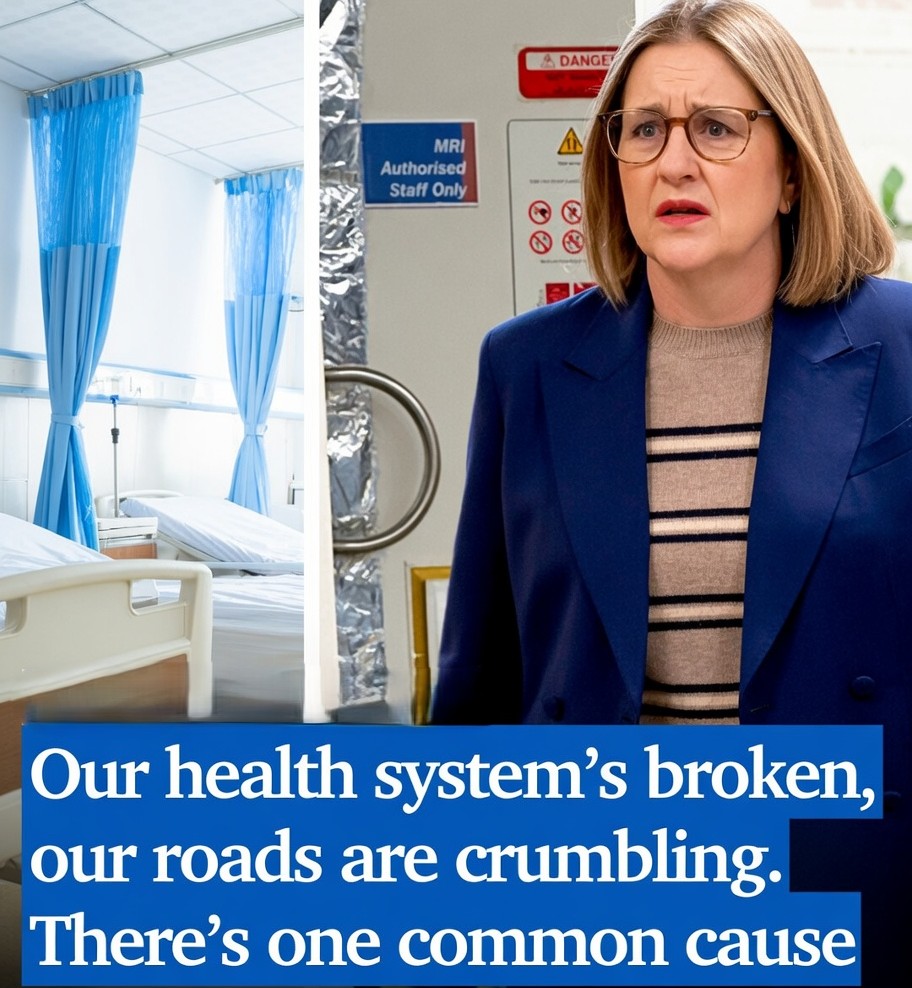
A failing MRI shield reportedly patched with foil should not be the defining image of a modern public health system spending tens of billions of dollars a year.
Yet the controversy at Maroondah Hospital has become a brutally effective symbol of the argument now confronting Jacinta Allan’s government.
Victoria says it is investing record amounts in health.
Patients are still waiting.
Emergency departments remain under pressure.
Ambulances are missing response targets.
Medical equipment is ageing.
And the state’s debt is heading towards $200 billion.
The uncomfortable question is no longer simply whether Victoria spends enough money.
It is whether the state has reached a point where its enormous financial commitments are making it harder to keep up with the basic services Victorians use every day.
That is the argument at the centre of a new intervention by Herald Sun state political editor Shannon Deery, who has linked Victoria’s struggling hospital system with another highly visible public frustration: deteriorating roads.
The connection, he argues, is financial.
Governments under pressure stop preventing problems and start responding to emergencies.
A patch here.
A repair there.
An urgent funding announcement when a service reaches crisis point.
In health, as on the roads, Victoria increasingly appears to be operating in triage mode.
The Maroondah MRI controversy became a symbol of something much bigger
The immediate controversy centres on an MRI service at Maroondah Hospital in Melbourne’s east.
Concerns were raised about radiofrequency shielding around the MRI unit, known as a Faraday cage, which is intended to prevent external interference affecting image quality.
Reporting by the Herald Sun revealed the shielding had failed recent testing and that staff had used what appeared to be kitchen foil in an attempt to address interference.
Some patients underwent repeat imaging at Box Hill Hospital.
Health sources cited in the reporting raised concerns about potentially affected scans, including breast, abdominal and spinal imaging.
Eastern Health has strongly rejected suggestions that patients were placed at risk.
The health service said only a small number of scans were affected and that all images were rigorously reviewed to ensure diagnostic accuracy.
It said patient safety had not been compromised.
That distinction is important.
There is no established finding that the shielding problem caused a missed cancer diagnosis or another diagnostic error.
But politically, the image is devastating.
A public hospital using foil around part of an MRI shielding system is almost impossible to reconcile visually with government claims about record investment and world-class care.
Health Minister Harriet Shing has pointed to the scale of the government’s funding and said health services are responsible for monitoring and maintaining their equipment.
Eastern Health is planning remediation work.
But the political damage comes from what the incident appears to represent.
Victorians hear billions announced in budgets.
Then they see foil around medical infrastructure.
They are entitled to ask where the gap exists between the money being committed and the condition of the system they encounter.
Victoria is spending more on health — and still struggling to keep pace
The Allan government can point to a genuine fact in its defence.
It is not abandoning public health spending.
The 2026–27 Victorian budget includes a further $3.9 billion to meet healthcare needs.
The government says its broader health investment is at record levels.
That money is supporting hospitals, staff, emergency care and a system dealing with population growth and increasingly complex demand.
The problem is that record spending does not automatically produce record performance.
Victoria’s elective surgery waiting list has climbed above 68,000 people.
According to the latest reporting, the list increased by more than 4,000 patients in three months and is almost 8,000 higher than at the same point a year earlier.
Category 3 patients are facing average waits well beyond the clinically recommended time.
Patients requiring semi-urgent category 2 surgery are also experiencing extended delays.
Emergency departments are under intense pressure.
The number of hospital patients stuck in emergency departments has risen sharply compared with a year earlier.
Ambulance performance remains another persistent problem.
Only 66.4 per cent of Code 1 responses were reported as arriving within 15 minutes against a target of 85 per cent.
These are not abstract Treasury numbers.
They describe people waiting for surgery while living with pain.
Families sitting in emergency departments.
Paramedics responding to more cases than the system can comfortably absorb.
Doctors and nurses trying to move patients through hospitals with limited beds and competing clinical demands.
When the waiting list grows while spending also grows, the question becomes much harder than “fund health better”.
The government is already putting more money into the system.
Demand is consuming it.
Victoria’s population and health needs have changed
Part of the pressure has little to do with party politics.
Victoria is a large and growing state.
More people mean more emergency presentations, more births, more surgeries and greater demand for diagnostic services.
An ageing population also changes the type of healthcare required.
Older patients are more likely to have multiple chronic conditions.
They may require longer hospital stays and more complex discharge planning.
When aged care or community support is unavailable, patients who are medically ready to leave hospital can remain in beds needed by others.
The consequences spread backwards through the system.
A ward bed is occupied.
A patient remains in emergency.
An ambulance cannot transfer its patient quickly.
The paramedic crew remains at the hospital instead of returning to the road.
Another emergency caller waits longer.
Healthcare systems are interconnected in ways that make a single bottleneck capable of affecting thousands of people.
COVID-19 also left lasting disruption.
Elective surgery was delayed.
Staff endured years of extraordinary pressure.
Health services have faced workforce shortages and rising costs.
None of this began with Jacinta Allan.
But Labor has governed Victoria since 2014.
After more than a decade in office, the government cannot credibly present itself as a new administration discovering inherited problems.
At some point, the condition of the system becomes the record of the government running it.
The debt approaching $200 billion changes every budget decision
This is where Victoria’s financial position enters the hospital debate.
The 2026–27 state budget forecasts net debt of $167.5 billion by June 2027.
It is then projected to continue rising.
By June 2030, net debt is forecast at $199.3 billion.
That is just short of the politically explosive $200 billion threshold.
Debt itself is not automatically evidence of financial failure.
Governments borrow to build infrastructure that will be used for decades.
A growing state requires railways, roads, schools and hospitals.
Future taxpayers who benefit from long-lived infrastructure can reasonably carry part of its cost.
The problem is not simply the existence of debt.
The problem is the cost of servicing it.
Interest payments consume revenue before a government employs a nurse, repairs a road or replaces a medical scanner.
Victoria’s interest expense is forecast to rise from about $8.9 billion in 2026–27 to $11.8 billion by 2029–30.
By the end of the forward estimates, almost one dollar in every ten of government revenue is expected to be absorbed by interest costs.
That money cannot simultaneously be spent on hospital equipment.
It cannot repair potholes.
It cannot fund an additional operating theatre.
It cannot pay another paramedic.
This is the opportunity cost of debt that is often missing from political arguments.
Governments can borrow more.
But the larger the debt becomes, the more future budgets must devote to servicing previous borrowing.
That reduces flexibility.
When another crisis arrives, there is less room to move.
Health and roads reveal what happens when maintenance loses the political competition
The comparison between hospitals and roads is powerful because both rely on continuous investment.
Maintenance is rarely politically exciting.
A government receives more attention for opening a new hospital building than replacing a component before it fails.
A major transport project produces ribbon cuttings and construction announcements.
Resurfacing an existing road before it deteriorates does not create the same political spectacle.
Yet preventive maintenance is often cheaper than emergency reconstruction.
Victoria’s regional road network is now at the centre of a similar debate.
Contractors and industry figures have warned that inadequate resurfacing can allow roads to deteriorate beyond the point where relatively inexpensive maintenance is sufficient.
Once the underlying pavement fails, the cost of reconstruction becomes much higher.
The same basic principle applies to public assets more broadly.
Replace equipment at the appropriate point in its lifecycle or risk a more disruptive failure.
Maintain infrastructure or pay more when it breaks.
Invest in capacity before demand overwhelms the system or spend years trying to clear backlogs.
The difficulty is that preventive spending competes against every immediate political demand.
A government facing debt and rising interest costs has an incentive to defer expenditure that does not appear urgent today.
Tomorrow, the deferred problem becomes urgent.
That is how governments become trapped in triage.
Labor’s biggest political protection is that voters still associate it with public health
The remarkable part of Victoria’s hospital crisis is that it has not yet destroyed Labor’s political credibility on health.
For decades, Labor has successfully positioned itself as the political defender of Medicare, public hospitals and frontline health services.
That brand is deeply established.
At the 2022 Victorian election, Daniel Andrews placed health at the centre of Labor’s campaign.
He promised to repair a system battered by the pandemic.
Labor won another commanding election victory.
Andrews resigned less than a year later.
Jacinta Allan inherited both the government and the promise.
Four years after that campaign, the surgery waiting list is again moving in the wrong direction and ambulance targets remain difficult to meet.
Yet the Coalition faces a credibility problem of its own.
Criticising Labor’s hospital performance is straightforward.
Convincing Victorians that a Liberal-National government would manage public health better is much harder.
That creates a political safety net for Labor.
A voter can be furious about an emergency department wait and still distrust the opposition on health.
A family can believe the hospital system is deteriorating while also fearing spending cuts under a Coalition government.
The opposition must also reconcile its promises to improve services with plans to reduce debt and reverse taxes that contribute billions of dollars to state revenue.
If the Coalition wants to spend more on roads and improve hospitals while cutting debt, it must identify what it will spend less on or how it will produce stronger revenue and economic growth.
There is no serious solution to Victoria’s financial problem that requires no trade-offs.
Record spending is not a complete defence when outcomes deteriorate
Governments love large numbers.
A $32 billion health investment sounds powerful.
A further $3.9 billion sounds substantial.
And in absolute terms, it is.
But a patient does not experience the health budget as a total number.
They experience whether an ambulance arrives.
Whether an emergency department has space.
Whether their operation happens within the recommended time.
Whether diagnostic equipment works reliably.
That is why the Maroondah MRI controversy has cut through.
The government’s defence is based on system-wide investment.
The public image is foil around a failed shielding system.
Both facts can exist at the same time.
Victoria can spend a record amount on health and still have ageing equipment.
It can hire staff and still face workforce shortages.
It can build hospital expansions and still have overcrowded emergency departments.
The real question is whether the government’s spending priorities and system management are producing enough improvement for the money being committed.
That is a more demanding test than announcing a funding record.
Victoria is reaching the point where debt becomes visible in everyday life
For years, state debt can feel theoretical.
It exists in budget papers.
Economists debate credit ratings.
Treasurers argue about ratios.
Most people continue with their lives.
Debt becomes politically dangerous when voters believe they can see its consequences.
A road that is repeatedly patched instead of properly rebuilt.
A hospital waiting list moving towards pandemic-era levels.
An ambulance arriving outside the target time.
An MRI shielding problem addressed with what appears to be foil.
At that point, the budget balance sheet stops being an abstract argument between politicians.
People begin connecting the condition of public services with the financial choices made over the previous decade.
Labor will argue that much of Victoria’s borrowing funded essential infrastructure and helped the state survive the pandemic.
It will point to population growth, rising demand and record health funding.
The opposition will argue that project overruns, waste and poor financial management have left Victoria with too little capacity to fund core services properly.
The election campaign will be full of both arguments.
But voters do not need to accept either party’s entire narrative to recognise the underlying constraint.
Victoria is carrying a very large debt load, interest costs are rising and the state’s essential services are competing for limited budget room.
The hospital system cannot be repaired with a slogan.
Neither can the roads.
More money may be required.
Better management may be required.
Some projects or programs may need to lose funding so essential services can receive more.
Taxes may need to remain higher than voters want.
Debt reduction may need to happen more slowly than fiscal conservatives demand.
Every path has a cost.
That is the financial reality confronting whoever governs Victoria after November.
The Maroondah MRI will eventually be repaired.
Potholes will be filled.
Another health funding package will be announced.
But those individual fixes will not answer the larger question.
When a state is heading towards $200 billion in net debt and almost one-tenth of revenue is being swallowed by interest, how long can government keep patching problems before it is forced to confront the structure of its spending?
Victoria’s hospitals and roads are different systems.
Right now, they are sending the same warning.






