One Nation says something unusual is happening at its head office.
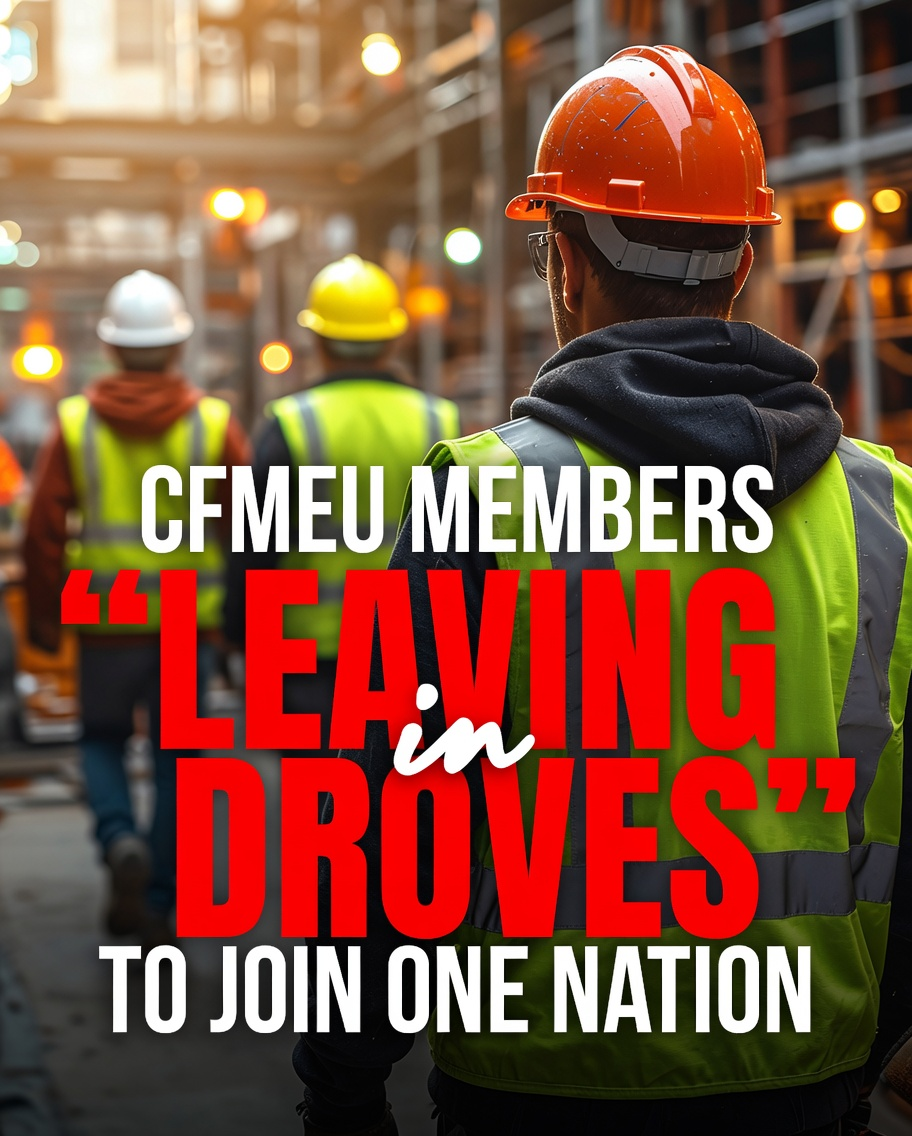
The phones, according to the party, are receiving calls from disgruntled tradies and workers who say they have cancelled their CFMEU memberships and now want to sign up with One Nation instead.
That claim needs an important qualification.
There is no independently published membership data demonstrating a mass exodus from the CFMEU directly into Pauline Hanson’s party. The account comes from One Nation itself, and the union has not publicly confirmed that a large bloc of members is abandoning it for the political right.
But dismissing the story as party propaganda would be a mistake.
Because the political conditions that could drive blue-collar workers away from a construction union and towards One Nation are no longer theoretical.
The CFMEU’s Construction and General Division has been under administration since August 2024.
Its Victorian operations have been engulfed by extraordinary allegations involving corruption, extortion, organised crime and criminal influence.
A major investigation commissioned by the union’s own administrator produced a devastating account of the culture that developed in Victoria.
Fresh allegations continue to emerge around taxpayer-funded construction projects.
In Queensland, an inquiry has been examining the cost and influence of union-backed Best Practice Industry Conditions on major infrastructure.
And in Victoria, political pressure is again intensifying over alleged CFMEU influence on public works.
Against that background, One Nation’s claim about angry workers calling head office deserves to be understood for what it could represent.
Not proof of a mass membership transfer.
A political warning.
The traditional relationship between Labor, unions and blue-collar Australia is under pressure.
Pauline Hanson can see the opening.
The CFMEU scandal is no longer just a collection of newspaper allegations
The construction union crisis exploded into national politics in 2024 after investigations alleged criminal and bikie infiltration in parts of the CFMEU’s construction operations.
The allegations were serious enough to trigger an extraordinary government intervention.
On 23 August 2024, the Construction and General Division of the CFMEU and its divisional branches were placed under administration for a period of up to five years.
Mark Irving KC was appointed administrator.
This was not an ordinary internal union dispute.
The administration scheme gave the administrator sweeping powers to restructure the division and remove officials.
The federal government argued intervention was necessary because of the scale of the crisis surrounding the construction division.
Since then, the public picture has become darker.
Geoffrey Watson SC was engaged to investigate alleged corruption within the Victorian branch.
His report, titled Rotting From the Top, described a culture in which violence, intimidation and corrupt practices were alleged to have become embedded.
Watson alleged extortion occurred through a model in which industrial pressure could be used against builders unless payments were made.
The consequences of shutting a major construction site, the report noted, could be financially enormous.
Watson’s report also examined the influence of controversial underworld figure Mick Gatto, who has denied wrongdoing.
The allegations remain the subject of investigations and disputes, and individual claims must be treated according to the evidence and legal process.
But the central political fact cannot be avoided.
The CFMEU construction scandal became serious enough for a Labor federal government to legislate for administration of a major union division.
That is an extraordinary place for Australia’s labour movement to find itself.
For ordinary members, the question is brutally simple: what was my union doing?
Most construction workers do not join a union because they want to participate in an ideological movement.
They join because construction can be dangerous.
They want somebody to defend their pay.
They want safe sites.
They want an organisation capable of standing up to a large contractor when an individual worker has almost no bargaining power.
They want their entitlements protected.
That is the basic trade union bargain.
A worker pays membership fees.
The union represents the worker.
When allegations emerge that parts of a union have instead become entangled with criminals, intimidation or corrupt practices, members are entitled to ask whether that bargain has been betrayed.
This distinction is important because CFMEU members are not responsible for the alleged misconduct of union officials.
A crane operator who pays union dues is not accountable for an official accused of corruption.
A carpenter working a 10-hour day is not responsible for alleged organised crime influence on a government project.
A labourer trying to pay a mortgage should not be treated as a political caricature simply because he carries a union card.
In fact, ordinary members may have more reason than anybody to be furious.
The union exists in their name.
Its institutional power comes from their membership.
Its officials claim to represent their interests.
If corruption is proven, the reputational damage falls on workers who had nothing to do with it.
That is why One Nation’s message is politically clever.
Hanson is not telling construction workers they are the problem.
She is telling them the people who were supposed to represent them became the problem.
For a party built around resentment towards institutions and elites, it is almost a perfect argument.
One Nation is trying to separate the worker from the union
For decades, Australian politics operated on a fairly reliable cultural map.
Labor represented workers.
The union movement was Labor’s organisational backbone.
The Coalition represented business, professionals and conservative voters.
There were always exceptions, but the broad identities were deeply embedded.
One Nation is trying to tear up that map.
Hanson’s political pitch increasingly distinguishes between working Australians and the institutions that claim to speak for them.
Under this argument, a tradie can support higher wages while distrusting a union official.
A factory worker can believe in workplace safety while voting against Labor.
A union member can resent corporate power and still believe the union movement has become politically captured.
One Nation wants these voters to see themselves as workers abandoned by both sides of the old political system.
The party’s CFMEU campaign fits directly into that strategy.
One Nation in Victoria has promised to pursue a royal commission into CFMEU involvement in Big Build contracts and examine the relationship with the Victorian Labor Party.
The language is designed to speak directly to workers and taxpayers.
Follow the money.
Expose corruption.
Put taxpayers before union bosses and politicians.
There is nothing subtle about it.
But subtlety is not required when the opposing institution is already under administration.
Labor’s problem is that the latest allegations keep arriving
If the CFMEU controversy had ended with the 2024 administration, Labor could argue the system had acted.
A scandal was exposed.
The government intervened.
An administrator was appointed.
Officials were removed.
Reform began.
That remains an important part of the story.
Administration is not evidence that nothing has changed.
The administrator has been attempting to restructure the construction division and address the culture that produced the crisis.
But politically, the scandal refuses to remain in the past.
In recent weeks, Victoria’s Big Build has again been at the centre of allegations about criminal infiltration and union influence.
Premier Jacinta Allan has acknowledged criminal elements infiltrated major infrastructure projects, while rejecting demands for a royal commission.
Her government argues that police investigations, stronger regulatory powers and existing reforms are the more effective response.
Critics disagree.
Former integrity officials, business groups, opposition politicians and Watson himself have pressed for a broader inquiry.
Then came new controversy involving Victorian hospital projects.
Health Infrastructure Minister Melissa Horne sought assurances from the Victorian Infrastructure Delivery Authority after allegations that pressure connected with CFMEU complaints had influenced decisions involving a subcontractor on the Royal Victorian Eye and Ear Hospital redevelopment.
Horne said neither she nor her office had contact with the union over the matter and demanded confidence that no improper conduct had occurred.
The Victorian Government has disputed claims of improper political interference.
But for voters, the pattern of headlines matters.
CFMEU.
Big Build.
Criminal infiltration.
Hospital projects.
Alleged pressure.
Calls for a royal commission.
Every new controversy makes it harder to persuade an angry construction worker that the crisis is simply an old problem already solved by administration.
Queensland has opened another front in the construction union argument
The political fight is not confined to Victoria.
Queensland’s construction industry has been consumed by debate over Best Practice Industry Conditions, known as BPIC.
The conditions applied to major government projects and were strongly associated with union-backed construction arrangements.
Supporters argue they protected wages, safety and working conditions.
Critics argue they increased costs, damaged productivity and gave the CFMEU excessive influence.
A Queensland Commission of Inquiry has been examining the policy and its implementation.
Recent evidence from a senior Transport and Main Roads procurement official raised serious questions about how BPIC was introduced.
The inquiry heard claims that appropriate modelling and consultation were lacking and that civil construction officials had warned about the policy’s suitability.
Cost estimates have become fiercely contested.
Critics have claimed the conditions increased project costs significantly.
The CFMEU and the wider union movement reject attacks they see as an attempt to weaken workers’ bargaining power and strip away wages and conditions.
That argument matters.
There is a genuine danger that corruption allegations involving officials become an excuse for governments or employers to attack legitimate worker entitlements.
A corrupt union official and a well-paid construction worker are not the same problem.
Higher wages are not evidence of corruption.
Strong safety rules are not evidence of organised crime.
Enterprise bargaining is not criminal conduct.
Any serious reform of the construction industry must preserve that distinction.
But unions also weaken their ability to defend legitimate conditions when their institutions become associated with intimidation and corruption.
If workers believe their pay and safety are being used as political cover for somebody else’s power network, loyalty can break quickly.
That is the opening One Nation is trying to exploit.
The union movement is already fighting back against Hanson
Labor and union campaigners understand the threat.
They are not standing by while Hanson presents herself as the new champion of working Australians.
The counterattack is straightforward.
One Nation, they argue, does not have a parliamentary record that consistently supports worker interests.
Labor figures and union campaigns have attacked the party over wages, workplace rights and industrial relations.
Prime Minister Anthony Albanese has argued One Nation opposes measures that make a practical difference to working people.
Union activists accuse Hanson of using anger towards individual unions while supporting economic policies that would ultimately weaken workers.
This is where the political contest becomes much more interesting than a simple CFMEU scandal.
One Nation does not need every union member to agree with its industrial relations platform.
It needs enough workers to stop trusting Labor’s claim to represent them automatically.
Once that emotional bond breaks, voting behaviour becomes much less predictable.
A worker may disagree with Hanson on one policy and still believe she understands his anger better than Labor.
He may value penalty rates but resent migration levels.
He may support collective bargaining but believe the CFMEU has failed.
He may want higher wages and a royal commission into construction corruption.
Voters are not policy spreadsheets.
They hold contradictory views.
Successful populist parties understand that better than traditional political institutions often do.
The danger for Labor is cultural, not merely electoral
For Labor, losing a construction worker to One Nation means more than losing one vote.
It represents a crack in the party’s historic identity.
Labor was created from the labour movement.
Its relationship with unions is not an incidental alliance arranged by modern campaign strategists.
It is part of the party’s institutional DNA.
That history creates strength.
It also creates vulnerability.
When a union is engulfed by scandal, voters naturally ask what Labor knew, how closely politicians were connected to union leaders and whether political relationships affected government decisions.
Those questions are particularly damaging in Victoria because the state’s enormous infrastructure program involved billions of dollars in public money and years of interaction between government, contractors and construction unions.
Allegations about corruption and criminal infiltration therefore do not remain internal CFMEU matters.
They become questions about governance.
Who had influence?
Who raised concerns?
Who listened?
Who did not?
How much did taxpayers pay?
Could misconduct continue after the union entered administration?
These are the questions driving demands for a royal commission.
Labor governments can point to administration, police work and regulatory reforms.
But politically, every unanswered question gives Hanson more material.
One Nation’s phone claim now has to survive scrutiny
There is a final responsibility on One Nation.
If the party says its head office is receiving calls from workers cancelling CFMEU memberships and joining One Nation, the claim should be treated as a political claim until measurable evidence emerges.
How many callers?
From which states?
How many actually resigned from the union?
How many became One Nation members rather than simply expressing support?
Is this a sustained trend or a burst of angry calls during a major news cycle?
Those questions do not invalidate the party’s account.
They are the questions any serious journalist should ask.
One Nation has every incentive to present worker anger as a movement towards the party.
The CFMEU and Labor have every incentive to describe that movement as exaggerated or politically manufactured.
The truth will eventually be visible in membership figures, polling and elections.
But political realignments often become culturally obvious before they become statistically undeniable.
You hear a different conversation on worksites.
You see political content shared by people who never previously discussed politics.
You notice workers who once voted Labor without thinking begin to say they are “looking around”.
Then the election numbers arrive.
That is why Labor should be careful about laughing at One Nation’s claim.
The biggest warning is not that workers are leaving one union
The CFMEU crisis is ultimately a test of whether Australia’s institutions can separate the legitimate interests of construction workers from the alleged misconduct of powerful people who operated around them.
Workers deserve safe sites.
They deserve fair wages.
They deserve the right to organise.
They also deserve unions that are not associated with extortion, criminal influence or corrupt deals.
Taxpayers deserve confidence that public infrastructure contracts are not being distorted by intimidation or improper pressure.
Businesses deserve to compete without fear.
And governments deserve scrutiny when billions of public dollars are involved.
One Nation believes the failure to deliver those basic standards has created a new constituency.
Angry tradies.
Disillusioned union members.
Workers who believe Labor takes their votes for granted.
People who still think of themselves as working class but no longer believe the institutions of the labour movement speak for them.
Perhaps the calls to One Nation head office are a temporary reaction to another ugly week of CFMEU headlines.
Perhaps they are the beginning of something larger.
There is not yet enough independent evidence to declare a mass political migration.
But the wider warning is already clear.
When workers begin looking at the union that was supposed to defend them and asking whether it has betrayed them, somebody else will offer to take their side.
Pauline Hanson is standing there with the membership form.






