Australia’s immigration debate has returned to the political spotlight after Home Affairs Minister Tony Burke launched a fierce attack on One Nation leader Pauline Hanson over comments she made during a podcast interview with controversial British far-right activist Tommy Robinson.
The latest political dispute erupted after Senator Hanson appeared alongside Robinson during a podcast recorded in the United Kingdom, where the pair discussed immigration, multiculturalism and Australia’s changing demographic profile.
During the interview, Hanson suggested Australia’s migration problems began after the Whitlam Government abolished the White Australia policy in 1973, arguing that immigration patterns changed significantly following its removal. She also made unsubstantiated claims that some migrants had come to Australia primarily for welfare benefits and alleged Muslim communities were disproportionately abusing the National Disability Insurance Scheme (NDIS).
The comments quickly attracted widespread criticism, prompting Burke to address the issue while announcing the Albanese Government’s response to a national report into Islamophobia.
“I never thought when I entered parliament that in my political lifetime anyone who had been elected would be calling for White Australia,” Burke said.
He argued that Australia’s success has been built on embracing diversity rather than excluding people because of their race or ethnicity.
“I thought we were in a country where everybody just accepted we had moved on and we were better because we had moved on.”
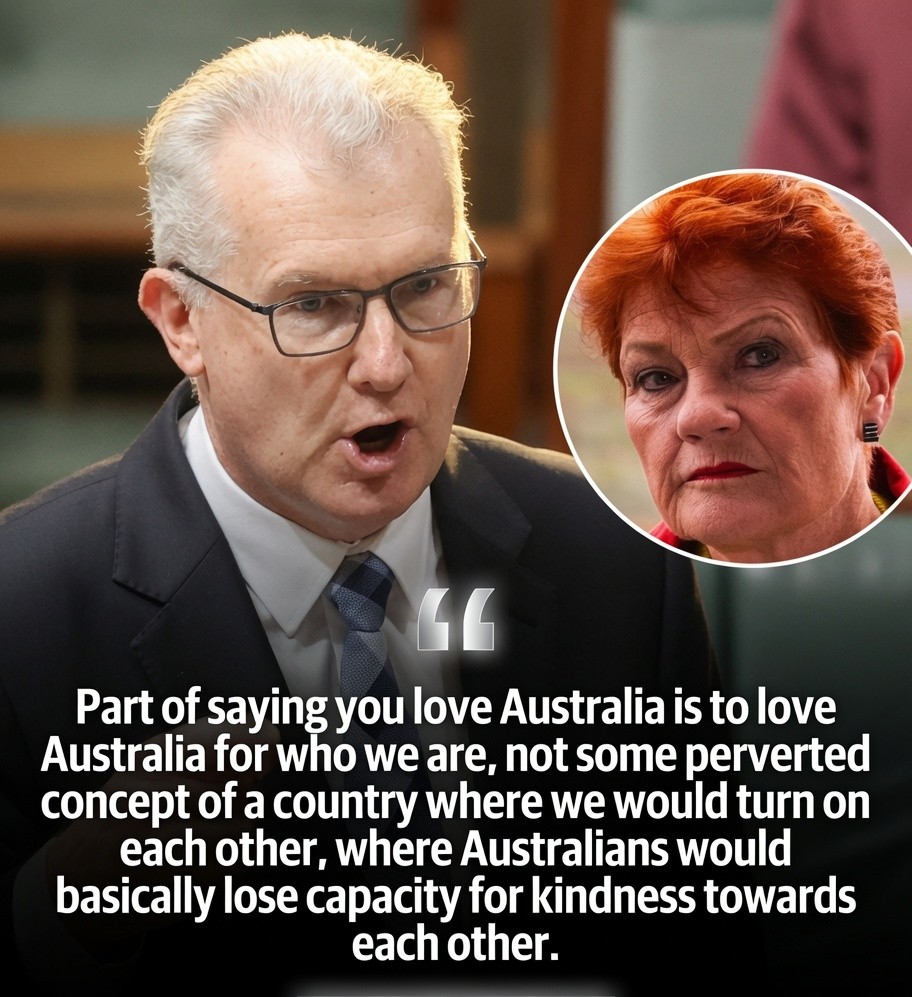
Burke went on to describe any attempt to romanticise the former immigration policy as “some perverted concept of a country where we would turn on each other, where Australians would basically lose capacity for kindness towards each other.”
Using an orchestra as an analogy, he said Australia’s strength comes from the contributions of many different communities.
“You will never find an orchestra where every instrument is the same.”
His remarks reflected the Albanese Government’s broader position that multiculturalism is one of Australia’s defining national strengths and should remain central to immigration policy.
The White Australia policy refers to a series of laws and administrative practices introduced after Federation in 1901 that severely restricted non-European immigration.
Its principal aim was to preserve Australia as a predominantly white British society through mechanisms including the Immigration Restriction Act and the notorious dictation test, which enabled authorities to exclude unwanted migrants.
Although aspects of the policy were gradually dismantled during the 1950s and 1960s, the remaining discriminatory provisions were formally abolished by the Whitlam Government in 1973.
The end of the policy marked a fundamental shift towards a non-discriminatory immigration system and laid the foundations for modern multicultural Australia.
Today, Australia’s migration program assesses applicants primarily through skills, family reunification, humanitarian commitments and economic priorities rather than race or ethnicity.
Following the backlash, Hanson insisted she had been misrepresented.
She emphatically denied advocating for a return to the White Australia policy, saying she had never supported reinstating it.
Instead, she argued that Australia should be selective about immigration and ensure newcomers integrate into Australian society.
Hanson said she wanted “the right people” brought into the country “in a measured way”, while maintaining that she does not believe in the White Australia policy itself.
Despite those clarifications, critics argued that referencing the abolition of the policy as the starting point for Australia’s migration problems inevitably revived one of the country’s most controversial historical chapters.
The controversy has also focused attention on Hanson’s decision to appear with Tommy Robinson, whose real name is Stephen Yaxley-Lennon.
Robinson is one of Britain’s best-known far-right activists and has been convicted of offences including assault, fraud, contempt of court and passport-related crimes.
Australian governments from both major parties have previously refused him entry visas, citing concerns about social cohesion and public safety. Home Affairs Minister Burke has previously stated Robinson “certainly wouldn’t get a visa” under his watch because Australia should not provide a platform for people who spread hatred.
The association with Robinson became almost as controversial as the substance of Hanson’s comments, with several politicians arguing that appearing on his platform lent credibility to an individual widely regarded as a divisive figure.
Prime Minister Anthony Albanese also criticised Hanson, accusing her of undermining social cohesion by portraying multicultural Australia in a negative light.
He said Australians should celebrate the country’s diversity rather than attempt to divide communities along racial or religious lines.
The issue has also generated disagreement within conservative politics.
Former Nationals leader Barnaby Joyce defended Hanson, arguing she was not advocating for the return of the White Australia policy but was instead discussing historical changes to Australia’s immigration system.
Joyce said critics had misunderstood her comments, although he also supported stronger action against people unlawfully remaining in Australia after their visas expire.
Others were unconvinced.
Senior Labor ministers argued Hanson’s explanation did little to address concerns raised by her original remarks, while Greens politicians described both her comments and her appearance alongside Robinson as inconsistent with modern Australian values.
The renewed controversy comes amid broader public debate over Australia’s immigration program.
Population growth, housing affordability, infrastructure capacity and workforce shortages have become major political issues over recent years, with both major parties promising adjustments to migration settings while maintaining support for multiculturalism.
One Nation has long argued for substantially lower migration numbers, stricter border controls and stronger integration requirements for new arrivals.
Labor, meanwhile, continues to argue that Australia’s multicultural model has contributed significantly to the country’s economic growth, international competitiveness and social stability.
The debate illustrates how immigration remains one of Australia’s most politically sensitive issues more than five decades after the White Australia policy was abolished.
While Hanson insists she is advocating tighter migration controls rather than racial exclusion, her critics argue that invoking the White Australia policy inevitably carries historical significance that cannot easily be separated from contemporary political debate.
As Parliament prepares to resume, the controversy is likely to continue shaping discussions around immigration, national identity and social cohesion, ensuring that one of Australia’s most contentious historical policies remains firmly in the public conversation more than 50 years after it officially came to an end.






