Australia’s debate over immigration and multiculturalism has intensified after Home Affairs Minister Tony Burke delivered a scathing rebuke of One Nation leader Pauline Hanson following controversial comments she made during a podcast interview with British far-right activist Tommy Robinson.
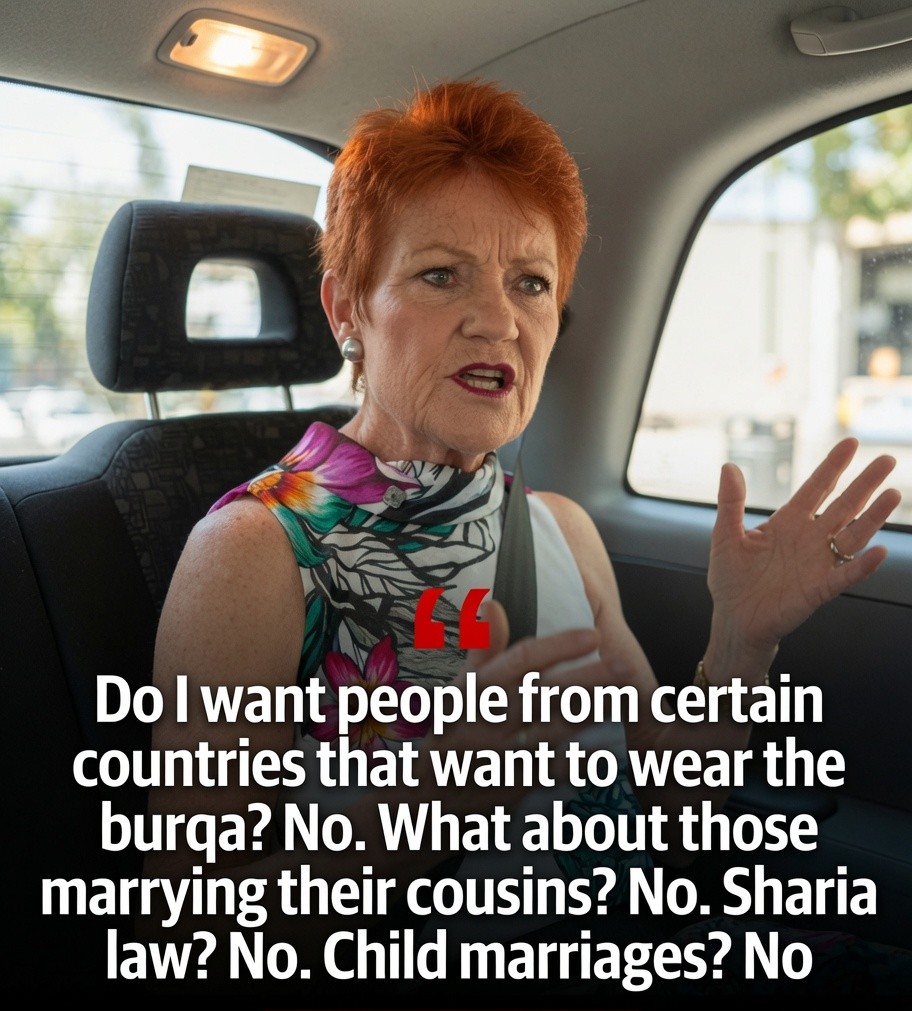
The political storm erupted after Hanson appeared on Robinson’s podcast while visiting the United Kingdom. During the discussion she linked Australia’s migration challenges to the dismantling of the White Australia policy in the early 1970s, arguing that immigration patterns had fundamentally changed after the policy ended.
Her remarks quickly drew criticism across the political spectrum, prompting Burke to accuse the veteran senator of invoking one of the darkest chapters of Australia’s immigration history.
Speaking while announcing the federal government’s response to a national report into Islamophobia, Burke said he never expected to hear an elected Australian politician appear to endorse ideas associated with White Australia.
“I never thought when I entered parliament that in my political lifetime anyone who had been elected would be calling for White Australia,” Burke said.
He argued modern Australia had become stronger because it had embraced multiculturalism and rejected racial exclusion.
“Part of saying you love Australia is to love Australia for who we are, not some perverted concept of a country where we would turn on each other, where Australians would basically lose capacity for kindness towards each other.”
Burke used an orchestra as a metaphor for modern Australia, saying societies become stronger through diversity rather than uniformity.
“You will never find an orchestra where every instrument is the same.”
The minister’s comments reflected the Albanese government’s longstanding defence of multicultural Australia as a defining national strength.
Hanson subsequently rejected suggestions she was advocating a return to the White Australia policy.
She insisted she had never supported reinstating the policy and claimed critics had misrepresented her comments.
According to Hanson, her position is that Australia should carefully manage immigration by selecting migrants who are willing to integrate into Australian society.
She said she wanted the “right people” brought into Australia “in a measured way”, while maintaining she does not believe in the White Australia policy itself.
The controversy stems largely from her conversation with Robinson, during which he questioned how Australia had changed demographically since the 1970s.
Hanson responded that migration problems “started” after the Whitlam government removed the final elements of the White Australia policy in 1973.
She argued that earlier European migrants had generally integrated into Australian society by learning English and adopting local customs, whereas she claimed many more recent migrants had come primarily to access Australia’s welfare system.
She also made claims regarding Muslim communities and the National Disability Insurance Scheme (NDIS), alleging without publicly presented evidence that some migrants were exploiting government support programs. Federal ministers rejected those assertions, saying no official data supported such conclusions.
The White Australia policy refers to a collection of laws and administrative practices introduced following Federation in 1901 that restricted non-European immigration into Australia.
Although some restrictions were gradually relaxed after the Second World War, successive governments dismantled the policy over several decades before the Whitlam government formally removed the remaining discriminatory provisions in 1973.
The end of the policy marked one of Australia’s most significant shifts in immigration philosophy, paving the way for the multicultural immigration system that exists today.
Modern Australian migration law no longer discriminates on the basis of race or ethnicity. Instead, visas are generally assessed using criteria such as skills, family connections, humanitarian obligations and economic needs.
Successive governments from both major political parties have maintained Australia’s multicultural framework, although debate over migration levels has remained a persistent feature of Australian politics.
One Nation has long campaigned for substantially lower migration numbers, stronger border controls and stricter citizenship requirements.
Hanson herself has frequently argued that immigration levels should be reduced to ease pressure on housing affordability, infrastructure and public services.
Critics, however, argue that her latest comments crossed a line by appearing to nostalgically reference an explicitly discriminatory immigration policy.
The controversy has also focused attention on Robinson, whose real name is Stephen Yaxley-Lennon.
The British activist has a lengthy criminal record and is widely known for anti-Islam activism through the now-defunct English Defence League. Australian governments from both major parties have previously opposed granting him entry visas because of concerns surrounding social cohesion and public safety.
Hanson’s decision to appear alongside Robinson attracted criticism independently of the substance of her comments, with opponents arguing that the interview gave legitimacy to an internationally controversial figure.
The debate has since expanded beyond immigration policy into broader questions about Australia’s political culture and national identity.
Prime Minister Anthony Albanese has also criticised Hanson following her overseas appearances, arguing that Australia should celebrate its diversity rather than portray multiculturalism as a national weakness.
Meanwhile, the political fallout has continued to spread through federal politics.
Former Nationals leader Barnaby Joyce defended Hanson, arguing that she had been misunderstood and was discussing historical immigration trends rather than advocating a return to racial exclusion. Other senior politicians rejected that interpretation and maintained that her comments inevitably revived memories of one of Australia’s most controversial historical policies.
The renewed dispute highlights how immigration remains one of Australia’s most politically sensitive issues.
Although both major parties continue to support multiculturalism, they have increasingly debated the appropriate size of Australia’s migration program amid housing shortages, infrastructure pressures and workforce demands.
The Albanese government has introduced measures intended to reduce net overseas migration from post-pandemic peaks while continuing to emphasise that Australia’s migration system should remain non-discriminatory and economically focused.
For Hanson and One Nation, immigration has remained a defining political issue since the party’s formation nearly three decades ago. Her supporters argue she raises concerns about integration and migration levels that many Australians share, while opponents contend her rhetoric risks inflaming racial division and undermining social cohesion.
The latest controversy demonstrates that questions surrounding Australia’s immigration history—and particularly the legacy of the White Australia policy—continue to provoke strong reactions more than half a century after the policy’s abolition.
Whether the debate ultimately changes public opinion or electoral dynamics remains to be seen, but it has once again placed immigration, multiculturalism and national identity at the centre of Australia’s political conversation.






