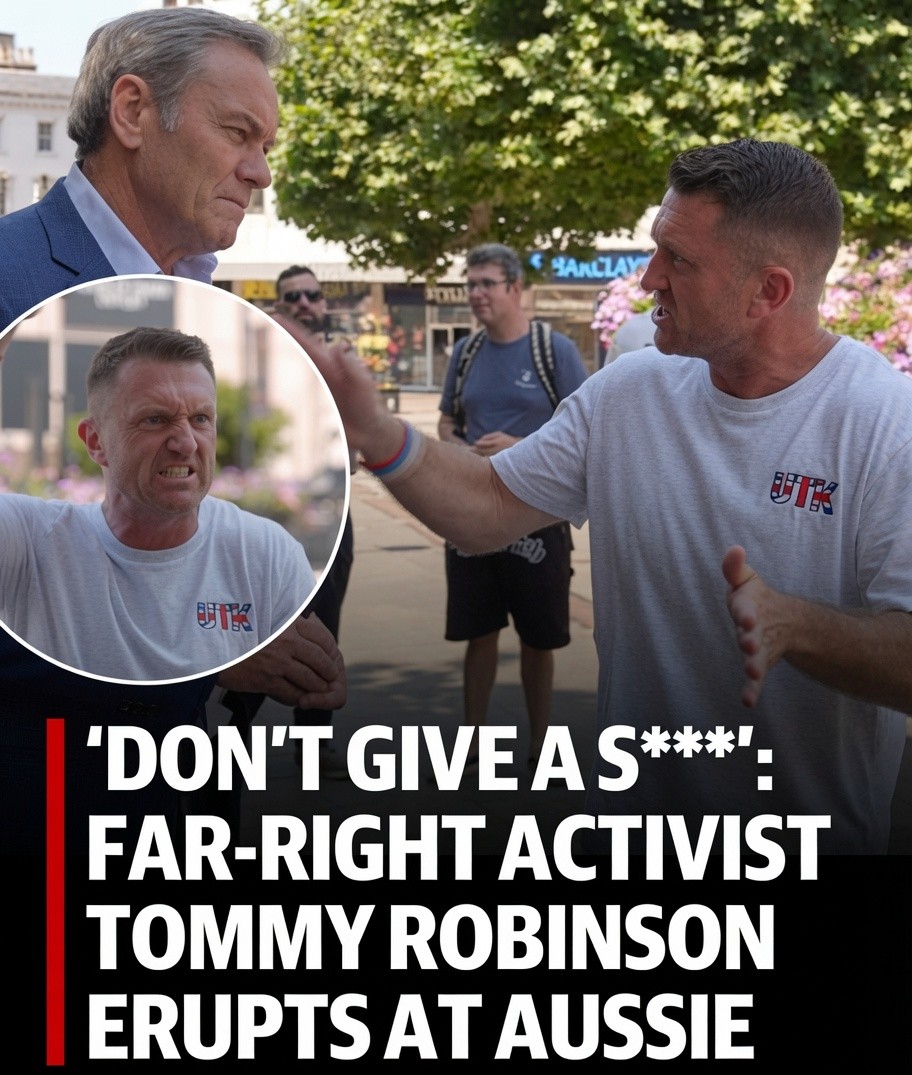
British far-right activist Tommy Robinson has clashed with veteran Australian journalist Liam Bartlett after being confronted over his criminal history during One Nation leader Pauline Hanson’s controversial tour of the United Kingdom.
The tense exchange was filmed for Seven’s Spotlight, which followed Hanson during her British trip as she met political and activist figures associated with the country’s populist and hard-right movements.
Robinson, whose real name is Stephen Yaxley-Lennon, spent considerable time with the Queensland senator and took her through his hometown of Luton, north of London.
But the encounter became confrontational when Bartlett questioned Robinson about his extensive history with the criminal justice system.
Robinson reacted angrily as the journalist pressed him about past offences, turning what had been a tour focused on immigration, Islam and multiculturalism into a direct confrontation over the credibility and background of Hanson’s controversial host.
The moment has attracted particular attention in Australia because Hanson’s association with Robinson has become one of the defining controversies of her UK visit.
Hanson has defended speaking with him, arguing she wanted to hear directly from people involved in Britain’s immigration and social cohesion debates.
Critics, however, have questioned why a serving Australian senator and leader of a federal political party would give legitimacy and publicity to a figure with Robinson’s record and history of far-right activism.
Who is Tommy Robinson?
Robinson is one of Britain’s best-known far-right activists and a former leader and co-founder of the English Defence League, a street protest movement that became prominent through demonstrations focused heavily on Islam and Muslim communities.
Born Stephen Yaxley-Lennon, he has used several names during his life and built an international profile through activism, online videos, podcasts and social media.
His supporters portray him as a campaigner willing to confront Islamist extremism, failures surrounding grooming-gang investigations and issues that mainstream politicians and media organisations have allegedly avoided.
His critics describe him as a far-right agitator whose campaigns have repeatedly blurred distinctions between legitimate criticism of extremism and hostility towards Muslims more broadly.
Robinson’s criminal and legal history is extensive and stretches back more than two decades.
His convictions have included assault, use of a false travel document, mortgage fraud and public-order offences, while he has also been imprisoned for contempt of court.
In 2005, he was jailed after being convicted of assaulting an off-duty police officer during an incident in Luton.
He was later convicted of assault in another case and has faced further legal proceedings over conduct ranging from fraud to breaches of court orders.
In 2012, he used another person’s passport to travel to the United States after being unable to enter under his own identity, resulting in a conviction for using a false travel document.
He subsequently received a prison sentence for mortgage fraud.
His more recent legal history has included contempt-of-court proceedings arising from his reporting and online activity around criminal trials.
In 2024, Robinson was jailed after admitting contempt of court for breaching a High Court injunction that prohibited him from repeating false allegations about a Syrian refugee who had successfully sued him for libel.
His record has therefore become central to how journalists and political opponents assess his public campaigning.
Bartlett challenges Robinson directly
Bartlett, a veteran Australian journalist and broadcaster, confronted Robinson about that history while filming Hanson’s UK visit.
The questioning prompted a hostile response from the activist.
The confrontation highlighted a tension running through the entire Spotlight program: whether Robinson should primarily be presented as a political campaigner raising concerns about immigration and Islam, or scrutinised as a controversial activist whose own conduct and legal history are directly relevant to his credibility.
For journalists covering figures such as Robinson, those questions are difficult to separate.
Robinson has built much of his public identity around the argument that mainstream institutions suppress uncomfortable truths about immigration, Islamist extremism and crimes involving some members of Muslim communities.
At the same time, courts have repeatedly examined his own conduct, including false claims, criminal offending and breaches of legal restrictions.
Bartlett’s questioning brought that contradiction into the centre of the Hanson story.
Hanson toured Luton with Robinson
Robinson took Hanson through Luton, a diverse town roughly 50 kilometres north of central London that has played an important role in his political story.
Luton has a large Muslim population and has experienced political and social tensions involving both Islamist extremists and far-right movements.
It was also where the English Defence League emerged in 2009.
Robinson has long presented the town as evidence for his arguments about immigration, integration and what he describes as the growing influence of Islam in Britain.
Hanson’s decision to tour the area with him was therefore highly symbolic.
Her own political career has been defined in large part by debates over immigration, multiculturalism and Islam in Australia.
After returning to federal Parliament in 2016, Hanson called for restrictions on Muslim immigration and famously entered the Senate wearing a burqa in 2017 before removing it during debate.
Her rhetoric has repeatedly drawn condemnation from political opponents and Muslim community organisations, while also helping One Nation build support among voters concerned about immigration and cultural change.
The parallels between Hanson and Robinson made their meeting politically explosive even before Spotlight aired.
Hanson says she wanted to hear his perspective
Hanson has rejected suggestions that meeting Robinson means she endorses every aspect of his record or political activity.
She has defended the encounter as part of an effort to understand Britain’s experience with high immigration, multiculturalism and social division.
Speaking publicly about the controversy, Hanson has said she is not backing away from the meeting.
Her position is that politicians should be willing to speak with controversial figures rather than allowing their reputations alone to determine whether their arguments are heard.
That defence has not satisfied critics.
Robinson is not simply a commentator with controversial opinions. His criminal convictions, history with the English Defence League and repeated legal battles form an important part of his public record.
For Hanson’s opponents, appearing alongside him risks normalising a figure associated with Britain’s far right.
For Hanson’s supporters, the backlash reinforces a different narrative: that mainstream political and media institutions attempt to discredit people who challenge prevailing approaches to immigration and multiculturalism.
Robinson’s recent Russia trip has added scrutiny
Robinson’s international activities have also attracted attention from British authorities.
In June 2026, British police stopped him after he returned from a trip to Russia and seized electronic devices under counter-terrorism border powers.
Being stopped under those powers does not itself establish criminal wrongdoing.
However, the episode generated scrutiny because of Britain’s deeply hostile relationship with Vladimir Putin’s government and concerns about Russian influence operations targeting Western democracies.
During the Russia trip, Robinson appeared in Moscow and met figures including Errol Musk, the father of billionaire Elon Musk.
His travel and contacts have become another element of the controversy surrounding his international political profile.
Claims about “ties” to Russian propaganda or government-linked actors require careful qualification: contact, travel or appearances alongside Russian figures do not by themselves prove that Robinson acts on behalf of the Russian government.
Nevertheless, his Moscow activities have added to the scrutiny surrounding political figures who choose to associate publicly with him.
The Seven program has created its own controversy
The story has become more complicated because Hanson and her team have subsequently challenged how Seven’s Spotlight presented the UK trip.
Hanson publicly released correspondence from the program’s producers showing that Seven had originally pitched a documentary focused heavily on immigration and its impact on Britain and Australia.
The correspondence referred to examining what the program described as “uncontrolled immigration” and proposed meetings with British political figures.
A planned meeting with Reform UK leader Nigel Farage did not ultimately take place.
Instead, Hanson’s interactions with Robinson became one of the most prominent elements of the final program.
Hanson and her chief of staff James Ashby have accused Seven of effectively shifting the focus and portraying the senator unfairly.
Seven has defended its journalism, saying the program was balanced and that the direction of a current-affairs investigation can evolve as events unfold.
The network has acknowledged extensive communication with Hanson’s team during production while disputing suggestions it funded her political travel.
The disagreement raises an important question about how much responsibility Hanson bears for the people she met compared with the role television producers played in arranging or facilitating access.
Regardless of how the meeting originated, Hanson chose to appear publicly with Robinson and subsequently defended doing so.
The UK trip became bigger than a debate about migration numbers
Hanson’s visit was initially framed around questions she has been raising increasingly forcefully in Australia: whether migration is too high, whether infrastructure and housing can keep pace, and whether multicultural policies have weakened social cohesion.
Those are legitimate subjects of political debate.
Australia experienced a sharp surge in net overseas migration after pandemic border restrictions ended, intensifying pressure on housing and infrastructure.
Britain has simultaneously experienced its own heated debate over both legal and irregular migration.
But Hanson’s UK tour moved beyond a technical argument about population policy.
Her meetings with Robinson and other figures on the British right turned the trip into a broader debate about national identity, Islam and the boundaries of acceptable political association.
Hanson also met former British MP Rupert Lowe, whose Restore Britain movement advocates sweeping changes to immigration policy and large-scale deportation of people without legal status.
Hanson expressed support for a tougher approach to deportations in Australia, further intensifying scrutiny of One Nation’s evolving immigration platform.
A clash over journalism as much as politics
Robinson’s confrontation with Bartlett also reflects his long and often hostile relationship with mainstream journalism.
He has frequently accused major media organisations of misrepresenting him and suppressing stories about Islamist extremism and grooming gangs.
Journalists, in turn, have scrutinised his factual claims, political activities, criminal record and methods.
That relationship has sometimes extended beyond verbal criticism.
In 2021, a British court imposed a five-year stalking prevention order against Robinson after conduct involving journalist Lizzie Dearden and her partner.
The order followed allegations that he went to the journalist’s home late at night after she sought comment for an investigation and published material about her partner online.
Robinson later failed in an attempt to overturn the order.
That history makes questions about his treatment of journalists particularly relevant when assessing confrontations such as the one filmed with Bartlett.
Why Hanson’s association with Robinson matters in Australia
The controversy comes at a time when One Nation is no longer operating solely on the margins of Australian federal politics.
Polling during 2026 has shown a dramatic increase in support for the party, although results vary considerably between surveys.
That growth means Hanson’s international relationships attract greater scrutiny than they might have when One Nation held a smaller share of the national vote.
A leader whose party is competing seriously for a large bloc of Australian voters is inevitably judged not only on domestic policies but on the political movements and personalities with which she chooses to associate.
Hanson argues Australia should learn from Britain’s experience and avoid repeating what she regards as failures of mass migration and multiculturalism.
Her opponents argue she is importing the language and politics of Britain’s far right into Australia.
The distinction between examining a controversial movement and endorsing it will remain central to that debate.
Politicians routinely meet people whose views they do not fully share.
But public appearances, podcasts and friendly tours can carry a political meaning beyond the formal purpose of a meeting.
The confrontation exposed the unresolved question at the heart of Hanson’s trip
Bartlett’s questioning of Robinson ultimately brought the broader controversy down to a simple issue: how should the public assess the credibility of someone asking to be taken seriously as a political voice?
Robinson wants audiences to focus on his arguments about immigration, Islamist extremism and failures by British institutions.
Journalists examining him cannot reasonably ignore his criminal convictions, contempt proceedings and other legal history.
Hanson wants Australians to focus on what she says Britain can teach them about migration and social cohesion.
Her critics cannot reasonably be expected to ignore the people she chose to meet while making that argument.
The confrontation between Robinson and Bartlett therefore became more than an angry exchange between an activist and a journalist.
It captured the central tension running through Hanson’s entire UK tour.
There are serious public-policy questions about immigration, housing, integration, extremism and national identity that democratic societies need to debate.
But who politicians choose as guides to those issues matters.
Robinson’s criminal past does not automatically invalidate every issue he discusses, just as questioning immigration policy does not automatically place someone on the far right.
His record, however, is part of the evidence voters are entitled to consider when assessing his credibility — and when judging the political significance of an Australian party leader choosing to appear alongside him.
For Hanson, the UK trip was intended to highlight what she sees as a warning for Australia.
Instead, the explosive confrontation with Bartlett has ensured another question follows her home: not only what lessons Australia should take from Britain, but why Tommy Robinson became one of the people helping her tell that story.






