An 80-year-old motorist was seriously injured when a police pursuit ended in a violent collision in Perth’s southern suburbs on Monday, 12 October, leaving emergency crews confronting badly damaged vehicles on a major road. The crash occurred on South Street in Leeming, near Beasley Road, shortly before 11am. Three people were taken to hospital and a person was later in custody. Police are investigating the circumstances of the incident, including the events leading up to the collision.
The case drew immediate attention because the most seriously injured person was not described as the driver officers had been pursuing. Reports published on Monday indicated that an unmarked police vehicle collided with a civilian car during the pursuit. The elderly driver’s condition was described as critical in later reporting. Those facts make this a serious road-safety and public-accountability matter, but they do not establish that any officer or civilian driver broke the law. The detailed cause of the crash requires investigation.
St John Ambulance told the ABC that one man was taken to Royal Perth Hospital under its highest transport priority. Another man in his 40s and a woman in her 30s went to Fiona Stanley Hospital. Subsequent reporting identified the two younger adults as police officers and the seriously injured man as a driver in his 80s. The difference between the severity of the injuries is important: the number of people taken to hospital does not mean that all three were in the same condition.
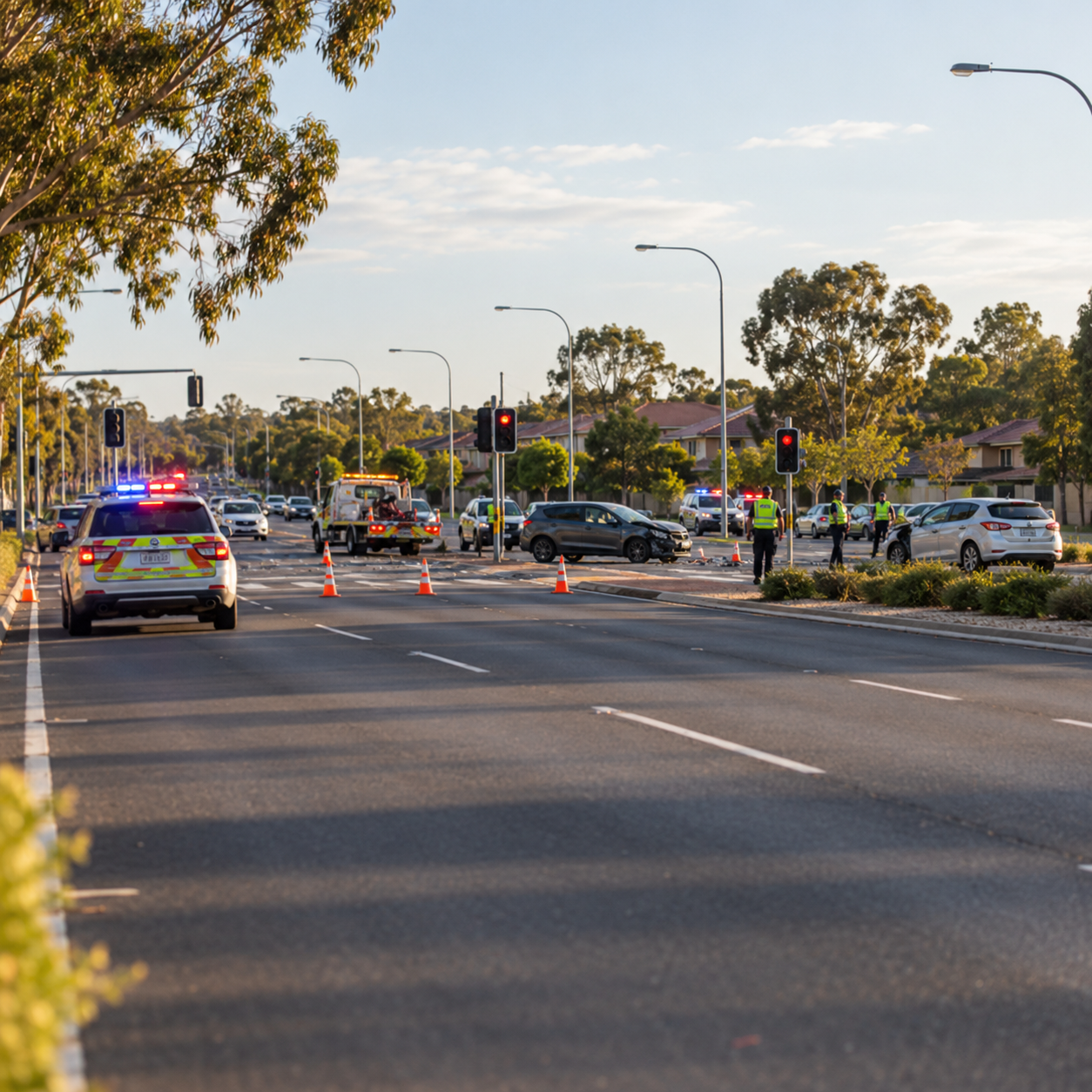
The impact left extraordinary damage. Aerial images reported by the ABC showed the front of a white sedan torn apart on the westbound side of South Street. The vehicle’s engine was thrown clear and was found around 50 metres away on the other side of the six-lane road. A second damaged vehicle was visible and a metal road sign was lodged in the bonnet of a black van farther away. These observations indicate the scale of the collision; they do not alone determine vehicle speed or who was responsible.
Firefighters, paramedics and police attended a scene that required both urgent medical care and traffic management. Earlier reporting said a person had been trapped inside one of the vehicles. South Street westbound between Vahland Avenue and Beasley Road was closed while emergency crews worked, affecting traffic through the area. The most important priority was treating injured people and securing a busy roadway strewn with debris, with later investigative work able to examine the vehicles and road environment.
Reports from several outlets said the pursuit involved a grey Renault Koleos alleged to have been stolen from a home in White Gum Valley earlier that day. Police reportedly located the vehicle later in the morning, after which it failed to stop. Those details were still emerging in the hours after the crash and must be attributed to police accounts or contemporaneous reporting. Being suspected of stealing a vehicle or refusing to stop is an allegation, not proof of the offences or of legal responsibility for the subsequent injury of another motorist.
The location matters. South Street is a major road serving several suburbs, with multiple lanes and busy junctions. A collision involving vehicles approaching an intersection during a police operation has consequences for people who may be doing nothing more unusual than driving to work, shops or appointments. That exposure to risk explains why the crash demands careful examination. It is not evidence, on its own, that every police pursuit is improper or that the response to this particular alleged theft was necessarily unjustified.
Different aspects of the case need to be kept separate. There is the reported initial vehicle theft, the police attempt to locate or intercept that vehicle, the pursuit through southern suburbs, the physical collision at Leeming, the medical condition of those hurt and the arrest of a person later in the day. Each stage has its own evidence and questions. A decision about one alleged offence cannot automatically answer whether the pursuit complied with policies or whether the collision could have been avoided.
Investigators reviewing a serious crash can consider footage from traffic cameras, nearby businesses, dashcams and responding vehicles if such material is available. They may also examine roadway marks, vehicle damage, traffic signals and eyewitness statements. It would be speculative to announce what that evidence will show before authorities have provided findings. No reliable conclusion about the exact speeds of the vehicles at impact was available in the primary ABC account reviewed for this report. Visual damage is not a substitute for a reconstruction.
For people following the case from afar, the presence of an unmarked police vehicle is another detail that requires context, rather than instant judgement. An unmarked car can be part of lawful policing, and its role in a pursuit may be assessed against the same broader safety expectations that apply to any police response. Conversely, the fact that officers were responding to a suspected crime does not remove the need to understand risk to other road users. Both considerations can be recognised without reaching a verdict ahead of an investigation.
The arrest of a suspect following the pursuit also needs precise wording. A person being taken into custody does not mean they were convicted of vehicle theft, dangerous driving or causing bodily harm. Charges may be laid later, and details may change as police establish which acts are supported by evidence. This article therefore does not attach a specific offence to the person reportedly arrested unless a verified charging statement becomes available. Readers should not infer guilt from an arrest or from the circulation of a suspect’s alleged identity online.
For the family of an older driver seriously hurt while using a public road, much of the detail about policy and police procedure is secondary to his condition. Hospital priority classifications describe the urgent response at a particular time. They do not tell the public what his full medical outlook will be or guarantee any particular recovery. Reports of critical injuries should not be inflated into claims of death or permanent disability, and updates must come from properly identified authorities or people entitled to speak for the patient.
Witness accounts can bring useful detail, including the sounds of a crash and what residents saw afterward. At the same time, a person who arrived after the impact may not know the full sequence that preceded it. Statements about a police vehicle’s apparent speed or a driver’s actions may be genuine impressions without providing a complete technical reconstruction. Investigators will have to weigh such information with objective records and other testimony. Reporting should preserve that difference rather than treat vivid eyewitness language as conclusive proof.
The damage seen on South Street is likely to prompt debate about the difficult balance between apprehending suspected offenders and avoiding additional danger. Police sometimes face a decision about whether continuing a pursuit could produce greater risks than disengaging, particularly in populated areas. Evaluating those choices requires knowledge of the particular threat, road conditions, communications, vehicle movements and policies that applied at the time. Those case-specific elements had not been independently established in full on Monday.
It would also be wrong to generalise from Leeming to claim that all stolen-car pursuits end in catastrophic crashes. One highly visible collision is a reason to examine what happened and whether lessons can be learned, not a statistically reliable basis for claims about the frequency or safety of pursuits across Western Australia. Any wider analysis of policing policy would need verified statewide data and the relevant policy text. This article is primarily about the people affected and the investigation into one specific incident.
The first public reports changed quickly during the afternoon. Initial dispatch information focused on a serious crash and the attendance of emergency services. Later accounts clarified that a police pursuit was involved, while subsequent reporting supplied details about the police vehicle and the elderly civilian. That progression is normal during a developing incident but requires care when scheduling a story for the following day. Facts such as hospital condition, charge status and investigative findings must be checked again before publication.
Residents of Leeming and surrounding suburbs were left to deal with road closures, congestion and shock as crews attended a major collision in an area used for ordinary daily travel. The public may reasonably expect an explanation of how the incident unfolded and what systems will review it. The answers are unlikely to come from one image, even a dramatic one showing extensive damage. They must come from a properly grounded account of the sequence and the decisions made by those involved.
The strongest verified account as of Monday evening is that a pursuit ended with a serious collision at South Street and Beasley Road, that an elderly driver suffered critical injuries, that two other adults received hospital care and that someone was taken into custody. Anything beyond those points, including blame, exact speeds, disputed driving manoeuvres and ultimate criminal charges, remains subject to investigation and later official confirmation. The immediate focus should remain on the injured man’s welfare and a transparent accounting of how the crash happened.






