Thomas Sewell has accused the Albanese government of effectively admitting to “treason” in its defence of laws used to prohibit White Australia, escalating the rhetoric around a High Court case that could test how far the Commonwealth can go in criminalising involvement with an organisation it has formally designated a hate group.
The nationalist activist made the accusation after the Commonwealth began advancing its position in the constitutional challenge brought by White Australia Party Inc and Sewell against the federal government.
Sewell claimed the government’s case amounted to an argument that political rights could be restricted to protect multiculturalism, comply with international human rights obligations and prevent psychological and social harm to communities targeted by hateful rhetoric.
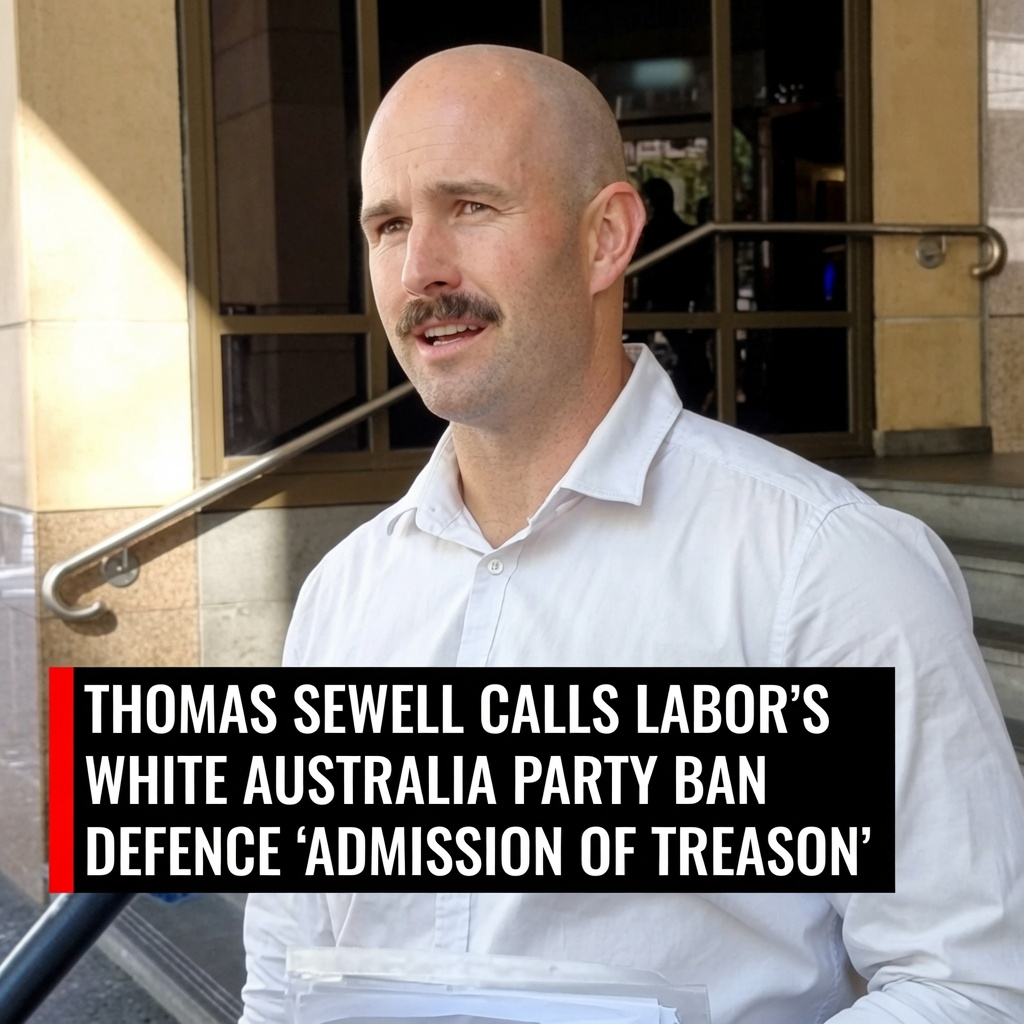
He characterised that position in explosive terms, describing it as an “open admission of treason” and accusing Labor of using federal power to eliminate political opposition.
Those are Sewell’s allegations.
They are not findings made by the High Court, and the Commonwealth has not admitted to treason.
But beneath the inflammatory language sits a constitutional case with consequences that may extend well beyond Sewell, White Australia or the ideology associated with the organisation.
The High Court’s own published judgment confirms the plaintiffs are challenging the validity of the new prohibited hate group regime on multiple grounds.
They argue the disputed provisions are not supported by an affirmative head of Commonwealth legislative power. They also argue the laws impair the Constitution’s implied freedom of political communication and are incompatible with Chapter III, which concerns the federal judiciary and the exercise of judicial power.
The Full Court is scheduled to consider questions raised by the case through a special case in the fortnight beginning 7 September 2026.
That means the most important question is not whether the High Court agrees with Sewell’s description of the government.
It is whether Parliament crossed a constitutional boundary when it created a system capable of prohibiting an organisation and then attaching serious criminal consequences to specified forms of involvement with it.
White Australia was formally listed on 15 May
The legal dispute began after Parliament enacted the Combatting Antisemitism, Hate and Extremism (Criminal and Migration Laws) Act 2026 in January.
The legislation inserted Part 5.3B into the Commonwealth Criminal Code and established the prohibited hate group framework.
According to the High Court’s published judgment, the stated objects of the regime include protecting the Australian community against social, economic, psychological and physical harm, as well as the promotion of violence, by prohibiting organisations connected with conduct constituting a hate crime.
The framework provides a process under which an organisation can be specified as a prohibited hate group by regulation made by the Governor-General.
White Australia was listed on 15 May 2026.
The government describes the organisation as the group previously known as the National Socialist Network.
Home Affairs Minister Tony Burke said at the time that the listing was intended to prevent organisations from spreading hatred, normalising extremist rhetoric and providing a platform for radicalisation.
Burke said there was “no place for racial supremacy in Australia”.
Once an organisation is listed, the consequences are substantial.
The High Court’s June judgment identifies offences covering conduct including intentionally directing the activities of the prohibited group, intentionally remaining a member subject to statutory qualifications, recruiting another person to participate in the organisation and providing funds with the intention of helping the organisation expand or continue to exist.
The legislation also deals with other forms of engagement.
Some offences carry severe prison sentences.
The practical effect, as the explanatory material quoted by the High Court put it, is to prevent a listed organisation from “legitimately operating in Australia” by criminalising particular forms of engagement with it.
That sentence is central to the constitutional controversy.
The government says the regime protects Australians from hate, violence and radicalisation.
The plaintiffs say the Commonwealth has created a mechanism that can suppress political organisation and communication before a court has determined criminal guilt against the organisation itself.
The case is not simply a free-speech argument
Public discussion of the challenge has often focused on freedom of speech.
Australia, however, does not have a broad constitutional guarantee of free speech equivalent to the First Amendment in the United States.
The constitutional doctrine at the centre of the White Australia case is narrower.
The High Court has recognised an implied freedom of communication concerning government and political matters because Australia’s system of representative and responsible government requires electors to be capable of communicating about political choices.
Importantly, the implied freedom is generally understood as a restriction on legislative power rather than a personal right belonging to an individual in the same way as an American constitutional speech right.
That distinction matters.
A person cannot simply argue that a law is invalid because it restricts something they want to say.
The constitutional analysis asks whether the law burdens political communication and, if it does, whether the burden is constitutionally justified under the applicable legal tests.
White Australia and Sewell argue the prohibited hate group laws impair that freedom.
They also contend the legislation is unsupported by Commonwealth legislative power.
The High Court judgment records a further argument that the regime is incompatible with Chapter III of the Constitution.
Those are serious legal questions, regardless of the political identity of the plaintiffs.
Indeed, during the earlier injunction proceedings, the Commonwealth did not dispute that the case raised a serious question to be determined concerning the consistency of the Act with the implied freedom of political communication.
That was not a concession that the legislation is unconstitutional.
It was also not an admission that Sewell’s case will succeed.
It means the constitutional issue is sufficiently serious to be determined in the substantive proceedings.
The High Court has already refused to suspend the regime
Sewell and White Australia sought temporary orders designed to preserve their position while the constitutional challenge proceeded.
On 4 June, Chief Justice Stephen Gageler dismissed the interlocutory application.
The plaintiffs had sought, among other things, an order restraining the operation of the regulations and an injunction preventing the Commonwealth from giving effect to or enforcing the listing against them.
The Chief Justice found significant problems with the relief sought.
In one part of the judgment, Gageler CJ explained that an order simply “restraining the operation” of regulations was not a form of judicial order known to law in the manner proposed.
The judgment drew a distinction between restraining a person from acting and attempting to injunct legislation itself.
On the broader injunction question, the Court considered established principles applying when legislation is constitutionally challenged.
Until legislation is held invalid, courts generally respect and defer to the enactment of Parliament unless compelling grounds justify interim intervention.
The plaintiffs attempted to draw an analogy with the historic Communist Party case.
That comparison is likely to remain one of the most politically charged elements of the challenge.
The shadow of the Communist Party case hangs over the dispute
In 1951, the High Court invalidated the Communist Party Dissolution Act.
The decision remains one of the most famous constitutional judgments in Australian history.
The Menzies government’s legislation had declared the Australian Communist Party unlawful and provided mechanisms affecting affiliated organisations, property and individuals.
The High Court ultimately found the legislation invalid.
White Australia and Sewell argue the new prohibited hate group provisions are, in relevant respects, comparable to the Communist Party legislation.
The Commonwealth disputes that characterisation.
The June judgment also demonstrates why the historical analogy cannot simply be treated as conclusive.
Chief Justice Gageler examined the interim orders made during the Communist Party litigation and noted the particularly severe and potentially irreversible consequences that could have occurred before the constitutional challenge was decided.
Those consequences included the divesting of property and the deprivation of livelihoods.
The Chief Justice found the present circumstances did not justify the temporary relief sought by White Australia.
The dismissal of the injunction application did not decide the ultimate constitutional validity of the 2026 legislation.
That distinction is critical.
White Australia lost its attempt to obtain temporary protection from the operation of the law.
It has not yet lost the substantive constitutional case.
Equally, the fact that the High Court will hear the challenge does not mean the plaintiffs are likely to win.
The constitutional questions remain unresolved.
Sewell’s ‘treason’ claim goes far beyond the legal record
In his latest public response, Sewell presented the Commonwealth’s position as proof that the government believes political criticism of Jewish influence, multiculturalism and international institutions can be prohibited.
He alleged that the government’s submissions showed White Australians were being denied political rights when their political activity conflicted with those interests.
He then escalated the allegation by claiming the government had acted at the request of Jewish organisations.
No High Court finding supports that accusation.
Nor does the published June judgment record any Commonwealth admission of treason.
The government’s publicly stated position is that White Australia was listed because the Commonwealth regards its conduct as involving racial supremacy, hateful rhetoric and radicalisation risks.
The explanatory case for the listing also relies on the prevention of physical, psychological and social harm.
The government argues restrictions associated with the regime are necessary and proportionate to legitimate protective objectives.
That is the legal and political position the Commonwealth must defend.
Sewell’s description of it as treason is advocacy by a plaintiff in an active constitutional dispute.
It should be reported as his claim, not as an established description of the Commonwealth’s conduct.
Yet the government’s willingness to acknowledge that the regime limits expression, association and participation-related interests creates a genuine point of controversy.
The argument is not that the laws impose no burden.
The argument is that the burden is legally justified.
That is precisely where the High Court’s constitutional analysis becomes important.
International treaties are part of the debate — but they do not automatically override the Constitution
Sewell has also attacked the government’s references to international human rights treaties.
Explanatory material associated with the listing discusses Australia’s obligations under the International Covenant on Civil and Political Rights and the International Convention on the Elimination of All Forms of Racial Discrimination.
Australia has ratified both treaties.
The government’s human rights analysis considers whether restrictions imposed by the prohibited hate group framework are compatible with protected rights and whether limitations are necessary, reasonable and proportionate.
Sewell has portrayed this as foreign institutions imposing sovereign law on Australians.
That description oversimplifies the legal position.
An international treaty does not, merely because Australia has ratified it, automatically become directly enforceable domestic law in every respect.
Parliament may legislate in connection with Australia’s international obligations, and the Commonwealth Constitution gives the federal Parliament an external affairs power.
But legislation enacted by Parliament remains subject to the Constitution.
If the High Court concludes the prohibited hate group regime exceeds Commonwealth legislative power or infringes a constitutional limitation, reference to an international treaty cannot simply make an otherwise invalid law valid.
Conversely, the mere involvement of international treaty obligations does not establish treason or unconstitutional foreign control.
The legal question is about the scope of Commonwealth power and constitutional limits.
The case could affect groups far removed from White Australia
This is why civil liberties concerns surrounding the legislation cannot be dismissed solely by pointing to the ideology of the first major plaintiff challenging it.
White Australia’s racial politics will make it an unsympathetic test case for many Australians.
That does not answer the constitutional question.
Constitutional limits are tested by the legislation Parliament actually enacted, not by whether judges or the public approve of the person bringing the challenge.
If a statutory power is constitutionally valid, future governments may be able to use that power in circumstances contemplated by the law.
If the law is invalid, it does not become valid because its first prominent target is widely condemned.
The prohibited hate group framework includes parliamentary review mechanisms.
The Parliamentary Joint Committee on Intelligence and Security announced a review of the White Australia listing in June, noting that the organisation was the second group listed under the new framework.
Such oversight is relevant to the operation of the scheme.
But parliamentary review and constitutional review perform different functions.
A parliamentary committee can examine a listing and make recommendations.
The High Court determines whether Commonwealth legislation and executive action comply with the Constitution.
The September case will therefore be watched by constitutional lawyers, civil liberties advocates and governments for reasons extending beyond the immediate organisation involved.
The real test begins in September
The political rhetoric surrounding the case is already intense.
The Albanese government says the prohibited hate group regime is part of a broader response to antisemitism, hate and extremism and is necessary to protect Australians from organisations that promote hatred and radicalisation.
Sewell says the legislation gives the Commonwealth power to destroy political opposition and criminalise political organisation.
Those positions are almost impossible to reconcile politically.
The High Court’s task is different.
It will not be asked to decide whether Sewell’s ideology is attractive, whether the government’s political messaging is persuasive or whether Australians approve of White Australia.
The constitutional challenge concerns legislative power, political communication and the limits imposed by Australia’s constitutional structure.
The Court has already refused to shield White Australia from the law while the case proceeds.
At the same time, the published judgment confirms there is a serious constitutional question to be determined concerning the implied freedom of political communication.
That combination explains why neither side can yet claim final victory.
Sewell can call the Commonwealth’s defence “treason”.
The government can describe White Australia as a racial supremacist organisation that threatens social cohesion.
But the legal outcome will turn on neither slogan.
In September, seven High Court justices may be asked to confront a much more difficult question: how far can the Commonwealth go in protecting the community from organised hate before the machinery used to suppress a group places an unconstitutional burden on Australia’s system of political communication and government?
The answer could define the reach of Australia’s new hate-group laws for years to come.






