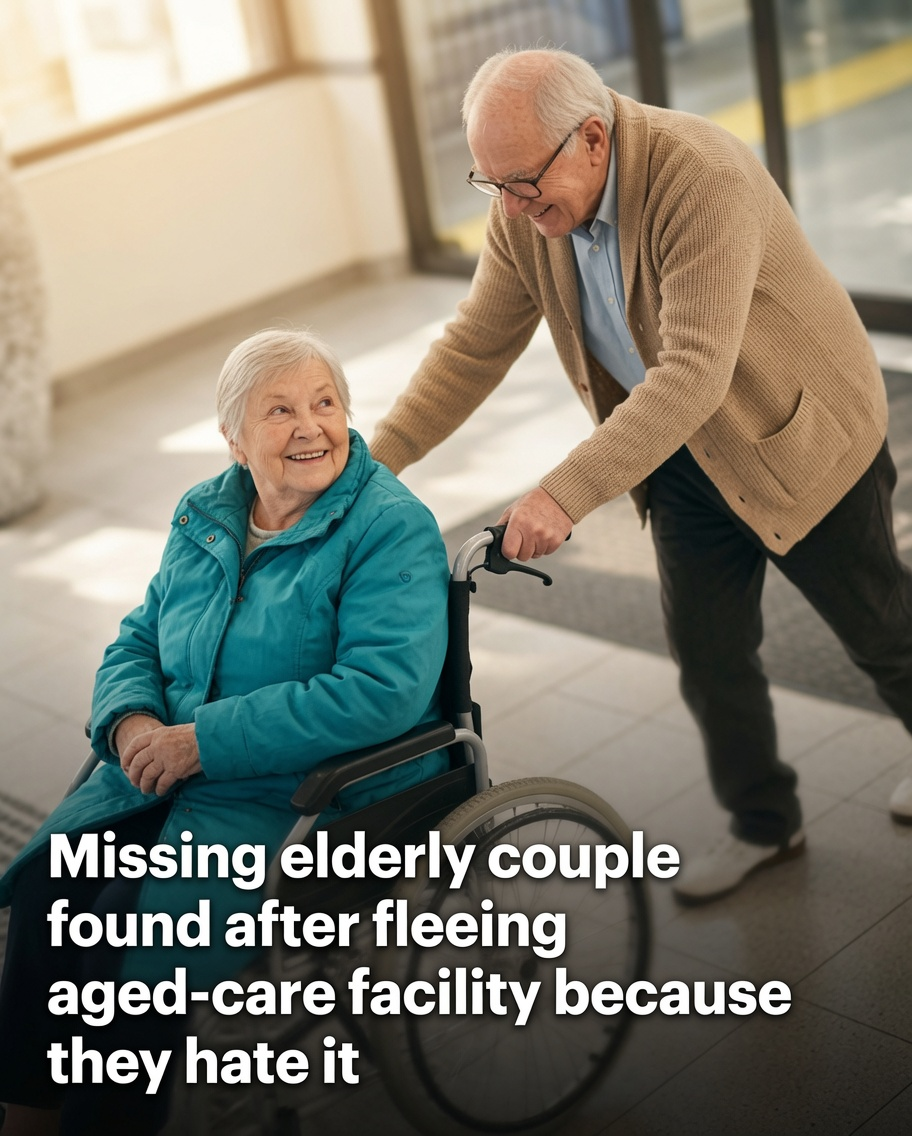
For 65 years, Colin and Claudette Geraghty had faced life together. When dementia and declining health pushed them into care, it appears the elderly couple wanted one thing more than anything else: to go home together.
Colin, 89, and Claudette, 83, sparked an urgent police search after leaving the Ryman Nellie Melba Retirement Village at Wheelers Hill in Melbourne’s south-east about 11.15am on Saturday.
They had only recently entered respite care.
By Sunday night, after roughly 32 anxious hours and a public appeal from their family, police confirmed the couple had been located safe and well in the Maryborough area, about 168 kilometres north-west of Melbourne.
The ending brought enormous relief.
But what emerged during the search transformed the disappearance from a straightforward missing-person case into a deeply human story about ageing, love, dementia and the painful line between keeping someone safe and allowing them to feel in control of their own life.
“They didn’t really like being in care and I think they just wanted to be home together,” their daughter, Linda McKelvie, said while her parents were missing.
Her father, she explained, believed he could still care for his wife.
“Dad thinks he can help her … they feel like all their choices are being taken away.”
The couple had been married for 65 years.
They first met on a dancefloor.
Decades later, with Colin living with Alzheimer’s disease and Claudette living with vascular dementia and suffering seizures, the bond between them remained at the centre of how they understood their lives.
That history helps explain the message Colin left for his daughter on the day he disappeared with his wife.
“Don’t worry, thank you for your help, I’ll make sure I look after her,” he said.
To a family aware of his Alzheimer’s diagnosis, the message could not remove the danger.
To Colin, it may have represented something else entirely: a husband doing what he believed he had always done.
Looking after his wife.
The couple had left the retirement village and travelled to The Glen Shopping Centre on Springvale Road. They bought their daily medication and were last seen leaving about midday in their white 2015 Mazda 2.
The fact they obtained medication suggested an element of purpose to their movements. But their medical conditions meant every passing hour increased concern.
Colin’s Alzheimer’s diagnosis affected his memory. Claudette’s vascular dementia and seizures required careful management. Both relied on daily medication.
When neighbour Sharon Jeikishore checked on them later that afternoon and received no answer, the alarm was raised.
Linda’s fear was immediate.
“Please come home mum and dad, we are all so worried about you,” she pleaded publicly.
“Even the grandkids. We are all so worried about you.”
Police and the family searched for the couple as information about their movements emerged.
There were reported sightings and attempts to piece together where the Mazda had travelled. The pair had moved a significant distance from Wheelers Hill by the time they were located near Maryborough.
Police eventually delivered the news everyone had hoped for: Colin and Claudette had been found safe and well.
Yet the reason they left is the part of the story that will stay with many Australian families.
According to Linda, her parents had moved into respite care only days earlier, on the previous Tuesday.
The transition had been difficult.
The facility had already contacted police earlier in the week after the couple attempted to leave for the first time.
Then, on Saturday, they left again.
It would be easy to describe their actions simply as the result of dementia.
That may be part of the clinical reality. Alzheimer’s disease and vascular dementia can affect memory, judgement, orientation and a person’s ability to recognise risk.
But dementia does not erase emotion.
It does not erase attachment.
And it does not necessarily erase a person’s understanding that the world around them has suddenly changed.
One week, Colin and Claudette were living a familiar life shaped by decades of marriage and routine.
The next, they were in respite care.
Other people were concerned about their medication, their movements and their safety. Decisions that may once have been ordinary parts of their daily life had become matters requiring supervision.
For their family, those changes were about protection.
For the couple, according to their daughter’s account, they felt as though their choices were disappearing.
Both realities can exist at the same time.
That is what makes dementia care so difficult.
Families do not usually arrive at aged care because they have stopped loving someone.
Often, they arrive because love is no longer enough to manage the risk alone.
A person with dementia may become lost in a neighbourhood they have known for 40 years. They may forget whether they have taken medication. They may continue to believe they can drive safely. They may leave a stove on or become confused about the time of day.
A spouse who has spent a lifetime providing care may also be elderly, unwell or living with cognitive impairment.
In Colin and Claudette’s case, the family’s concern was particularly complicated because both husband and wife had significant health issues.
Colin believed he could look after Claudette.
His daughter said he did not fully recognise his own memory problems.
From his perspective, the promise to care for his wife may have seemed entirely reasonable.
From his family’s perspective, it could not guarantee either of them was safe.
This is the brutal calculation thousands of Australian families eventually confront.
When does helping become taking control?
When does protecting a parent require overriding what that parent says they want?
How much risk should an older person be allowed to accept in order to preserve independence?
There are no easy universal answers.
Australia’s aged-care system is increasingly supposed to approach those questions through the rights of the older person rather than treating residents merely as recipients of services.
The new aged-care framework places greater emphasis on dignity, self-determination, independence and a person’s ability to make decisions about their own care and life.
Government guidance is also explicit that restrictive practices should be used only as a last resort to prevent harm, and in the least restrictive way appropriate to the circumstances.
That principle sounds straightforward on paper.
In real life, it can become extraordinarily complicated.
Imagine a resident with dementia standing at the door of a facility and saying they want to go home.
Do they understand where home is?
Can they navigate there safely?
Do they understand their medical needs?
Is preventing them from leaving an act of care, or an unacceptable restriction on their liberty?
The answer may depend on the person’s condition, capacity, care plan and immediate risk.
But for the person at the centre of the decision, the experience can feel much simpler.
A door that used to open now does not.
A car they used to drive is no longer available.
A family member says no.
A staff member says they cannot leave.
Choices disappear one by one.
For people who have spent eight or nine decades making their own decisions, that loss of control can be profound.
The Geraghtys’ story is particularly powerful because they were not trying to be independent from each other.
They appear to have wanted to remain together.
Colin’s message was not the declaration of a man planning a solitary escape.
“I’ll make sure I look after her.”
Those words contain the entire history of a marriage.
For 65 years, husband and wife had presumably built routines around one another. Marriage at that length becomes more than companionship. It shapes identity.
One person knows how the other takes their tea.
They know which stories have been told a hundred times.
They know the names of relatives who died decades ago and the private jokes nobody else understands.
They may finish each other’s memories when one begins to fade.
Dementia complicates all of that, but it does not make the relationship meaningless.
Research and dementia-care advocacy have increasingly emphasised person-centred care because a diagnosis does not reduce a human being to a collection of symptoms.
The person still has preferences, relationships, history and emotional needs.
For couples, maintaining connection can be especially important when the surrounding world is becoming confusing.
A familiar spouse may be one of the strongest remaining anchors to a life that still feels recognisable.
This does not mean Colin and Claudette were safe to travel alone.
The police search was necessary. Their family’s fear was justified. Their health conditions created genuine risks and the fact they were found safe should not obscure what could have happened during those 32 hours.
But the danger of their journey does not make the emotion behind it irrelevant.
Good care has to understand both.
Australia has spent years confronting failures in aged care.
The Royal Commission into Aged Care Quality and Safety exposed a system in which older Australians too often experienced neglect, poor-quality care and a loss of dignity.
The reforms that followed were designed, in part, to move the system towards a more person-centred and rights-based model.
That shift matters because institutional efficiency and human dignity do not always point in the same direction.
From an administrative perspective, the safest resident may be one whose movements are constantly controlled.
From a human perspective, a life without meaningful choice can become its own form of suffering.
Aged-care workers are placed in the middle of that tension.
They have responsibilities for residents’ safety. They deal with complex medical conditions, cognitive decline and behaviours that can change quickly. They may be caring for multiple people with different needs while also communicating with distressed families.
It is unfair to reduce every difficult decision to a simple accusation that a facility is “locking people up”.
At the same time, Australia’s own laws and guidance recognise the danger of unnecessarily restricting older people.
The goal must be care that is safe without automatically removing every possible choice.
That can require individual behaviour support, careful assessment, family involvement and a willingness to understand why a person is trying to leave rather than focusing only on stopping them.
Sometimes the answer may be confusion.
Sometimes it may be fear.
Sometimes the person may be searching for a home that no longer exists.
And sometimes, perhaps, they simply want to be with the person they have loved for most of their life.
Colin and Claudette were fortunate.
They were found.
Their family received the call it had desperately wanted.
The public appeal did not end in tragedy.
But the story should not be remembered only as an unusual escape from an aged-care facility.
It is a reminder of what families lose gradually when dementia enters their lives.
First there may be forgotten names or repeated questions.
Then missed medication.
Then concern about driving.
Then a conversation about whether Mum or Dad can still live safely at home.
Eventually, adult children may find themselves making decisions for the people who once made every decision for them.
Those choices can be necessary and still be heartbreaking.
Linda’s public plea captured that conflict.
She wanted her parents home because she loved them.
Her parents, it appears, wanted to go home because they loved each other.
There was no villain in that contradiction.
Only a family trying to navigate the consequences of ageing and illness.
Colin had promised he would look after Claudette.
After 65 years of marriage, perhaps that promise was so deeply embedded in him that even Alzheimer’s could not easily dislodge it.
His family knew love alone could no longer remove every risk.
Colin may not have understood that.
What he seemed to understand was that his wife was beside him.
And he wanted to take her home.






