Sometimes there is no family rushing down a hospital corridor.
No son trying to make the last flight home.
No daughter sitting beside the bed with a hand wrapped around Mum’s.
No husband or wife quietly remembering the decades that came before this final room.
Sometimes, when a person’s life is coming to an end, there is simply nobody who can be there.
They may never have had children. Their partner may have died years earlier. Their relatives may live interstate or overseas. Friends may be elderly, unwell or unable to reach the hospital in time.
And sometimes a family has spent days beside a bed, exhausted and frightened, only to discover that the final hours arrive during the brief period when they have gone home to shower, sleep or collect themselves.
Death does not always wait for the people who love us to be ready.
That is where a remarkable group of Australian volunteers can step in.
In Western Australia, Amana Living operates a program with a name that explains its purpose in four words: No One Dies Alone.
Known as NODAC, the No One Dies Alone Campaign provides trained volunteers to sit with residents approaching the end of life when family or friends cannot be present.
The volunteers are not there to provide medical treatment.
They are there to provide something much simpler.
A human presence.
Sometimes that means talking.
Sometimes it means reading.
Sometimes music is played.
And sometimes there is nothing to say at all.
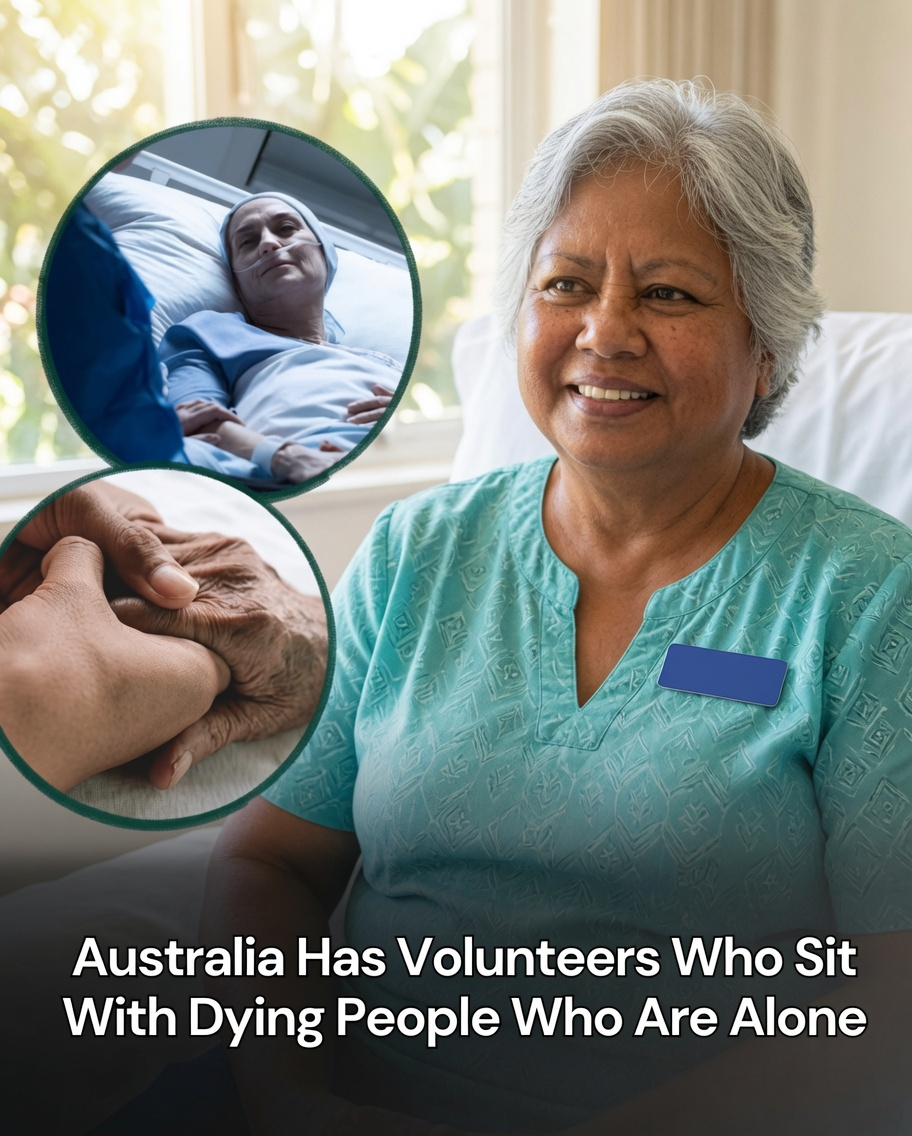
A volunteer may simply sit quietly beside the bed and hold a person’s hand.
For somebody who has lived 70, 80 or 90 years, the last experience of human contact may come from a person who was a stranger only hours earlier.
That stranger stays anyway.
The purpose is not to stop death — it is to make sure somebody is there
Modern hospitals are extraordinarily good at doing things.
They test.
They scan.
They operate.
They monitor.
They administer medication and respond to emergencies with systems built around speed, expertise and precision.
But dying creates a different kind of need.
There can come a point when the most important question is no longer what medicine can fix.
The question becomes how a person will be cared for as life reaches its end.
Palliative care is built around that distinction.
Its aim is to improve quality of life for people with serious, life-limiting illness and to support families and carers. As death approaches, care can become more intensive, with attention to pain, symptoms, psychological needs and the person’s wishes.
But doctors and nurses cannot remain continuously at every bedside.
A nurse may deeply care about a dying patient and still have medications to administer, observations to complete and other patients requiring immediate attention.
Clinical staff have responsibilities that a volunteer does not.
The volunteer can sit.
That sounds almost absurdly small.
Until you imagine the alternative.
A quiet room.
A ceiling.
The sound of equipment.
Footsteps occasionally passing outside the door.
And nobody beside the bed.
No One Dies Alone programs are based on the idea that presence itself has value.
Amana Living says its dedicated volunteers support residents when family or friends cannot be with them in their final hours.
That support is described as emotional and holistic.
It is not about pretending the volunteer is family.
It is about recognising that a person remains a person until the end.
Sometimes the most important job is simply knowing how to be quiet
We tend to imagine companionship as conversation.
When somebody is lonely, we think we should talk to them.
When somebody is frightened, we search for reassuring words.
When somebody is dying, many of us become anxious about saying the wrong thing.
Experienced end-of-life companions learn that words are not always required.
A person nearing death may be unconscious.
They may be too weak to speak.
They may drift in and out of awareness.
They may not respond in a way the volunteer can recognise.
The job does not suddenly become meaningless.
The companion can still sit nearby.
They can speak gently.
They can read if that is appropriate.
They can help create a calm environment.
They can offer touch when it is welcomed and permitted.
Or they can simply remain.
That ability to remain is more difficult than it sounds.
Most of our lives are structured around fixing problems.
If something hurts, we want to stop the pain.
If somebody cries, we want to make them feel better.
If a situation becomes uncomfortable, we search for an action that will restore normality.
There is no action that restores normality when a person is actively dying.
Companionship at the end of life requires accepting that limitation.
You cannot save the person.
You cannot reverse the illness.
You cannot promise tomorrow.
You can stay.
For some volunteers, that becomes the entire meaning of the work.
Australia already has a broader tradition of palliative care volunteering
The idea of ordinary people supporting the dying is not confined to one Western Australian program.
Volunteer involvement has long been part of Australia’s palliative care and hospice landscape.
Palliative Care Australia has documented the work of end-of-life companions such as volunteers with Warrnambool & District Community Hospice in Victoria.
In one account, retired nurse Sandra Mugavin described volunteering as primarily being a companion to people who wanted to die at home and to their families.
The work was not casual.
The hospice provided an eight-week training course. Volunteers completed police checks, immunisation requirements and confidentiality processes before beginning.
They also had support available if concerns arose.
That detail matters because end-of-life volunteering should never be romanticised as simply finding a kind person and placing them beside a dying stranger.
Death can be confronting.
Families can be exhausted.
Illness can change a person’s behaviour and communication.
Cultural, spiritual and personal wishes differ enormously.
Volunteers need boundaries.
They need training.
They need to understand when something is a matter for clinical staff.
They also need support for themselves.
A compassionate person can still be deeply affected by sitting beside somebody who dies.
That is why structured programs matter.
They turn goodwill into safe, organised companionship.
Many volunteers understand loss because they have lived through it
There is something particularly moving about older Australians volunteering in end-of-life care.
By the time somebody reaches their 60s, 70s or beyond, death is rarely theoretical.
They may have buried parents.
They may have lost a husband or wife.
They may have sat beside a brother, sister or close friend during a long illness.
They know what it is to receive the phone call.
They know the strange exhaustion of a hospital vigil.
They know that families can love somebody deeply and still become physically unable to remain awake beside a bed for another night.
Some retirees also reach a stage of life where they begin asking a different question about time.
Not how to fill it.
How to use it.
Australia’s ageing population is often discussed almost entirely as a problem.
We talk about health costs, aged care beds, the pension and the shrinking proportion of working-age taxpayers.
Those pressures are real.
But an ageing population also contains an extraordinary reservoir of human experience.
Retired nurses.
Teachers.
Parents.
Carers.
People who have spent decades learning patience, resilience and the ability to sit through difficult moments without needing to make themselves the centre of the room.
Not every older Australian will want to volunteer around death.
Many would find it too confronting, particularly after their own experiences of loss.
But for those who choose the work, life experience can become a form of service.
The person in the bed may not know the volunteer’s story.
They may never hear about the husband who died five years earlier or the mother whose final hours changed the volunteer’s understanding of death.
None of that needs to be explained.
Experience can be present without being announced.
Families can love somebody and still not be there at the exact moment of death
There is another reason programs like No One Dies Alone matter.
They can relieve a particular kind of guilt.
Families sometimes imagine that a “good death” requires everybody to be gathered around the bed at the final moment.
Real life is less orderly.
A dying process may continue for days.
Relatives become exhausted.
Children need to be collected.
Pets need feeding.
People have to eat.
Somebody goes home for a shower.
A son drives to the airport to collect his sister.
A daughter steps outside to make a phone call.
Then the person’s breathing changes.
Death comes.
Families can carry enormous guilt over that timing.
They tell themselves they should have stayed another hour.
They replay the decision to leave the room.
They imagine their loved one abandoned.
A trained companion cannot remove grief.
But knowing somebody remained at the bedside can matter.
The family can know the room was not empty.
Somebody was there.
Somebody noticed.
Somebody treated those final minutes as worthy of attention.
That is a small mercy.
Small mercies can become enormous after a death.
Australia’s palliative care challenge makes community support increasingly important
These volunteer programs also sit inside a much larger national problem.
Australia is ageing.
More people are living longer with chronic and progressive illnesses.
Dementia is now a leading cause of death, yet palliative care is still often misunderstood as something reserved for the final days of cancer.
Recent reporting on Australian palliative care has highlighted significant gaps in access.
Palliative Care Australia has pointed to available national data indicating that only 38 per cent of people who died from a progressive illness and were therefore likely to benefit from palliative care accessed specialist palliative care services.
The figures require caution because the underlying 2019–20 data was affected by the COVID period and does not capture every form of palliative support delivered through general practice.
But the disparities remain troubling.
People dying from cancer have historically been far more likely to access specialist palliative care than people dying with organ failure, frailty or dementia.
Many people also enter specialist palliative care very late.
Recent analysis cited a median of just 15 days between the beginning of specialist care and death for those who accessed it.
This is not because palliative care is supposed to begin 15 days before somebody dies.
It can support people much earlier.
It can help manage symptoms, plan future care, support carers and improve quality of life during a serious illness.
The problem is that patients and families may not understand what palliative care offers.
Some hear the words and believe medicine has given up.
Referrals may also occur too late.
Services can vary depending on where a person lives.
Volunteer companionship cannot solve those structural problems.
A person holding a hand is not a substitute for a palliative care specialist, nurse, social worker or properly funded health service.
It would be dangerous to pretend otherwise.
But health systems are also built around human beings.
Community support can complement professional care in ways a medical budget cannot easily measure.
Australia’s compassionate communities movement has long argued that dying, death and bereavement should not be treated solely as matters for health professionals.
Communities have a role too.
Neighbours.
Friends.
Volunteers.
Local organisations.
People willing to cook a meal, give a carer a break or sit quietly beside a bed.
The health system manages clinical care.
A community can help make sure the person inside that system is not forgotten.
It is the kind of work almost nobody notices
There are volunteer roles that come with applause.
People see the uniform.
They see the fundraising total.
They see the community event.
End-of-life companionship is different.
The most meaningful moment may happen at 3am in a quiet room.
There may be no photograph.
No social media post.
No person awake to say thank you.
The resident may be unconscious.
The family may never meet the volunteer.
The work can end with a nurse entering the room and confirming that a life has finished.
Then the volunteer eventually goes home.
That is all.
And perhaps that is why the work is so powerful.
It is an act of care stripped of almost every reward we normally attach to generosity.
The person beside the bed cannot improve the volunteer’s career.
They cannot return the favour next year.
They may not be able to speak.
There is no long-term relationship to build.
There is only a human being approaching death and another human being deciding that this matters.
Nobody can promise how the final moment will come
Most of us avoid thinking about our own death.
We plan birthdays.
We plan holidays.
We plan retirement.
We make lists for next week and worry about appointments three months from now.
Death sits somewhere beyond the edge of the calendar.
Until it does not.
Perhaps we will be surrounded by family.
Perhaps somebody we love will be holding our hand.
Perhaps our final hours will happen at home in a familiar room.
But life makes no such guarantee.
Some people will reach the end after outliving almost everyone they knew.
Some will have families separated by thousands of kilometres.
Some will be estranged.
Some will simply die at an hour when the people who love them cannot arrive in time.
Programs such as No One Dies Alone begin with a simple refusal to accept that an empty room must be the final answer.
The volunteer cannot change the ending.
They cannot give the person another year.
They cannot bring back a partner who died decades earlier or put an adult child on a faster flight.
They can pull up a chair.
They can sit down.
They can stay.
After 80 or 90 years of birthdays, disappointments, ordinary Tuesdays, first kisses, bad jobs, family arguments, Christmas lunches and all the millions of small moments that make a human life, perhaps that is not such a small thing.
Nobody’s final view should have to be an empty hospital room and a ceiling.
Sometimes dignity at the end of life is highly specialised medicine.
Sometimes it is pain relief.
Sometimes it is careful planning and a family given the support to cope.
And sometimes it is simply another person sitting beside you, holding your hand, making sure that when your time comes, you do not have to leave the world entirely alone.






