There is an old rule in media: if you are going to take a swing at somebody, make sure you are not accidentally writing their next advertising campaign.
This week, The Australian turned its attention to Karl Stefanovic’s relationship with Ringers Western, the fast-growing Australian country clothing brand backing his independent podcast.
The newspaper’s Margin Call column was not impressed by Stefanovic’s interview with James, Emma and Matteo Salerno, the siblings behind the brand.
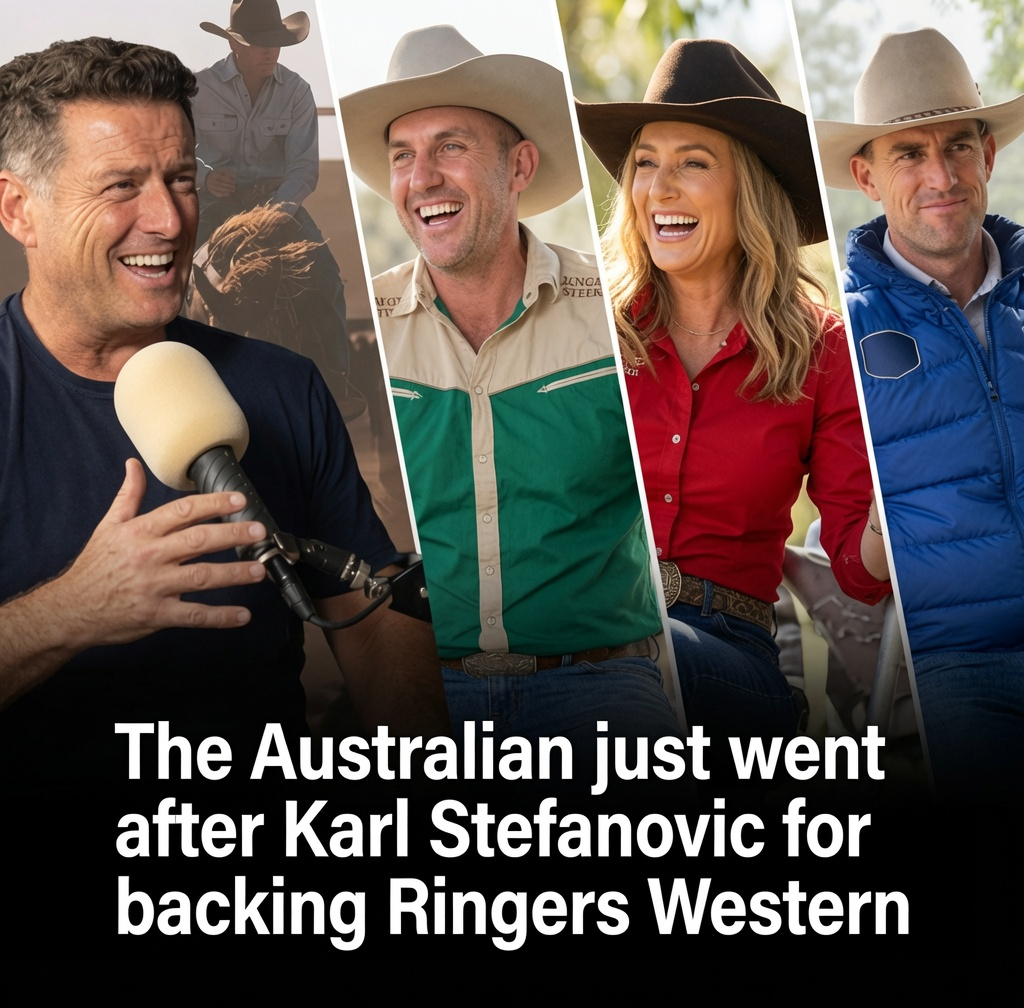
Its criticism was specific. Stefanovic, it argued, had given the family a soft interview while failing to properly interrogate the controversial history surrounding their father, James Gino Salerno, and the Kimberley community he once led.
That history is serious and it should not be casually erased.
Salerno has denied that the community was a cult. He was also previously convicted over sexual abuse allegations, but that conviction was set aside on appeal. Charges were ultimately withdrawn in 2023 after a second retrial, with Salerno maintaining his innocence.
There is a legitimate journalistic argument about whether Stefanovic should have explored that history in greater depth when interviewing the Salerno siblings.
But there is another question worth asking.
What exactly happens when a national newspaper tries to diminish a business by drawing millions of Australians’ attention to an extraordinary Australian business story they may never have heard before?
Because Ringers Western is no obscure vanity label attached to a celebrity podcast.
It is a business reportedly worth about $70 million. It has built a national following around country clothing, workwear and an identity deeply connected to regional Australia. Its ranges extend across men’s, women’s and children’s clothing, boots, denim, shirts, hats, activewear and babywear.
And its origin story is almost absurdly well designed for the modern media age.
A shirt concept. A crayon. A Weet-Bix packet. A campfire in the Kimberley.
You could spend six months in a Sydney advertising agency and struggle to manufacture a brand story half as memorable.
The attack has a problem: the business story is genuinely compelling
Ringers Western was born from the world its branding still celebrates.
The company’s story traces its beginnings to a cattle station in Western Australia’s Kimberley region, where the original concept for a shirt was famously sketched in crayon on a Weet-Bix packet.
From that unlikely starting point grew a clothing business that has moved well beyond a niche western audience.
The company has developed relationships across Australian sport and built a product catalogue broad enough to compete for customers who may never have worked on a cattle station in their lives.
That is the clever part of the Ringers Western story.
Country brands have always existed in Australia. The commercial challenge is crossing the invisible border between being authentic enough for rural customers and accessible enough for metropolitan buyers.
Get it wrong in one direction and the brand becomes costume clothing for city people playing cowboy on a weekend.
Get it wrong in the other direction and the business remains trapped in a narrow market with limited room to scale.
Ringers Western appears to have found a powerful middle ground.
Its branding is unapologetically country. Its visual identity, language and product positioning do not appear embarrassed by the Australia they come from.
But the business has also understood modern retail, social media, sports partnerships and the value of building a tribe around a brand rather than simply selling shirts.
That matters because Australian retail is brutal.
Consumers have access to global brands at the tap of a phone. Online advertising costs can punish growing businesses. Fashion trends change rapidly. Inventory mistakes can destroy cash flow. Customers who claim to love Australian brands will still compare the price at checkout.
Building a national clothing business from regional roots is not a sentimental achievement.
It is a commercial one.
And that is where the latest media attack may have miscalculated its audience.
Many Australians reading about Ringers Western this week will not begin by asking whether Karl Stefanovic conducted the perfect interview.
They will ask: who are these people?
Then they will search the brand.
Then they will discover the Weet-Bix packet story.
Then they will see the clothes, the boots and the sporting connections.
That is called publicity.
Brands routinely pay enormous amounts of money trying to achieve exactly that sequence.
Karl Stefanovic is now operating under different rules
The wider story is not really about one clothing company.
It is about what happens when a major media personality leaves the institution that made him famous and discovers that the old gatekeepers no longer control the entire audience.
Stefanovic spent roughly two decades as one of the defining faces of Nine’s Today program.
His television career was built inside one of Australia’s most powerful media companies. Nine provided the studio, production infrastructure, distribution, advertising operation and enormous promotional machine required to turn a breakfast presenter into a national celebrity.
But institutional media comes with institutional rules.
That tension became impossible to ignore after Stefanovic’s controversial podcast interview with British activist Tommy Robinson.
Nine and Stefanovic subsequently parted ways. His brief radio partnership with Eddie McGuire also ended amid the controversy.
For the traditional media industry, the natural assumption might have been that Stefanovic had lost the two things that mattered most: a major television platform and a major broadcast employer.
Instead, his independent show kept publishing.
Stefanovic had already been building The Karl Stefanovic Show with a small production team and direct commercial sponsors. The podcast expanded its output and generated millions of views across its various social and digital platforms.
Individual interviews have demonstrated the scale of that audience. His conversation with Piers Morgan, for example, attracted more than 320,000 views within days of publication.
At the same time, ABC News reported that Today‘s ratings declined following Stefanovic’s departure, with former senior television executive Peter Meakin saying he believed Nine was being “punished for getting rid of Karl”.
None of that proves Stefanovic will build a permanent digital media empire.
Podcast audiences can be volatile. Viral episodes do not guarantee a sustainable business. YouTube views are not directly comparable with television ratings, and any serious analysis should resist pretending otherwise.
But the direction of travel is impossible to miss.
Stefanovic no longer needs every Australian to like him.
He needs a sufficiently large audience to choose him.
That is an entirely different media model.
Ringers Western understood the value of loyalty when others saw only risk
The most interesting decision in this story may have been made by the Salerno family.
When Stefanovic became radioactive inside sections of the mainstream media, Ringers Western did not run.
The company doubled down on its sponsorship.
That was not a risk-free decision.
Brands are normally terrified of controversy.
Corporate communications teams spend fortunes developing crisis plans built around phrases such as “monitoring the situation”, “reviewing our partnership” and “our values do not align”.
The modern sponsorship playbook is simple: attach yourself to fame during the good times and disappear before the social media mob can connect your logo to the bad times.
Ringers Western chose another path.
The brand’s motto is “Stickin’ Together”.
In the Stefanovic controversy, the company effectively decided that a slogan printed on clothing should also mean something when the relationship became commercially uncomfortable.
That does not mean every company must remain loyal to every controversial ambassador.
Businesses have the right to protect their reputations. Some conduct is plainly incompatible with a commercial relationship. Sponsorship agreements exist for a reason.
But consumers are increasingly capable of recognising the difference between a company making a principled decision and a company panicking because a journalist has called for comment.
Ringers Western appears to have calculated that Stefanovic’s audience overlaps with its own.
It also appears to believe that the broadcaster remains commercially valuable despite — and perhaps partly because of — the controversy surrounding him.
That is a business decision.
So far, the national media attention has ensured that far more Australians are now aware of the relationship.
The Australian raised a legitimate issue — but the framing carries its own risk
It would be easy to turn this into a simplistic story in which the big bad newspaper attacks a heroic Australian family business.
That would be intellectually lazy.
The Australian’s criticism of Stefanovic’s interview deserves to be taken seriously.
If a journalist interviews people whose family history contains significant public controversy, viewers are entitled to ask why difficult questions were avoided or reduced to vague references.
Stefanovic himself has built his new media identity around editorial freedom.
He has repeatedly emphasised his desire to host conversations outside the restrictive conventions of traditional broadcasting.
Freedom cuts both ways.
If you want the freedom to interview controversial figures, audiences and rival journalists also have the freedom to scrutinise your interviewing choices.
There is no contradiction in admiring Ringers Western’s business success while asking whether the interview should have been tougher.
Both things can be true.
Where the attack becomes commercially dangerous is when criticism of Stefanovic begins to sound like contempt for the brand, its customers or the country identity it represents.
The language of cultural sneering is incredibly easy to recognise in Australia.
People know when a ute, a pair of boots or a country shirt is being used as shorthand for stupidity.
They know when a regional aesthetic is treated as an embarrassing costume rather than a legitimate part of Australian life.
And they are increasingly hostile to media institutions that appear unable to distinguish between criticism and condescension.
Stefanovic understands that resentment.
Ringers Western understands it even better.
The brand has built an identity around the idea that country Australians do not need permission from Sydney or Melbourne tastemakers to decide what is fashionable, valuable or authentic.
Every dismissive reference to Stefanovic’s new western look risks reinforcing precisely the brand narrative Ringers Western wants customers to believe.
They do not get us.
We get each other.
Stickin’ Together.
That is an extraordinarily powerful marketing loop.
The old media system keeps underestimating the new economics of attention
There was a time when a hostile newspaper column could inflict enormous damage on a television personality because there were only a handful of places that personality could work.
Lose the network and you lost the cameras.
Lose the cameras and you lost the audience.
Lose the audience and sponsors disappeared.
That chain has been broken.
A broadcaster with national recognition can now build a small production team, publish directly to digital platforms and sell sponsorship against an audience the old media company no longer owns.
The economics are not necessarily easy.
Stefanovic’s sponsor Emma Salerno has publicly acknowledged the difficulty of relying on YouTube advertising revenue alone. A show would need enormous monthly viewing numbers if platform advertising were its only source of income.
That is precisely why direct sponsorship matters.
Ringers Western is not merely buying a television-style advertisement placed between segments.
The company is attached to Stefanovic’s independent media identity.
The clothes are visible. The relationship is discussed. The sponsor becomes part of the story around the show.
Traditional journalists may find that uncomfortable.
They should.
The boundaries between journalism, entertainment, creator media and commercial partnerships are becoming increasingly messy.
Audiences deserve transparency about those relationships.
But discomfort does not make the model disappear.
If anything, the current controversy demonstrates how powerful it can become.
A newspaper attacks the podcast host.
The attack focuses attention on his sponsor.
The sponsor’s unusual origin story becomes part of the national conversation.
Supporters rally around the brand’s loyalty.
Critics investigate the family.
More people search the company.
More people watch the interview to decide for themselves.
And the independent media operation gains another week of attention without buying a national advertising campaign.
This is the new attention economy in its most chaotic form.
Ringers Western may be the real winner
Karl Stefanovic remains a divisive figure.
Some Australians believe Nine made the correct decision. Others believe the network panicked. Some enjoy his podcast. Others cannot stand it.
That argument will continue.
Ringers Western does not need to settle it.
The Salernos need Australians to remember the name of their company.
This week, a national newspaper helped with that job.
It told readers that the family behind Karl Stefanovic’s sponsor had an unusual and controversial history.
It told readers that the company came from the Kimberley.
It put the Salerno name and the Ringers Western brand into another national media cycle.
And it sent curious Australians towards a business story that begins with a crayon drawing on a Weet-Bix packet and ends, at least for now, with a multimillion-dollar clothing brand connected to major Australian sporting organisations and one of the country’s most recognisable broadcasters.
That is not necessarily a hit job that landed cleanly.
It may be the most valuable piece of free publicity Ringers Western receives all year.
The company says “Stickin’ Together”.
The Salernos stood by Stefanovic when his traditional media relationships collapsed around him.
Now the old media has turned its spotlight on them.
For a brand built on loyalty, country identity and refusing to look embarrassed about where it came from, that spotlight might be exactly where Ringers Western wants to be.






