A former Sydney childcare worker has been publicly identified as the man facing 329 child abuse charges after federal police said they had identified 136 alleged victims and were still trying to establish the identities of 22 more children.
Hamish Alexander Edward Tait, 35, is accused of offending against children over a 16-year period between 2009 and 2025 while working in or attending early childhood education settings and through a private business.
His identity can now be reported after a court lifted a non-publication order that had prevented his name and workplace history from being made public.
The Australian Federal Police says 121 families have been contacted as part of Operation Moonbi, the major investigation into the allegations.
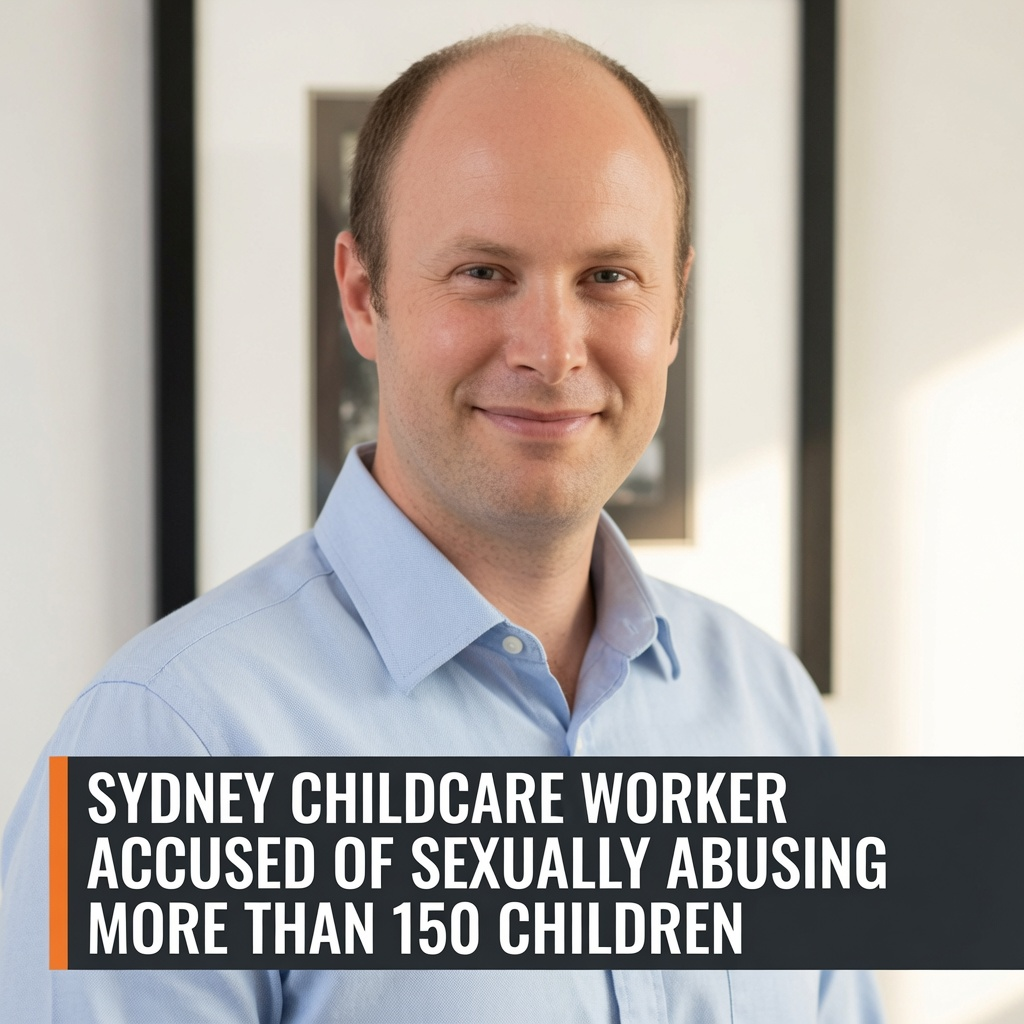
Investigators have identified 136 alleged child victims.
They are still trying to identify another 22 children.
For police, the decision to publicly identify Tait and release details of the early childhood facilities where he worked or attended is not simply about naming an accused man.
It is part of an active attempt to find children investigators believe may have been victims.
“There are 22 victims who we are yet to positively identify,” AFP Assistant Commissioner David Berston said as authorities urged the community to examine the information released through Operation Moonbi.
Some of the alleged victims may now be adults because the investigation stretches back more than a decade.
Tait has not been convicted of the offences and the allegations against him remain before the courts.
The scale of the charges, however, is extraordinary.
Tait faces 329 alleged offences, including charges connected with producing child abuse material, using children to make abuse material, sexual offences and allegedly sharing material overseas.
Police allege the offending occurred between 2009 and 2025.
The AFP has released a detailed list of early childhood education facilities Tait worked at or attended during that period. Updated reporting based on the police investigation identified 59 verified locations in his work and attendance history.
Investigators allege offending occurred at five locations, including four Fit Kidz Learning Centre sites and through Tait’s private business, Wild Earthlings.
The four Fit Kidz centres identified in reporting on the allegations are at Box Hill, Putney, Rouse Hill and Warrawee.
There is no allegation that every facility Tait worked at or visited was a location of offending.
That distinction is crucial.
The wider list has been released because police are reconstructing years of contact between an accused childcare worker and children across the early education sector.
For parents, the task is painfully practical.
Where was their child enrolled?
When did Tait work or attend there?
Could their family have had contact with him?
Police are asking people with potentially relevant information to come forward rather than attempt to determine for themselves whether an offence occurred.
Operation Moonbi began with information about alleged online child abuse material.
The AFP launched the investigation in June 2025 after receiving a report connected with the United States-based National Center for Missing & Exploited Children.
According to police, the report concerned a person allegedly uploading a file depicting child abuse online.
Investigators linked Tait to the alleged activity.
The following month, police searched his home at Glossodia in Sydney’s north-west.
Electronic devices were seized.
Investigators allege those devices contained a vast quantity of data, with more than 2.4 million files examined as part of the investigation and a large volume of alleged child abuse material identified.
Tait was arrested in July 2025.
He has remained in custody and has not applied for bail.
What followed was a painstaking process of examining digital material, identifying children and contacting families.
The numbers alone provide some indication of the investigative challenge.
More than two million files.
Allegations spanning 16 years.
Dozens of early childhood facilities in an employment and attendance history.
Children who may have been too young at the time of the alleged offending to now remember names, dates or locations clearly.
Families who have moved.
Some alleged victims who may now live overseas.
And, police say, 22 children whose identities have still not been established.
The investigation demonstrates how a single online report can lead authorities backwards through years of a person’s life.
A digital file allegedly uploaded in 2025 became the starting point for an investigation into suspected offending dating to 2009.
That chronology is one reason the case has caused such alarm among parents.
If the allegations are proven, the central question will not simply be how one man allegedly offended.
Australians will also ask how a person accused of offending over such an extended period could move through a sector built around the care of young children.
The lifting of the non-publication order was a significant moment in the investigation.
Tait’s identity had initially been suppressed while investigators worked to contact families and protect the integrity of Operation Moonbi.
When police later sought to identify him publicly, his legal representatives opposed publication.
Arguments raised in support of continued suppression included concerns about Tait’s safety in custody and the effect publication could have on his family.
Police, prosecutors and media organisations opposed the continuing order.
At Parramatta Local Court, Judge Stuart Devine was not persuaded that publication would create incurable prejudice to a future jury.
Instead, the court accepted the AFP’s argument that continued suppression could hinder attempts to identify the remaining children.
“I do not accept publication of the accused’s name and workplaces will cause incurable prejudice,” Judge Devine said, according to reports of the ruling.
“To the contrary I find a [non-publication order] would frustrate attempts of the Australian Federal Police.”
The decision created an unusual but important public-interest balance.
An accused person retains the right to a fair trial.
At the same time, police say there are children depicted in alleged abuse material whose names remain unknown to investigators.
Without identifying the accused and publishing his work history, families who may hold critical information might never realise they have a connection to the investigation.
The court allowed publication.
The AFP then made its appeal directly to the public.
For 121 families, police contact has already changed their lives.
The AFP has established a Local Contact Point to support those affected by the investigation.
Authorities have acknowledged the extraordinary distress caused by the allegations and the process of notifying parents.
For a mother or father, receiving a call from federal police about a childcare worker who once had access to their child is almost impossible to imagine.
Parents entrust early childhood educators with children who may not yet have the language to describe something that has happened to them.
A toddler cannot necessarily identify inappropriate conduct.
A preschool child may describe an event without understanding its significance.
Memories can be fragmented, particularly when years have passed.
That vulnerability is why childcare systems depend so heavily on layers of protection.
Worker screening is one layer.
Supervision is another.
Rules governing personal devices and images are another.
Staff training, reporting systems, information sharing between regulators and the ability to track workers across services all form part of the safety structure.
No single check can carry the entire burden.
That is particularly important when discussing Working with Children Checks.
Screening can identify known criminal history or other relevant information available to authorities. It cannot reliably predict future offending by a person who has never previously come to official attention.
A clearance should therefore never be treated as proof that a worker presents no possible risk.
Child safety requires an organisation to remain alert after recruitment, not simply complete a check before a worker begins.
Australia has already begun introducing national childcare safety reforms after a series of shocking cases exposed weaknesses in the sector.
On February 27 this year, a National Early Childhood Worker Register commenced as part of a $226 million federal safety reform package.
Early childhood education and care services are now required to provide workforce information to the register.
The system is intended to give regulatory authorities greater visibility of who is working in the sector and where.
It brings together information services are already required to maintain, including identifying information, qualifications and Working with Children Check details.
Mandatory national child safety training also began across the sector on the same date.
The requirements cover staff, volunteers, students, nominated supervisors and people with management or day-to-day control responsibilities.
The reforms followed growing concern about whether Australia’s fragmented early childhood system could adequately track workers moving between services and jurisdictions.
Other measures under the broader safety program have included stronger regulatory powers, tougher penalties, work on digital-device rules and trials involving CCTV.
The Tait allegations will inevitably intensify scrutiny of whether those reforms go far enough.
Education Minister Jason Clare has pointed to the national worker register, spot checks and other safety measures as evidence governments are strengthening the system.
But when police allege offending stretching from 2009 to 2025, parents are entitled to ask a more difficult question.
What could have detected the risk earlier?
That question must be approached carefully.
It is not yet possible to assume a particular centre, regulator or colleague had information that should have exposed the alleged offending.
The charges have not been proven.
The investigation remains active.
But major child abuse investigations often force institutions to examine the difference between having safety policies and having systems capable of recognising warning signs in practice.
A policy may prohibit personal devices.
Who checks compliance?
A centre may require workers to be visible while caring for children.
How is that rule enforced during busy periods?
A staff member may move between services.
Can regulators see the full employment history?
A concern may appear minor when viewed in isolation.
Can information be connected across organisations?
These are the questions Australia’s childcare sector now has to confront.
The allegations have also placed renewed attention on the use of cameras, phones and other digital devices around children.
Police allege Tait produced child abuse material and that material was shared internationally on three occasions.
There is no allegation reported by the AFP that he used the dark web.
The distinction matters because the alleged case illustrates a wider problem: technology capable of recording and transmitting images is ordinary, portable and almost invisible in daily life.
A smartphone does not look like specialist criminal equipment.
That makes digital safeguards inside childcare environments particularly important.
Australia’s national child safety reforms have increasingly focused on policies governing the taking, use, storage and destruction of images and videos of children, as well as the use of service-issued and personal digital devices.
Some childcare providers have introduced their own additional measures.
Fit Kidz said it had implemented new precautions following the investigation, including changes involving bathroom and toileting duties and the removal of photography phones from centres.
The provider has rejected suggestions it attempted to conceal the allegations.
There is no suggestion that other male educators at the provider were involved in wrongdoing.
Any response must also avoid turning child safety into suspicion based solely on a worker’s sex.
Male educators make an important contribution to a sector in which they remain a small minority.
Effective safeguards should be designed around behaviour, access, supervision and accountability.
A system that protects children by assuming every male worker is dangerous is neither fair nor sophisticated.
A system that assumes a valid clearance and a friendly manner are sufficient is not safe enough.
For police, the immediate priority remains the unidentified children.
The AFP has asked families and people with knowledge of Tait’s work history to review the information published through Operation Moonbi.
The agency has released the list of facilities connected with his employment or attendance to help members of the public determine whether they may hold relevant information.
Investigators do not want families conducting their own inquiries or making assumptions about what happened to a child.
They want information that may help establish identities and timelines.
The passage of time makes that work more difficult.
A child who attended an early learning centre in 2009 may now be an adult.
Families may no longer have old enrolment documents readily available.
Parents may struggle to remember which educators worked in a room more than a decade ago.
People may have moved interstate or overseas.
Yet somewhere in those old records, family photographs, emails and memories may be the information investigators need to identify the remaining 22 children.
That is why Tait’s name is now public.
It is why his workplace history has been released.
And it is why police have made clear that Operation Moonbi is not finished.
The 329 charges will eventually be tested through Australia’s criminal justice system.
Tait is entitled to the presumption of innocence unless and until offences are proven.
But the investigative task confronting federal police exists now.
One hundred and thirty-six alleged victims have been identified.
One hundred and twenty-one families have been contacted.
Twenty-two children remain unidentified.
Behind each number is a person.
For the AFP, finding the names behind the final 22 images may be one of the most difficult parts of an investigation already unprecedented in its scale.






