Strap yourself in, Australia.
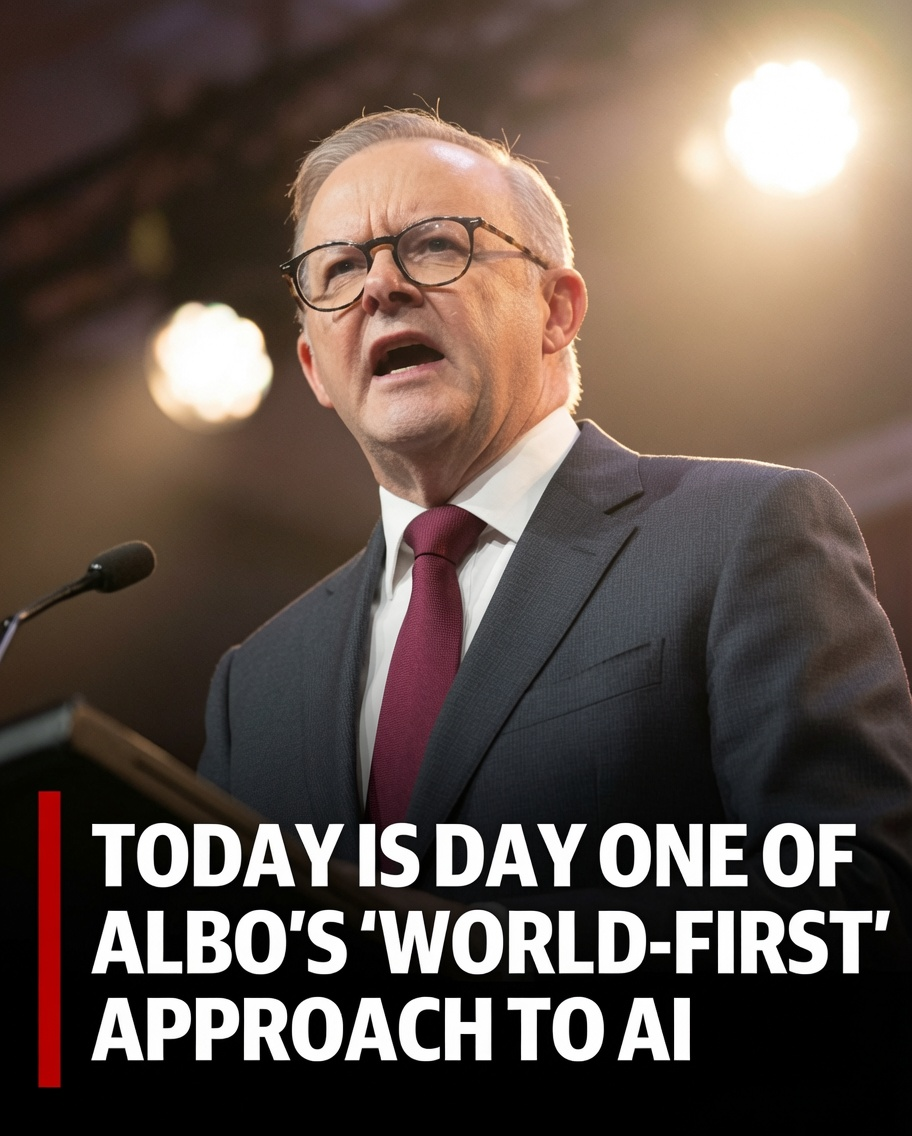
Anthony Albanese has just placed artificial intelligence at the centre of the Australian Government.
Not inside a technology taskforce.
Not buried in an industry department.
Not left to a voluntary ethics document that most Australians have never heard of.
From today, a new Office of AI will operate inside the Department of the Prime Minister and Cabinet.
Labor will develop Australian Standards for AI.
The framework will go to National Cabinet in August.
The government expects legislation early next year.
And Albanese’s message is that Australia has reached a moment when delay itself has become a decision.
“If we act now, Australia can set the ground rules for AI,” the Prime Minister said in his landmark Sydney speech.
“We can shape the future, not let the future shape us.”
It is a dramatic shift in the way Canberra is talking about artificial intelligence.
For years, the political debate around AI has moved from one anxiety to another.
Deepfakes.
Job losses.
School cheating.
Copyright.
Chatbots.
Data centres.
Foreign interference.
Power consumption.
Each problem attracted its own minister, inquiry, consultation or warning.
Albanese is now arguing that this fragmented approach is no longer good enough.
AI is not one policy problem.
It is becoming infrastructure.
It is becoming an economic system.
It is becoming a national security capability.
And the countries that establish the rules, compute, energy and investment environment first may gain an advantage that becomes increasingly difficult to recover.
The Prime Minister has taken AI policy into his own department
The institutional change matters.
The Office of AI is being established within the Department of the Prime Minister and Cabinet, effective immediately.
Its job is to accelerate implementation of the government’s new Australian Standards and coordinate AI policy on a national level.
That places the issue close to the centre of executive government.
Albanese described the old approach as one in which governments responded to individual AI problems as they emerged.
Workplace questions went to workplace ministers.
Copyright went to the Attorney-General.
Education went to the education portfolio.
National security agencies examined hostile uses of AI.
Energy ministers confronted the electricity demands of data centres.
Industry policy focused on investment and productivity.
All of those responsibilities still exist.
But the new Office of AI is intended to impose coordination across them.
“Effective today, I am establishing The Office of AI in the Department of the Prime Minister and Cabinet,” Albanese said.
The government says this will create a simpler and more consistent framework for companies operating in Australia.
It also sends a signal to the bureaucracy.
AI is no longer somebody else’s problem.
The Prime Minister wants the whole government working from a national framework.
Labor wants the world’s AI money — but on Australian terms
The most interesting part of Albanese’s announcement is that it is not fundamentally anti-AI.
Quite the opposite.
The government wants more investment.
It wants frontier companies.
It wants data centres.
It wants advanced computing infrastructure.
It wants Australian workers and businesses using AI to lift productivity.
And it wants global capital to see Australia as a serious place to build.
But Labor believes the way to win that investment is through national rules rather than a regulatory free-for-all.
Albanese’s argument is that certainty has economic value.
A company considering a multi-billion-dollar AI infrastructure investment does not necessarily want to negotiate a completely different political and planning environment every time it crosses a state border.
It wants to know the standards.
It wants to know the approval pathway.
It wants to know what will be required on power, water, environmental impact and community expectations.
Then it can price the project.
Labor is betting that a single Australian framework will make the country more attractive to responsible capital.
The government describes its proposed model as a simple and consistent regulatory framework for large data centres and AI training.
It says the standards will be the first of their kind legislated by a national government anywhere in the world.
That is a very large claim.
It is also a declaration of ambition.
Australia does not intend to beat the United States or China by spending more money on frontier AI research than they do.
It is trying to compete through resources, energy, political stability, infrastructure and a predictable investment environment.
In other words, Australia may not build the world’s dominant AI model.
But Albanese wants Australia to become one of the places where the AI economy physically lives.
Data centres are about to become a major political fight
The AI Australians see is a chatbot on a laptop or phone.
The AI economy governments see is land, transmission, electricity, water and billions of dollars of infrastructure.
That difference explains why data centres sit at the heart of Albanese’s framework.
AI training and large-scale computing require enormous physical facilities.
Those facilities consume electricity.
They require cooling.
They can use significant quantities of water.
They compete for grid capacity.
And the scale of investment now being proposed means they can affect communities that may never personally use an AI chatbot.
The Albanese Government published national expectations for data centres and AI infrastructure developers in March.
Those expectations are now becoming the foundation for the broader AI standards.
The Prime Minister’s message to major infrastructure developers is increasingly clear.
Do not arrive in Australia, connect a massive facility to the electricity system and expect households and existing industries to absorb the consequences.
Under the government’s proposed approach, large data centres will be expected to bring additional energy into the system.
Albanese said major facilities should become “net producers” of power.
The government also wants developers to minimise water consumption and consider where facilities are built.
This is potentially one of the most consequential elements of the entire framework.
Australia is already struggling with an energy transition.
Coal-fired power stations are retiring.
Transmission projects are politically difficult.
Households remain deeply sensitive to electricity prices.
Manufacturers are worried about energy reliability and cost.
Now AI companies want to build infrastructure capable of consuming extraordinary amounts of power.
If Canberra gets this wrong, Australians will not blame a language model.
They will blame the government when their electricity bills rise.
The government says AI infrastructure cannot simply take from the grid
Labor’s answer is to make the social licence explicit.
The government’s March expectations state that AI infrastructure investment must be consistent with Australia’s national interests.
Developers are expected to engage with energy providers and governments.
They are expected to consider new generation and storage.
They are expected to improve energy efficiency.
Water use is expected to be minimised.
Projects are also expected to engage with local communities and contribute to the regions in which they operate.
The new national standards will build on those expectations.
This is where Albanese’s investment pitch becomes politically clever.
He is not telling Australians they must sacrifice for AI companies because technological progress is inevitable.
He is telling AI companies they must demonstrate a benefit to Australia if they want access to the country’s investment environment.
“AI must earn and maintain its social licence,” Albanese said.
That phrase will become central to the debate.
For industry, it creates uncertainty until the standards are written in detail.
For Labor, it provides a political shield.
If a data centre requires huge amounts of electricity, the government can say it must support additional generation.
If communities worry about water, the government can point to national standards.
If companies complain about regulation, Labor can accuse them of wanting the Australian public to subsidise private AI infrastructure.
Whether the framework works will depend on the technical details.
But the political strategy is already visible.
Copyright may become the war that decides whether Australians trust the AI boom
Albanese devoted significant attention to Australian creators.
Artists.
Writers.
Musicians.
Journalists.
Publishers.
The creative industries have spent years warning that AI companies can ingest enormous volumes of copyrighted work to train models without traditional licensing arrangements.
The technology industry argues that broad access to data is essential for innovation and that overly restrictive copyright rules could make countries uncompetitive.
Creators see something much simpler.
Their work was made by them.
Companies should not be allowed to take it without permission, use it to build a commercial system and then tell the original creator that technological progress has made ownership inconvenient.
Albanese sided rhetorically with the creators.
“If a creator makes something, it belongs to them,” he said.
“Taking it without permission or payment is theft.”
That is unusually direct language from a prime minister discussing one of the most technically complicated copyright battles of the modern era.
It does not, by itself, settle the law.
The government still has to design the framework.
Questions remain over licensing.
Questions remain over model training.
Questions remain over transparency.
Questions remain over whether Australian copyright owners can realistically identify when their work has been used inside vast training datasets.
And global AI companies will warn that Australia can regulate itself out of investment if the rules become commercially unworkable.
But Albanese has now established the political starting point.
The Australian Government does not accept that AI development automatically creates a right to take Australian creative work for free.
This is also a sovereignty argument
The word “sovereignty” appears repeatedly in Australia’s AI debate for a reason.
The most powerful frontier AI systems are overwhelmingly controlled outside Australia.
The major cloud platforms are foreign.
The leading model developers are foreign.
Much of the advanced semiconductor supply chain is foreign.
The software Australians use can depend on infrastructure, corporate decisions and laws in other countries.
For ordinary consumers, that can sound abstract.
For national security officials, it is not.
What happens if Australian government systems become deeply dependent on a foreign AI provider?
Where is sensitive data processed?
Who controls access to advanced models?
Can a provider withdraw a capability?
What happens during a geopolitical crisis?
Can Australia independently test systems used in critical infrastructure?
Can Australian laws be enforced against a company whose technical operations are mostly overseas?
Independent Senator David Pocock and Coalition figures including Andrew Hastie have been pressing the government on sovereign AI capability.
The political sides disagree on many details, but the strategic concern is becoming bipartisan.
Australia cannot treat AI purely as another imported digital service.
The technology is becoming too deeply embedded in defence, intelligence, infrastructure and the economy.
Albanese’s framework explicitly links AI development to Australia’s sovereignty and resilience.
The Office of AI is therefore not simply an economic agency.
It sits at the intersection of technology policy and national power.
Foreign states and extremists are already using AI
Albanese’s speech also carried a darker warning.
AI is not waiting for governments to finish writing ethical principles.
Hostile actors are already using it.
Authoritarian states can generate propaganda at scale.
Foreign influence operations can produce convincing fake content.
Extremists can use AI tools to create material aimed at vulnerable young people.
Deepfakes can impersonate political figures.
Automated systems can flood information environments faster than human moderators can respond.
The Prime Minister warned that extremists and foreign actors are using AI to spread disinformation and undermine democratic institutions.
This is not science fiction.
Australia’s defence and national security establishment already treats artificial intelligence and machine learning as major disruptive technologies.
The government is working with international partners, including Five Eyes allies, on AI-related security risks.
The strategic problem is brutal.
Australia cannot protect itself from hostile AI by refusing to develop AI capability.
A country that deliberately falls behind may become more vulnerable, not less.
But rapid adoption also creates new attack surfaces and dependencies.
The government therefore has to accelerate and regulate at the same time.
That is much harder than choosing one side of the “AI good or AI bad” argument.
Workers have every reason to watch this closely
For millions of Australians, the most immediate question is not sovereignty.
It is employment.
Will AI take my job?
That fear sits beneath almost every political speech about artificial intelligence.
Albanese argues that the debate cannot be reduced to whether AI is good or bad.
The technology is already arriving.
The real question is how its gains and disruptions are managed.
Labor’s political problem is particularly difficult.
Business wants productivity.
Technology companies want faster adoption.
Investors want certainty.
Unions want workers protected from surveillance, algorithmic management and job destruction.
Creative industries want copyright protection.
Environmental groups are worried about energy and water consumption.
National security agencies want capability.
Parents are worried about children interacting with AI systems.
Universities and schools are trying to decide what learning means when a machine can produce an essay in seconds.
There is no policy that gives every group everything it wants.
Albanese’s answer is the “Australian way”.
The government says AI development should not undercut workplace conditions, divide communities or damage the environment.
That language is unmistakably Labor.
The risk is that it becomes a slogan rather than an implementation strategy.
Protecting workers sounds easy until an Australian business says automation is the only way it can remain globally competitive.
Supporting investment sounds easy until a data centre demands access to scarce grid capacity.
Protecting copyright sounds easy until an AI developer says it will build its next model somewhere else.
Every principle will eventually meet a trade-off.
Australia may have an unusual advantage in the global AI infrastructure race
Australia is not Silicon Valley.
It does not have the same venture capital ecosystem as the United States.
It does not manufacture the world’s most advanced AI chips.
It does not have a domestic frontier model company operating at the scale of the largest American labs.
But Australia does possess assets that matter enormously in the next phase of AI.
Land.
Energy resources.
Political stability.
A sophisticated financial system.
Close security relationships with the United States and other Five Eyes nations.
Large pools of institutional capital.
Universities and research capability.
Proximity to Asian markets.
And the potential to build enormous amounts of new electricity generation.
Australia has already emerged as a major destination for data centre investment.
Technical and industry assessments have placed the country among the world’s leading markets for new data centre capital.
The opportunity is obvious.
AI companies need compute.
Compute needs facilities.
Facilities need power.
Australia can potentially provide all three at scale.
The danger is equally obvious.
Australia could become the quarry of the digital age.
We provide the land.
We provide the energy.
We provide the infrastructure.
Foreign companies own the models, intellectual property and highest-value services.
Australians carry the environmental and grid costs while the largest profits flow overseas.
That is the scenario Albanese’s national-interest framework is supposed to prevent.
The test will be whether the standards actually secure Australian capability and economic value, or merely make foreign infrastructure slightly greener.
The phrase “frontier investment” should make Australians pay attention
Governments use the word “investment” constantly.
AI investment is different in scale and strategic significance.
A frontier AI ecosystem is not a collection of suburban software companies.
It involves hyperscale computing.
Advanced chips.
Specialised networking.
Huge energy requirements.
Highly paid technical talent.
Secure data environments.
Research institutions.
Defence applications.
And global companies capable of moving billions of dollars between jurisdictions.
Once that infrastructure is built somewhere, network effects begin.
Suppliers follow.
Workers move.
Universities form partnerships.
Start-ups build around the infrastructure.
Governments develop expertise.
Capital becomes comfortable with the jurisdiction.
That is why Albanese is framing the moment as urgent.
The world is deciding where the next generation of AI infrastructure will live.
Australia may not get unlimited chances to establish itself as a serious destination.
“The world is queuing up to invest in Australia,” Albanese said.
The government wants to convert that interest into physical infrastructure before competing markets take the capital.
But it also wants to write the conditions before the investment becomes too powerful to regulate.
That is the balance.
Move too slowly and the projects go elsewhere.
Move too quickly and Australia may discover it has built an industry on terms written by foreign technology companies.
The new Office of AI will have to prove it is more than another Canberra office
The announcement of any new government office produces an immediate and predictable reaction.
Another bureaucracy.
Another set of public servants.
Another acronym.
Another strategy.
Another ministerial press release.
The scepticism is understandable.
Canberra has created digital strategies before.
Governments have announced innovation agendas before.
Australia has repeatedly watched promising technology companies move overseas or sell to foreign buyers.
Productivity growth remains a national problem.
Major projects still become trapped in approvals.
Energy infrastructure still faces delays.
Against that history, creating an Office of AI is the easy part.
The difficult work begins immediately.
Can the office coordinate departments that protect their own policy territory?
Can it produce standards quickly enough for an industry moving at extraordinary speed?
Can it create national consistency when states control important planning and infrastructure decisions?
Can it attract investment without becoming a concierge service for global technology giants?
Can it protect Australians without writing rules obsolete before Parliament passes them?
Can it explain AI policy in language ordinary voters understand?
And can it identify which AI capabilities Australia genuinely needs to control domestically?
If the answer is no, the Office of AI will become another layer of administration sitting above an already fragmented system.
If the answer is yes, Albanese may have created one of the most consequential institutions of his prime ministership.
National Cabinet is the next test
The government’s approach will go before National Cabinet in August.
That matters because AI infrastructure is not governed by Canberra alone.
States deal with planning.
States have enormous influence over energy systems.
Water regulation is critical.
Local communities deal with the physical consequences of major projects.
A genuinely national framework requires cooperation.
Investors will watch whether governments can align.
If Canberra announces one standard while states impose conflicting requirements, the promise of regulatory simplicity disappears.
If the states cooperate, Australia could create a clearer national investment environment than many competing jurisdictions.
The government says the Australian Standards are expected to be legislated early next year.
That is an aggressive timetable for a policy area involving energy, technology, copyright, employment and national security.
It also reflects Albanese’s central argument.
There is no comfortable period in which Australia can spend five years thinking about AI and then decide what to do.
The infrastructure decisions are being made now.
The models are being trained now.
Workers are using the systems now.
Creators are fighting over their work now.
Foreign actors are experimenting with AI now.
The future has already started spending money.
Albanese has made a very large bet
The Prime Minister is betting that Australians will accept rapid AI development if they believe somebody is setting boundaries.
He is betting global investors will accept stricter national standards if those standards provide certainty.
He is betting data centre companies will bring new energy into the system rather than walk away.
He is betting creators can be protected without isolating Australia from frontier AI development.
He is betting workers can share productivity gains without becoming casualties of automation.
And he is betting the Australian Government can coordinate technology policy faster than the technology changes.
Any one of those bets could fail.
Several may fail simultaneously.
But the alternative is not a world without AI.
That world has already disappeared.
The alternative is an Australia in which the major decisions are made elsewhere.
Models built elsewhere.
Rules written elsewhere.
Infrastructure controlled elsewhere.
Australian data processed elsewhere.
Australian creative work absorbed into systems Australians do not own.
Australian businesses paying foreign providers for capabilities they increasingly cannot operate without.
That is the future Albanese says he is trying to avoid.
“We have the chance to write our own future,” he told his Sydney audience.
The rhetoric is enormous.
Now comes the harder part.
Writing the standards.
Building the power.
Protecting the creators.
Training the workers.
Attracting the capital.
Securing sovereign capability.
And convincing Australians that the machines reshaping their workplaces, schools and economy are operating in their interests.
Strap yourself in.
Canberra has finally decided AI is not a future problem.
It is a national power contest happening right now.






