A satirical article claiming the Victorian Liberal Party wants to commission a report into bringing back Melbourne’s removed railway level crossings has attracted attention online, but the story is not based on an actual policy proposal.
The piece, which begins with the tongue-in-cheek declaration “NO CFMEU INVOLVED”, presents a fictional scenario in which the Victorian Liberals allegedly plan to reverse one of the state’s largest transport infrastructure programs by restoring level crossings that have already been removed.
Throughout the article, anonymous “party insiders” are quoted making increasingly absurd claims, including suggestions that bringing back level crossings would create traffic congestion, encourage motorists to use toll roads and generate thousands of construction jobs.
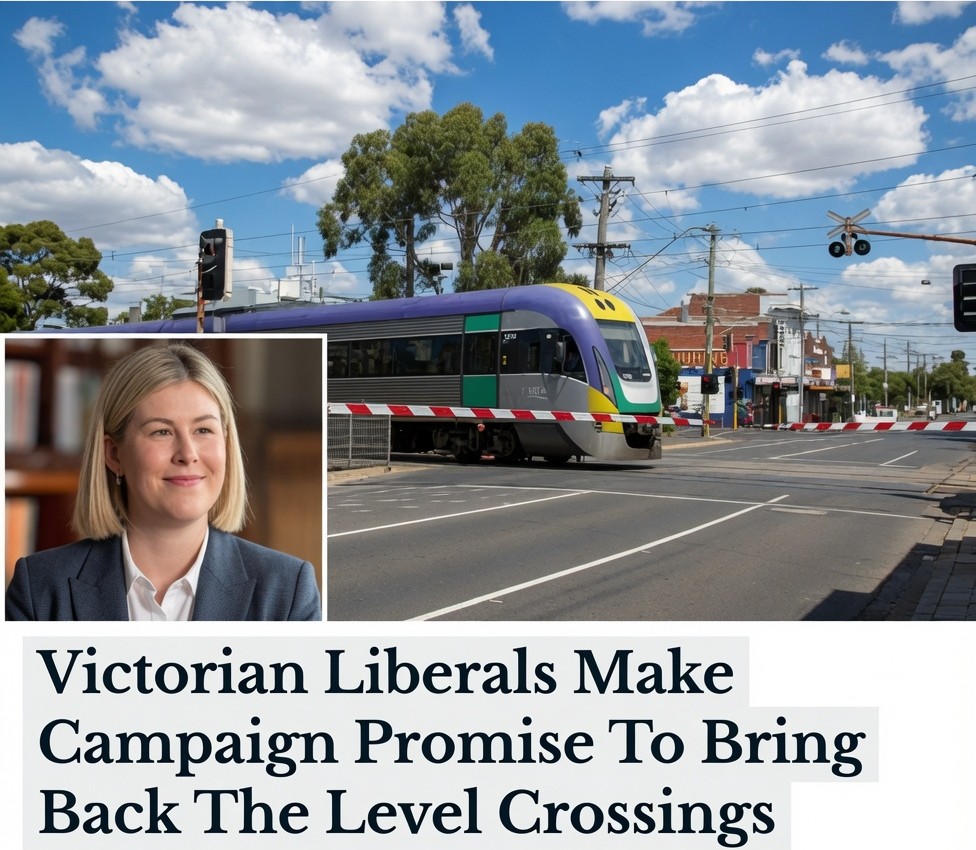
The fictional source even jokes that hiring non-union labour would keep rebuilding costs low while mocking long-running political debates surrounding Victoria’s construction industry.
There is no evidence that the Victorian Liberal Party has proposed reinstating removed level crossings, commissioned a report into doing so or adopted any policy resembling the claims contained in the satirical article.
Instead, the story uses exaggeration and irony to criticise the Opposition’s approach to major infrastructure projects and its longstanding opposition to several initiatives undertaken by successive Victorian Labor governments.
The Level Crossing Removal Project has been one of the largest transport programs ever undertaken in Victoria.
Originally announced before the 2014 state election, the project aims to eliminate 110 dangerous and congested level crossings across metropolitan Melbourne by separating roads from railway lines through bridges, trenches or elevated rail infrastructure. As of 2026, the vast majority of those crossings have already been removed, with the project widely regarded as one of the Allan and former Andrews governments’ signature infrastructure achievements.
The program has consistently divided opinion.
Supporters argue that removing level crossings has improved road safety, reduced traffic congestion, allowed more frequent train services and transformed surrounding suburbs through new stations, parks and community facilities.
Critics, however, have questioned the overall cost of the program, the use of elevated “Sky Rail” structures in some suburbs and whether every project represented value for money.
The Victorian Liberal Party has opposed aspects of several major infrastructure projects over recent years, particularly the multibillion-dollar Suburban Rail Loop.
Current Liberal policy has focused on reviewing or halting future stages of that project rather than reversing infrastructure that has already been completed. Public statements by party leaders have centred on concerns about project costs, debt and economic priorities rather than reinstating removed level crossings.
The satirical article appears designed to parody that broader political position by imagining an extreme scenario in which the Opposition seeks not merely to cancel future projects but to undo completed ones as well.
Its fictional quotations reinforce that intent.
One fabricated insider jokes that “if the party can make it to the election without suing itself out of existence that’s a win”, while another sarcastically suggests restoring level crossings would deliberately create traffic congestion.
Those remarks are obvious examples of political satire rather than genuine reporting.
The opening reference to the Construction, Forestry, Maritime, Mining and Energy Union (CFMEU) is another clue that the article is intended as parody.
Industrial relations involving the CFMEU and allegations surrounding aspects of Victoria’s Big Build have been major political issues over recent years, providing fertile material for satirical commentary.
By beginning with “NO CFMEU INVOLVED”, the article immediately signals that it is lampooning those debates rather than revealing a real government announcement.
Political satire has long formed part of Australia’s media landscape, using fictional news reports, exaggerated quotations and invented scenarios to comment on real political controversies.
Its effectiveness often depends on closely resembling genuine journalism, which can sometimes lead readers encountering isolated excerpts online to mistake satire for factual reporting.
That risk has increased with the growth of social media, where screenshots and cropped articles frequently circulate without accompanying context identifying them as satire.
Media literacy experts regularly advise readers to consider whether quoted statements appear unusually extreme, whether multiple reputable news organisations are reporting the same development and whether the claims align with previously announced government policy before accepting extraordinary political stories as fact.
In this case, no mainstream Australian news organisation has reported that the Victorian Liberals intend to rebuild removed level crossings, nor has the party announced any such proposal.
The genuine political debate instead remains focused on future infrastructure spending, the cost of major transport projects and which initiatives should proceed if there is a change of government following the next Victorian election.
The Level Crossing Removal Project itself continues to attract both praise and criticism.
Government ministers argue it has saved lives by eliminating dangerous road and rail intersections while reducing congestion and improving train reliability.
Opposition figures have generally questioned the program’s cost, planning decisions and value for taxpayers rather than advocating for the restoration of removed crossings.
As Victoria heads toward another state election, infrastructure is expected to remain one of the campaign’s defining issues.
Debates over transport investment, public debt and future construction priorities are likely to dominate political discussion.
However, the notion that the Opposition plans to physically bring back completed level crossings belongs firmly in the realm of satire rather than public policy.






