Sam Neill once admitted that, as a young man in his early twenties, he did not believe he was capable of being a father.
It was a decision that would separate him from his first son for 25 years.
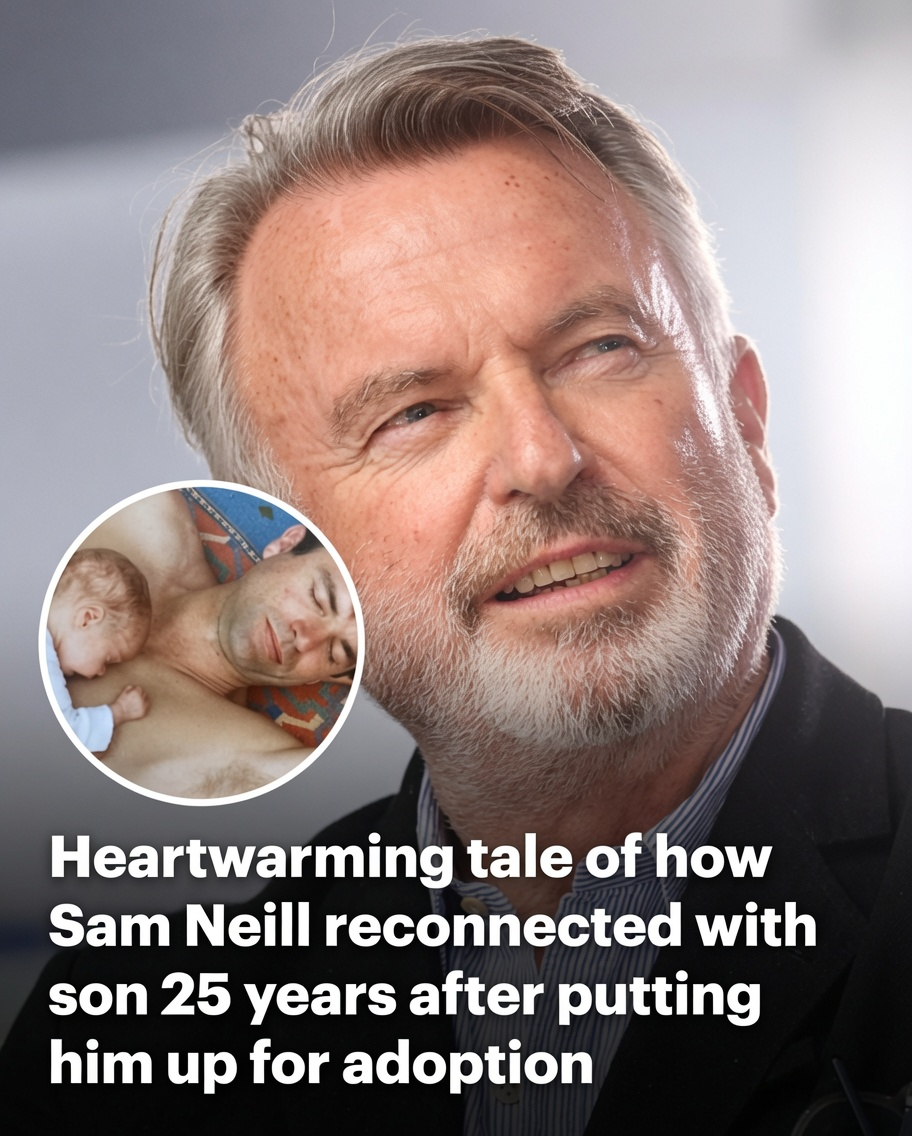
Now, following the beloved actor’s sudden death at the age of 78, the story of Neill’s reunion with his eldest son Andrew has taken on a particularly poignant meaning.
The Jurassic Park and Peaky Blinders star died in Sydney on Monday, 13 July, surrounded by members of the sprawling family that had become one of the great sources of happiness in his later life.
His death was described by his family as “sudden and unexpected”.
There was, they said, one blessing amid their grief: Neill remained cancer-free following years of treatment for a rare blood cancer.
“Sam was surrounded by family and passed with the dignity that has characterised his whole life,” the family said in a statement announcing his death.
For a man who spent much of his career travelling between film sets, countries and continents, being surrounded by family at the end carried an added significance.
Neill was a father of four and a grandfather of eight.
But his journey into fatherhood began with a painful separation that lasted a quarter of a century.
Andrew was adopted when Sam was barely more than a young man himself
Neill rarely made his private life the centre of his public identity.
He was far more comfortable discussing acting, wine, the animals on his Central Otago farm or the absurdities of celebrity than turning his family into entertainment.
Yet in a 2014 interview, he spoke with unusual openness about what he called his “slightly unusual family”.
His first son, Andrew, had been placed for adoption when he was very young.
Neill was in his early twenties.
“My first son, Andrew, was given up for adoption when he was very small,” Neill recalled.
“I was quite small, too — in my early twenties.”
The actor did not see Andrew for the next 25 years.
The circumstances left a vast empty space in both of their lives, but Neill’s later account of their reunion was characteristically restrained.
There was no attempt to transform the story into a sentimental Hollywood scene.
After 25 years, he said, father and son simply “went looking for each other”.
They found one another in 1994.
By then, Andrew was a grown man in his mid-twenties.
Neill was an internationally recognised actor whose career had already taken him from New Zealand cinema to Hollywood blockbusters.
Only the previous year, audiences around the world had watched him as palaeontologist Dr Alan Grant in Steven Spielberg’s Jurassic Park.
But when Neill later described meeting Andrew, he resisted the easy cinematic version of events.
“No one sobs in anyone’s arms,” he said of such reunions. “It’s much more grown-up.”
It was a strikingly Sam Neill way of describing one of the most consequential encounters of his personal life.
Dry.
Understated.
Almost deliberately resistant to melodrama.
Andrew became part of the family.
And the young man who had once doubted his ability to be a parent eventually found himself at the centre of a large and complicated family stretching across generations.
His advice to his 20-year-old self revealed how his perspective had changed
In the same interview, Neill was asked what advice he might give his younger self.
His answer was simple.
“You’re more capable than you think.”
Viewed alongside the story of Andrew’s adoption, the words are difficult to ignore.
Neill did not publicly frame the comment as a direct expression of regret about his eldest son.
It would be wrong to place words in his mouth that he did not use.
But he was open about the insecurity of his younger years.
The man audiences later knew as a calm, intelligent and quietly authoritative screen presence had not always felt confident in his own abilities.
Neill suffered from a stutter as a child.
He later described himself as painfully shy.
Acting, somewhat paradoxically, offered him a place where that self-consciousness could disappear.
As a young man, however, the prospect of fatherhood appears to have felt beyond him.
Decades later, his answer to his younger self suggested a different understanding of his own life.
You are more capable than you think.
It is the kind of knowledge that often arrives only after the moment when it would have been most useful.
By the time Andrew returned to his life, Sam had built an ‘extended’ family
Neill’s family did not follow a simple structure.
He had a son, Tim, with New Zealand actor Lisa Harrow.
Neill later married Japanese make-up artist Noriko Watanabe, whom he had met while working on the Australian thriller Dead Calm.
He adopted Watanabe’s daughter Maiko, and the couple had a daughter, Elena.
Then, in 1994, Andrew entered his life again.
Neill described the family as “more extended than most”.
The description was accurate, but characteristically modest.
There were biological children, an adopted daughter and a son who had himself been adopted and reunited with his birth father as an adult.
Over time, grandchildren expanded the family further.
Neill would eventually become a grandfather of eight.
His official Two Paddocks biography noted that Andrew became part of the family following their meeting in 1994.
It was not a secret Neill attempted to erase.
Nor did he turn it into a recurring celebrity story.
It simply became part of the reality of his family.
That approach reflected the way Neill often discussed deeply personal subjects.
He could be candid without becoming performative.
Even when confronting cancer decades later, he wrote and spoke about mortality with a mixture of honesty and dry humour.
Sam Neill never pretended he had been a perfect father
Neill’s acting career created another complication in his family life: he was frequently away.
His work took him around the world for months at a time.
By the 1990s, he was appearing in major international productions and maintaining a career across Australia, New Zealand, Britain and the United States.
His credits eventually exceeded 150 film and television roles across five decades.
The professional success came with an obvious personal cost.
Neill jokingly described his family life as “somewhat haphazard”.
His approach to parenting, he once said with typical self-deprecation, involved “benign neglect”.
Behind the joke was an acknowledgement that he had often been absent.
His son Tim, however, publicly remembered him as a good father.
Neill himself appeared unwilling to indulge in elaborate claims about his parenting skills.
When discussing family, he often sounded like a man who understood that love and imperfection could exist at the same time.
He had missed the first 25 years of Andrew’s life.
He had spent long periods away from his other children while filming.
He knew his family history was unusual.
But he also allowed relationships to continue, change and expand.
Andrew’s return was perhaps the clearest example.
Twenty-five years of separation could not be recovered.
Father and son could not return to the beginning and create a different childhood.
They could only decide what came next.
His grandchildren became central to his thoughts about mortality
When Neill publicly revealed his blood cancer diagnosis in 2023, he made clear that death itself was not the thing that frightened him most.
He had been diagnosed with stage-three angioimmunoblastic T-cell lymphoma, a rare form of blood cancer.
Treatment was brutal.
He underwent chemotherapy, and when one treatment stopped working, his future appeared increasingly uncertain.
Neill later said he was not afraid to die.
He would find it “annoying”, he joked, because there were still things he wanted to do.
But the prospect of leaving his family carried a different emotional weight.
In interviews surrounding his memoir, Did I Ever Tell You This?, Neill spoke about the sadness of potentially not seeing his grandchildren grow up.
He loved being a grandfather.
His social media accounts, often filled with farm animals and jokes, also occasionally offered glimpses of his family happiness.
When a new grandson arrived in 2021, Neill proudly shared the news.
The actor who once believed he might not be capable of fatherhood had become the patriarch of a family containing four children and eight grandchildren.
That transformation was not neat.
It did not erase the past.
But it gave Neill something his younger self could not have imagined.
Three months before his death, Neill received extraordinary news
In April 2026, Neill publicly revealed that scans showed no cancer in his body.
His health journey had taken another dramatic turn after years of treatment.
He had been living with lymphoma and receiving chemotherapy, which he described as a “pretty miserable business” even as it kept him alive.
Eventually, the chemotherapy stopped working.
Neill said it appeared he was “on the way out”.
He then entered a clinical trial involving CAR T-cell therapy.
The treatment genetically modifies a patient’s immune cells to help them recognise and attack cancer.
For Neill, the result was remarkable.
“I’ve had a scan just now, and there is no cancer in my body,” he said in April.
He called it “science at its best”.
The news appeared to give him renewed enthusiasm for work.
“It’s time I did another movie,” he declared.
That is part of what made the announcement of his death only months later so shocking.
His family stressed that he remained cancer-free.
They described the loss as sudden and unexpected.
No cause of death was given in the family’s initial statement.
They thanked the staff of St Vincent’s Private Hospital in Sydney for their care.
Neill died surrounded by family.
The world remembered a movie star; his family lost the man at the centre of their lives
For audiences, Sam Neill will remain Dr Alan Grant.
He will be remembered standing in stunned silence as a dinosaur moves across a field in Jurassic Park.
Others will remember The Piano, Dead Calm, A Cry in the Dark, The Hunt for Red October, Possession or his chilling performance as Major Chester Campbell in Peaky Blinders.
New Zealand audiences knew him from Sleeping Dogs and later embraced the warmth and humour he brought to Hunt for the Wilderpeople.
His career stretched across more than five decades.
He became an international star without ever appearing particularly comfortable with the idea of behaving like one.
Colleagues repeatedly described him as kind, funny and generous.
His family used different words in their farewell.
They remembered him as “wry and dry, thoughtful and laconic”.
They wrote of his dignity.
And at the end of his life, they were with him.
That final detail feels particularly moving when placed beside the story Neill told about Andrew.
His first experience of fatherhood began with absence.
A baby was adopted.
A young man who did not believe himself capable of being a father continued with his life.
Twenty-five years passed.
Then father and son went looking for each other.
There was no dramatic scene of people collapsing into one another’s arms, at least not in Neill’s telling.
It was “more grown-up” than that.
Andrew became part of the family.
Years became decades.
Children became adults.
Grandchildren arrived.
And the man who once questioned his capacity for fatherhood reached the end of his life as a father of four and grandfather of eight, surrounded by the family he had spent a lifetime gathering around him.
Perhaps that is why his old advice to his 20-year-old self now feels so poignant.
“You’re more capable than you think.”
Sam Neill had 78 years to discover just how true that was.






