Chris Thomas was not the star of the television series. He did not have Sam Neill’s fame, decades of screen credits or place in cinema history. But on one difficult day on set, Neill noticed him.
Thomas had been working as a non-speaking actor on the Australian courtroom drama The Twelve when an incident left him distressed enough to walk away from the set.
He eventually returned.
Neill, one of the most recognisable actors in the production and a screen veteran known around the world as Dr Alan Grant in Jurassic Park, could easily have allowed the working day to continue.
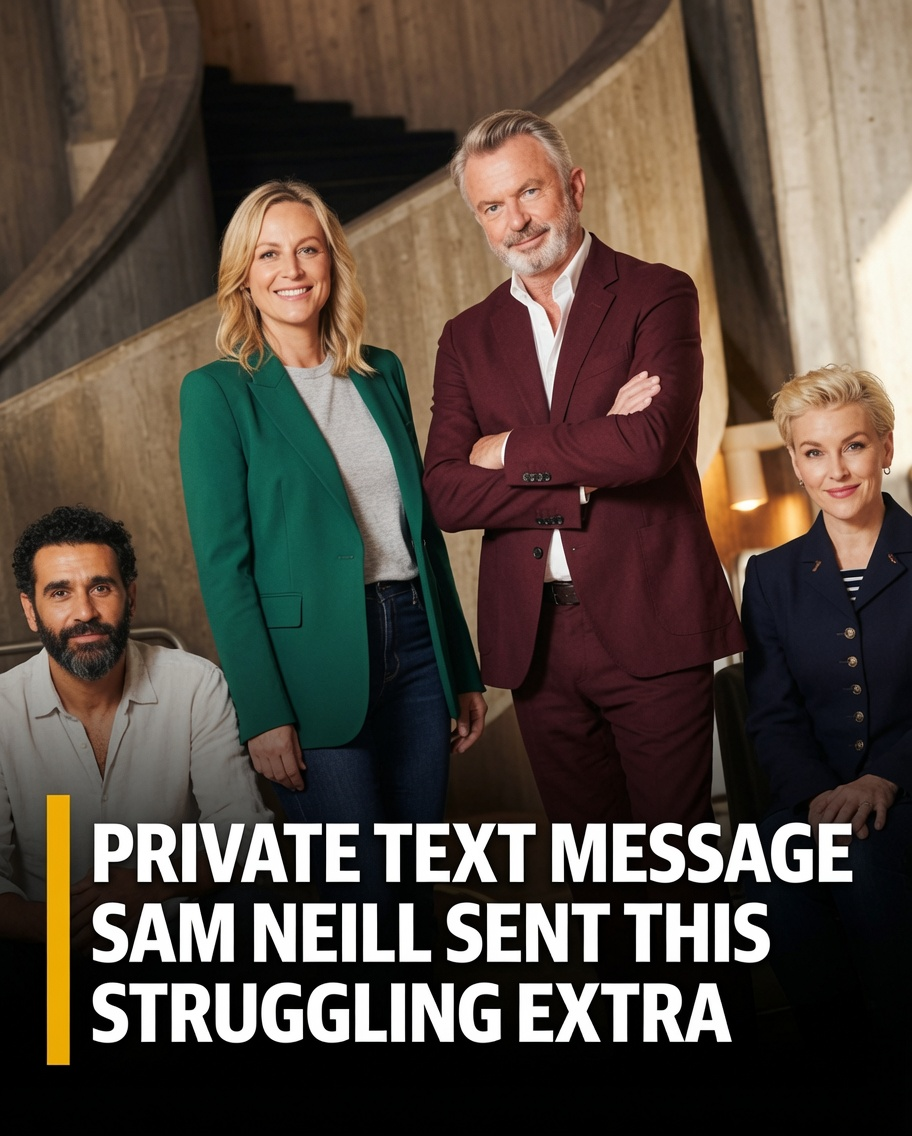
Instead, he quietly found Thomas’s phone number.
Then he sent him a message.
“Chris, this is Sam. I hope this is the right number and I hope you are ok today,” Neill wrote.
He told Thomas that what had happened the previous day had been wrong and unfair.
More importantly, he told the younger actor something that Thomas apparently needed to hear.
Neill had been watching his work.
“You have been immaculate all these weeks, always fully concentrating and doing your job well,” he wrote.
It was a private exchange between two people on a television set.
Years later, after Neill’s sudden death in Sydney at the age of 78, Thomas shared the story publicly.
For him, the messages had changed the way he saw the screen legend.
“Those text messages gave me the utmost respect for him,” Thomas said in his tribute.
In the days after Neill’s death, Hollywood stars, directors, prime ministers and lifelong friends have spoken about his career and character.
But Thomas’s memory may explain something about Sam Neill that a filmography cannot.
He noticed the person who could easily have been invisible.
Thomas was working on the third season of The Twelve in Western Australia.
The legal drama centres on a group of ordinary Australians selected for jury duty and the complicated personal lives they carry into a criminal trial.
Neill played barrister Brett Colby, a role that earned him considerable recognition in Australia and became one of his prominent television performances late in his career.
For Thomas, the production offered a different kind of experience.
He was a non-speaking actor.
That distinction matters when understanding the hierarchy of a major film or television set.
At the top are the stars whose names sell the production.
Then there are supporting actors, recurring performers, crew heads and large technical teams.
Further down the call sheet are background and non-speaking performers whose faces may appear on screen without audiences ever knowing their names.
Their work still requires concentration.
Continuity matters.
A performer may have to repeat the same movement through multiple takes, remain aware of cameras and marks, and maintain the reality of a scene while the principal actors deliver dialogue.
But recognition is not guaranteed.
Thomas said he had been working consistently and professionally when the difficult incident occurred.
Details of the event have been reported only in limited form, and the significance of his tribute lies less in reconstructing the dispute than in what happened afterwards.
Thomas left the set.
He later came back.
Neill noticed.
The next day, a text arrived.
There was no publicist involved and no camera recording the gesture.
Neill apparently had to obtain Thomas’s number from someone else before contacting him.
That detail is what makes the story so striking.
He had made a deliberate effort.
At 78, Neill was a knighted actor with a career stretching across more than five decades. He had worked with Steven Spielberg, Jane Campion, Meryl Streep, Nicole Kidman, Laura Dern, Jeff Goldblum and generations of acclaimed filmmakers and performers.
He had appeared in enormous Hollywood productions and intimate Australian and New Zealand dramas.
Thomas was a non-speaking actor having a bad day at work.
Yet Neill took the time to tell him he had seen his professionalism.
“You have been immaculate all these weeks,” Neill wrote.
For an actor without a major role, those words carried unusual weight.
They came from Sam Neill.
Thomas later described the exchange as remarkable.
The message did not offer a grand speech about the acting profession.
It did something more immediate.
It told a distressed colleague that someone had seen what happened.
It told him his work had been noticed.
And it gave him a reason to believe that returning to the set had been worthwhile.
The story has emerged as the entertainment world struggles to absorb Neill’s unexpected death.
His family announced on Monday that the actor had died in Sydney surrounded by loved ones.
“Sam was surrounded by family and passed with the dignity that has characterised his whole life,” the family said.
They described the loss as “sudden and unexpected”.
The statement also made clear that Neill remained cancer-free at the time of his death.
That detail was particularly poignant because his battle with blood cancer had become a public part of his later life.
Neill revealed in 2023 that he had been diagnosed with stage three angioimmunoblastic T-cell lymphoma, a rare form of blood cancer.
He underwent chemotherapy.
When treatment stopped working, he later participated in an Australian clinical trial involving CAR T-cell therapy.
In April this year, Neill announced that a scan had found no cancer in his body.
He was delighted.
He also spoke with characteristic humour about death.
Neill had previously said he was not afraid to die, although the prospect would “annoy” him because he still had things he wanted to do.
Retirement held little appeal.
Acting, family, his animals and the vineyards of Central Otago continued to give him reasons to remain curious about life.
His death on July 13 therefore came as a profound shock.
According to his family, it was sudden.
He had been cancer-free.
Only weeks earlier, Neill had still been seen publicly smiling and speaking about his work.
The tributes that followed were remarkable for their consistency.
Steven Spielberg remembered the actor he directed in Jurassic Park.
Laura Dern and Jeff Goldblum mourned the colleague with whom they created one of cinema’s most enduring adventure films.
Cillian Murphy, who worked with Neill on Peaky Blinders, described him as one of the kindest, funniest and gentlest people he had known.
Nicole Kidman, Russell Crowe, Richard E Grant and filmmakers across Australia, New Zealand and Hollywood shared memories.
Australian Prime Minister Anthony Albanese and New Zealand Prime Minister Christopher Luxon paid tribute to his contribution to screen culture.
Again and again, the same words appeared.
Kind.
Gentle.
Generous.
A gentleman.
Thomas’s story gives those words a scene.
It is one thing for a famous actor to be described as kind in an official tribute after death.
It is another to learn that he once tracked down the phone number of a non-speaking performer because he was worried about him.
There was no career advantage for Neill in sending that text.
No award depended on it.
No interviewer was waiting to ask about his compassion.
Thomas might never have told anyone.
Neill sent the message anyway.
That private behaviour is often how reputations are truly built inside the film industry.
Audiences know actors through edited performances.
Crews know them through 12-hour days.
They see how a star behaves when a camera is not rolling, when a technical problem delays a scene, when a junior employee makes a mistake or when somebody without status needs help.
A performer can maintain a carefully managed public image.
It is much harder to manufacture the same impression across decades of private interactions with hundreds of colleagues.
The volume of tributes to Neill suggests his reputation was not created by one isolated act.
Directors have recalled his support.
Co-stars have spoken of his warmth.
Younger actors have described generosity.
Friends remember his humour and loyalty.
Thomas remembers a text message.
Each story is different.
Together, they form a remarkably consistent portrait.
Neill had every reason to become distant from ordinary people on a set.
By the time Jurassic Park opened in 1993, he was already an established international actor.
He had appeared opposite Judy Davis in My Brilliant Career, played Michael Chamberlain in Evil Angels, starred in Phillip Noyce’s Dead Calm and joined the cast of The Hunt for Red October.
Dr Alan Grant then made his face recognisable to millions of people around the world.
Neill returned to the role decades later in the Jurassic franchise.
His wider career moved easily between genres and countries.
He appeared in Jane Campion’s The Piano, played Cardinal Wolsey in The Tudors and became the menacing Major Chester Campbell in Peaky Blinders.
Australian audiences also knew him through productions including Rake, The Twelve and a long history of local screen work.
He accumulated more than 150 screen credits across his career.
Yet Neill often seemed uncomfortable with the machinery of celebrity.
His public persona was frequently built around self-deprecating humour, wine and animals.
At his Two Paddocks vineyard in Central Otago, he named farm animals after famous friends and shared their lives with followers online.
He could discuss cancer without turning himself into a symbol of tragedy.
He could talk about a major film career while making himself the joke.
That lack of grandeur appears to have carried onto the set.
There is another reason Thomas’s story has resonated after Neill’s death.
Most people will never know whether a famous actor is truly a good person.
Celebrity creates distance.
Interviews are scheduled. Red carpets are organised. Public appearances are photographed. Even apparent spontaneity can be managed.
Private acts cut through that uncertainty.
Neill did not send Thomas a message because the world was watching.
The world only learned about it because Thomas chose to reveal it after Neill was gone.
That changed the meaning of the exchange.
A message intended to help one person has become part of a much larger public understanding of the man who sent it.
Thomas said Neill encouraged him to continue.
For someone working in an industry defined by rejection and insecurity, encouragement from a performer of Neill’s stature could be difficult to forget.
Actors at the beginning or edges of the profession often spend years wondering whether anybody notices their work.
Neill noticed.
He even used a word that would stay with Thomas.
“Immaculate.”
Not adequate.
Not fine.
Immaculate.
It was an extraordinary piece of reassurance from one actor to another.
Sam Neill’s career will be remembered through images that belong to popular culture.
Dr Alan Grant staring in astonishment at a living dinosaur.
Michael Chamberlain confronting unimaginable public scrutiny.
Captain Vasily Borodin dreaming of life in Montana.
Major Campbell stalking the streets of Birmingham.
Brett Colby standing in an Australian courtroom.
Those performances will remain available to audiences who never met him.
But for the people who did meet Neill, the memories are often smaller.
A conversation.
A joke.
A word of encouragement.
A message sent after a bad day.
Thomas had walked away from the set feeling distressed.
He returned.
Then his phone received a message from one of the biggest actors in the production.
Neill told him what happened was unfair.
He told him his work had been excellent.
He told him, in effect, that he had been seen.
Years later, Thomas still had the messages.
After Sam Neill died, he finally shared them.
For a man whose career filled cinema screens around the world, it may be one of the smallest stories told about him this week.
It is also one of the most revealing.






