Queensland has passed a major package of road-law changes that will sharply increase penalties for drug driving from 1 December, introduce stronger consequences for combined drink-and-drug offences and create an immediate six-month licence suspension for drivers caught more than 40 kilometres per hour above the speed limit.
The drug-driving changes are substantial. From 1 December 2026, a motorist found with a relevant drug in saliva can face a fine of up to $4,835 and a licence disqualification of at least two months. The drugs identified in current reporting include methylamphetamine, cocaine, MDMA and tetrahydrocannabinol, or THC.
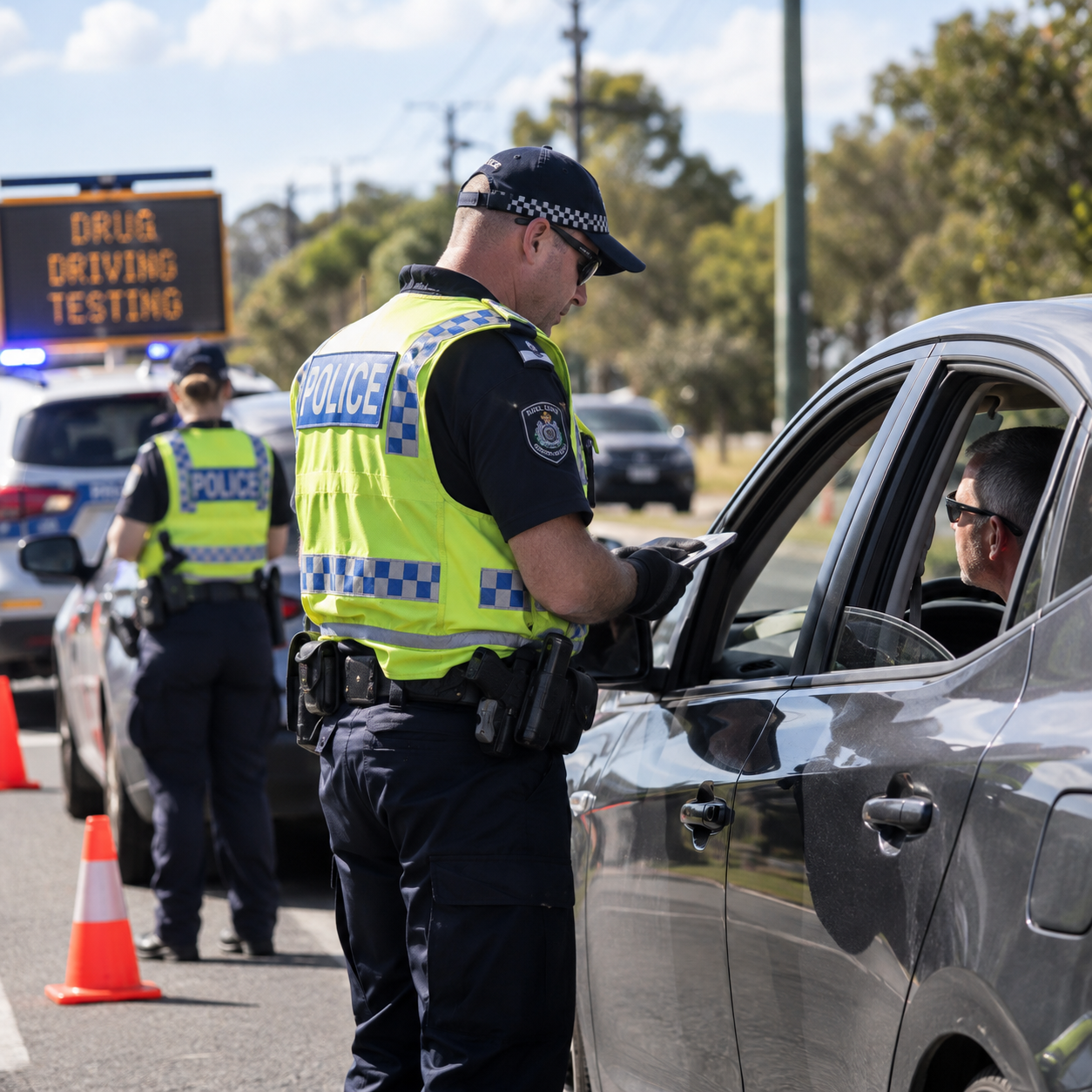
A driver who has a relevant drug present and also records an illegal blood-alcohol concentration can face a maximum fine of $5,699 and a licence disqualification of at least three months. The government says the package is intended to ensure penalties better reflect the seriousness of conduct it links to road trauma.
The Queensland government’s own ministerial statement says the Transport and Other Legislation Amendment Act 2026 was passed alongside separate dangerous-driving reforms. The road package covers drink and drug driving, extreme speeding and seatbelt enforcement, while other legislation increases penalties for the most serious motor-vehicle offences causing death or grievous bodily harm.
The commencement date is important. The tougher drug-driving and related penalty settings do not apply simply because parliament has passed the legislation. The key changes described by the government begin on 1 December 2026, meaning drivers and legal practitioners need to distinguish offences committed before and after the new provisions start.
Transport Minister Brent Mickelberg told parliament the government was responding to worsening road trauma and said Queensland’s road toll had increased by 35 per cent between 2019 and 2024. He argued there was no single measure that could reverse that trend and said the new penalties were one part of a broader safety strategy.
The government has also focused on a perceived inconsistency in the present system. Under existing law, there are no minimum court-imposed fines for some drink- and drug-driving offences. Mickelberg has argued that this can lead to cases where a court fine is lower than a fixed penalty for offences such as illegal mobile-phone use or failing to wear a seatbelt.
The new reforms are intended to introduce minimum court-imposed fines so that the punishment for drink or drug driving cannot fall below a specified threshold. The details still matter because the exact penalty depends on the offence, the driver’s circumstances and how the court applies the amended law.
Drug driving also raises a different legal and scientific issue from drink driving. Alcohol offences can be tied to measured blood-alcohol concentration thresholds. Queensland’s roadside drug regime is largely concerned with the presence of specified drugs, including THC, rather than a simple numerical roadside measure of impairment equivalent to a blood-alcohol limit.
That distinction has generated concern among medicinal-cannabis users and drug-policy advocates. A person can argue they do not feel impaired while still returning a positive test for THC. Current reporting on the legislation notes that the Alcohol and Drug Foundation raised concerns during consultation about legally prescribed medicinal cannabis and the possibility of detection after the most obvious intoxicating effects have passed.
The government’s response is that there is no sufficiently reliable roadside THC threshold that can be used in the same straightforward way as a blood-alcohol limit. The Queensland Drug Driving Review examined that problem, along with prescribing practices, enforcement and crash risk. The new legislation increases the consequences within the existing presence-based model rather than replacing it with a roadside impairment threshold.
For drivers, that means the practical message is not simply “do not drive if you feel impaired”. A relevant drug detected under the law can trigger an offence even when the driver disputes how affected they felt. Anyone prescribed medicinal cannabis therefore needs to understand the legal position rather than assuming a prescription automatically provides a defence to a roadside drug-driving offence.
The package also targets drivers who combine drugs with an illegal blood-alcohol concentration. Government and road-safety advocates regard that combination as especially dangerous because multiple substances can compound impairment. The new maximum fine of $5,699 and minimum three-month disqualification reflect that policy judgment.
Extreme speeding is another major element. From December, drivers detected travelling more than 40km/h above the speed limit will face an immediate six-month licence suspension framework. That is separate from whatever court or infringement consequences may also arise from the speeding offence itself.
The government has also changed seatbelt enforcement so drivers can identify an adult passenger responsible for a seatbelt offence. The stated aim is to make sure liability falls on the correct person rather than automatically on the driver in every camera-detected case.
Further reforms are scheduled to roll out in 2027. The Queensland government says roadside drug testing will be streamlined to allow more tests and faster enforcement, and a mandatory drug-driving education program will be introduced to address repeat offending. Those future measures should not be confused with the 1 December penalty changes.
A separate dangerous-driving law passed at the same time increases the maximum penalty for motor-vehicle offences causing death or grievous bodily harm from 16 years to 25 years and broadens mandatory imprisonment for serious and repeat dangerous-driving offenders. According to Queensland legislation material, those criminal-law changes have their own commencement arrangements, including provisions starting in 2027.
That separation matters because the government’s public announcement grouped several road-safety reforms together. Drivers should not assume every announced measure begins on the same day. The clearest immediate date for the drug-driving, combined-offence and extreme-speeding changes is 1 December 2026.
The opposition supported the need to address road trauma but raised concerns about reducing judicial discretion. Shadow Transport Minister Bart Mellish said Labor welcomed recognition of the road-safety problem while arguing that parts of the package went too far in constraining courts.
That debate reflects a familiar tension in sentencing policy. Mandatory minimums and fixed consequences can improve consistency and send a clear deterrent message, but they also leave judges with less ability to adjust a penalty to unusual circumstances. The legislation represents the government’s decision to place greater weight on consistency and deterrence for the targeted offences.
Road-safety groups have generally supported a combination of enforcement and behaviour-change measures rather than relying on fines alone. RACQ has backed the need for stronger intervention while the continuing medicinal-cannabis debate shows that the design of drug-driving laws remains contested even among people who support the goal of safer roads.
For Queensland motorists, the immediate takeaway is concrete: the new drug-driving penalty regime starts on 1 December, not on the day parliament passed the bill. From that date, positive drug-driving offences can bring much larger fines and longer licence loss, with still stronger consequences when an illegal blood-alcohol level is also involved.
The broader package will continue unfolding into 2027. That means drivers, employers and legal advisers will need to watch commencement dates carefully as testing, education and dangerous-driving provisions come online at different times.
The legislation also illustrates the difference between punishment and detection. Increasing a fine does not by itself mean more offenders will be detected. That is why the government’s 2027 plan to streamline roadside drug testing matters: a deterrence strategy depends both on the severity of the consequence and on drivers believing there is a realistic chance of being tested.
At the same time, more testing will sharpen the policy debate around presence-based offences. If the state conducts more roadside drug tests, questions about medicinal cannabis, the duration of detectable THC and the relationship between presence and impairment will affect more drivers. The government has chosen to retain the current legal model while increasing penalties, so those questions have not disappeared.
Drivers should also distinguish a roadside screening result from the complete evidentiary process used for an offence. Police procedures can involve screening and confirmatory analysis under the relevant legislation. The exact evidentiary requirements depend on the offence and should not be reduced to the idea that any roadside device reading by itself is necessarily the final proof presented in court.
In practical terms, the reform changes the risk calculation for motorists from December. A person who previously viewed a drug-driving offence as a relatively short loss of licence or manageable fine will face a much more serious financial and mobility consequence. For people who rely on a licence for work, care responsibilities or regional travel, that can have effects well beyond the court penalty itself.