Qantas is asking the Fair Work Commission to stop planned industrial action by ground workers next week, setting up a workplace-relations showdown that could affect freight movements and selected QantasLink services during the school-holiday period. The proposed action is significant, but it is not a shutdown of the entire Qantas network.
The Transport Workers Union has notified industrial action involving about 650 employees, most of them working in Qantas Freight and a smaller group servicing QantasLink flights at Sydney Airport. ABC News reported that a 24-hour stoppage is planned for Thursday, while separate reporting indicates Victorian action may begin a day earlier. The dispute remains before the Fair Work Commission and the action has not yet occurred.
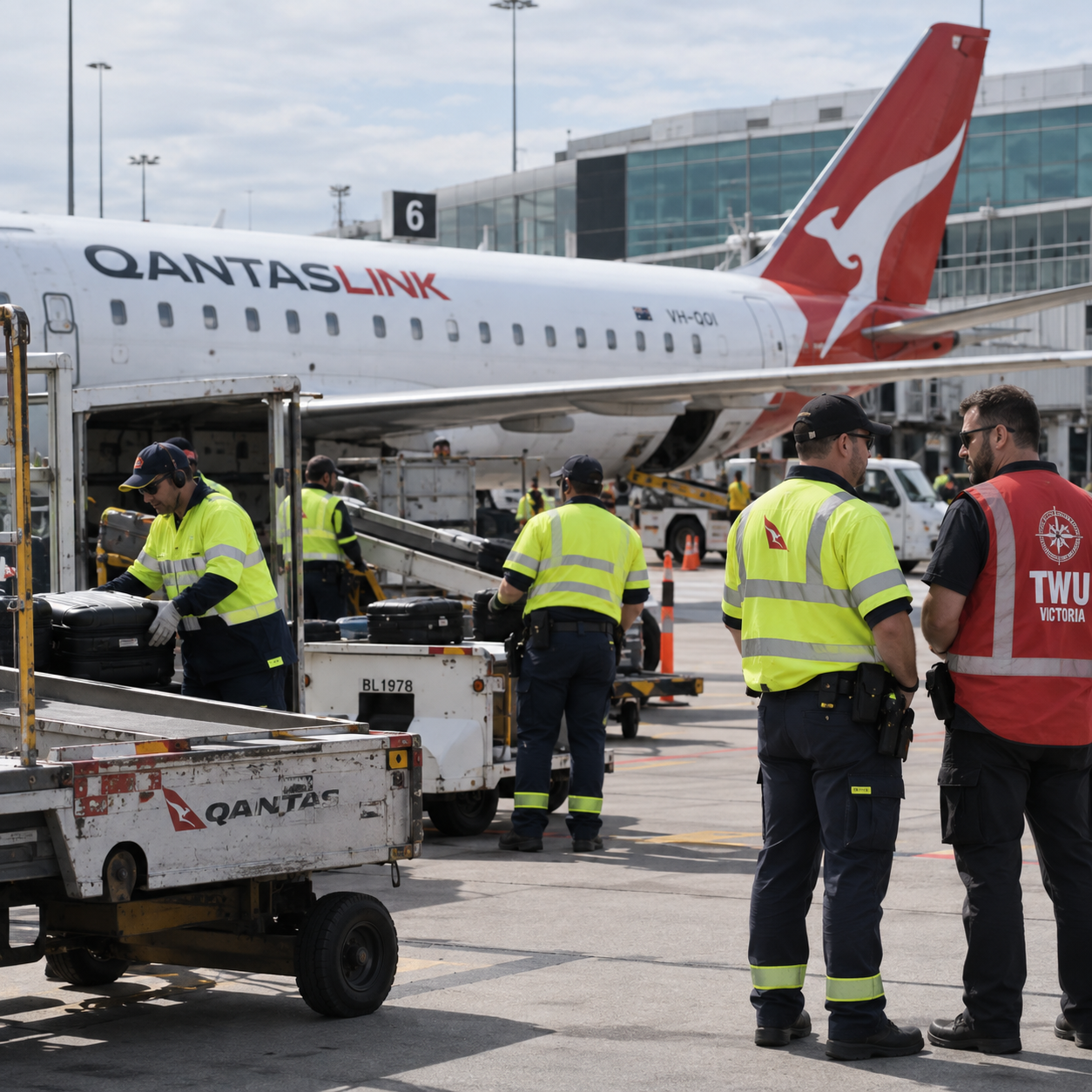
The scope matters for travellers. The workers involved do not service Qantas mainline domestic and international flights, according to the airline, and they do not service QantasLink at airports outside the affected Sydney work. The clearest exposure is therefore Qantas Freight and a subset of regional services rather than every Qantas passenger.
School holidays are beginning in Queensland, Victoria and the Northern Territory, increasing attention on any potential disruption. Regional routes can be more sensitive to ground-handling problems because some communities have fewer alternative flights, fewer competing airlines and longer distances to major hubs.
Qantas says it has contingency plans intended to minimise disruption if the industrial action proceeds. It has also said discussions through the Fair Work Commission have been constructive and that negotiations are continuing. The airline says it wants an agreement that includes annual pay rises and more full-time opportunities.
The union presents the dispute differently. TWU national secretary Michael Kaine says workers are pursuing better pay, job security and safer conditions, and argues that increased casualisation and fragmentation of ground-handling work have damaged employment standards. Qantas disputes union claims that safety incidents have increased as a result of changes to ground operations.
The latest proposed stoppage follows a protected-action ballot in which the TWU said 97 per cent of 350 workers who voted supported the right to take industrial action. That ballot authorised a range of possible measures, including stoppages from one hour to 24 hours. A vote in favour did not itself trigger a strike; the union still had to give the required notice before action could lawfully begin.
Reuters reported at the end of August that the workers were employed through Qantas Ground Services, a Qantas subsidiary, and were seeking improvements to pay, conditions and job security. At that stage no strike date had been set. The dispute has now moved from the possibility of action to a notified stoppage and a Qantas application to the Fair Work Commission.
That distinction is important. Protected industrial action is part of Australia’s enterprise-bargaining system and can be lawful when statutory requirements are met. Employers can challenge proposed action on legal or procedural grounds, and the Fair Work Commission can become involved in bargaining disputes, applications and conciliation. A company going to the commission does not automatically cancel a strike, just as a union giving notice does not guarantee that every threatened stoppage will happen.
The practical impact also depends on which tasks the striking employees perform. Freight operations rely on loading, unloading, sorting and transferring goods through airport facilities. A 24-hour disruption can affect time-sensitive shipments, including express freight and postal movements, even if passenger aircraft continue operating.
On the passenger side, the exposure is narrower. QantasLink connects major airports with regional centres, and the group involved in the dispute includes some workers servicing QantasLink flights at Sydney. If staffing is reduced, an airline can try to move employees, adjust rosters, retime flights or use other contingency arrangements, but specialised airport work cannot always be substituted immediately.
That means passengers should not assume a cancellation simply because they are booked on Qantas or QantasLink. The airline has not announced a system-wide cancellation program. At the same time, people booked on potentially affected regional services during the stoppage window should monitor direct Qantas advice because the position can change quickly if the Fair Work Commission process or negotiations do not resolve the dispute.
Freight customers face a similar uncertainty. The TWU has warned that disruptions could include Australia Post shipments and other freight. Qantas says responsibility for minimising customer impact is central to its contingency planning. Those claims come from parties in an industrial dispute and should be read as competing positions rather than settled findings about what will happen.
Safety is one of the most contested issues. The union has linked its bargaining campaign to alleged safety failures and has pointed to a fatal workplace incident involving a Qantas Freight worker. Qantas disputes the suggestion that safety has deteriorated because of its ground-handling arrangements. No Fair Work Commission ruling cited in current reporting has determined that broader argument.
The dispute also sits against a longer restructuring history. Qantas has changed the way some ground services are organised, and unions have repeatedly argued that outsourcing and the use of separate employing entities weaken wages and conditions. Qantas has defended its operating model and says it is negotiating on pay and full-time opportunities.
For readers trying to understand the immediate risk, the most useful facts are therefore operational rather than rhetorical. About 650 employees are involved in the current notified action. Most are connected to freight. A smaller group services QantasLink at Sydney. Mainline domestic and international services are not described as being directly worked by this group, and QantasLink ground operations at other airports are outside the reported scope.
The next major variable is the Fair Work Commission. If Qantas succeeds in its application, the planned action could be stopped or altered. If the application fails and no agreement is reached, the notified industrial action may proceed. The parties could also reach a bargaining compromise before the stoppage begins.
That makes timing crucial. Travellers and freight customers need current information close to the planned action rather than broad assumptions based on the initial announcement. A legal or bargaining outcome could change the picture within hours.
The dispute is also a reminder that aviation disruptions do not need to involve pilots or cabin crew to affect schedules. Ground handling is part of the chain that turns an arriving aircraft into a departing service: bags, freight, equipment, loading and ramp operations all have to align. Removing one part of that chain for a full day can produce knock-on effects even if the aircraft and flight crews are available.
For now, however, disruption remains a risk rather than a confirmed outcome. Qantas is seeking Fair Work Commission intervention, the TWU has notified industrial action, and negotiations are continuing. The strongest advice for affected passengers is to watch their own service status rather than treating the dispute as a blanket Qantas shutdown.
There is also a difference between a protected-action ballot and the current notified stoppage. The August ballot gave eligible workers legal authority to take a range of industrial steps if the statutory requirements were met. The September notice identifies when the union intends to use that authority. Qantas’ Fair Work Commission application is aimed at the latter stage, when a possible disruption has become immediate rather than hypothetical.
Passengers should also separate airline-wide branding from the employing entity involved. Qantas Ground Services is part of the Qantas group, but the workers in this dispute perform particular freight and regional ground-handling functions. That is why the same dispute can be significant for Qantas operations without directly involving every airport, route or employee under the Qantas name.
If the action proceeds, the first visible effects may not be a dramatic line of cancelled flights. Freight backlogs, delayed loading, retimed regional services and operational knock-on effects can emerge unevenly through the day. That is another reason current service information from the airline is more useful than assuming either total normality or a network-wide shutdown.