One Nation leader Pauline Hanson has used a high-profile conservative conference in London to deliver a forceful warning about Australia’s future, arguing that the country is heading down the same path as Britain after years of high migration and multicultural policies.
Addressing delegates at the Conservative Political Action Conference (CPAC) in London, Hanson claimed Australians were beginning to recognise the consequences of what she described as “mass migration”, telling the audience that Australia was only “five or ten years behind England” in facing similar social and cultural challenges.
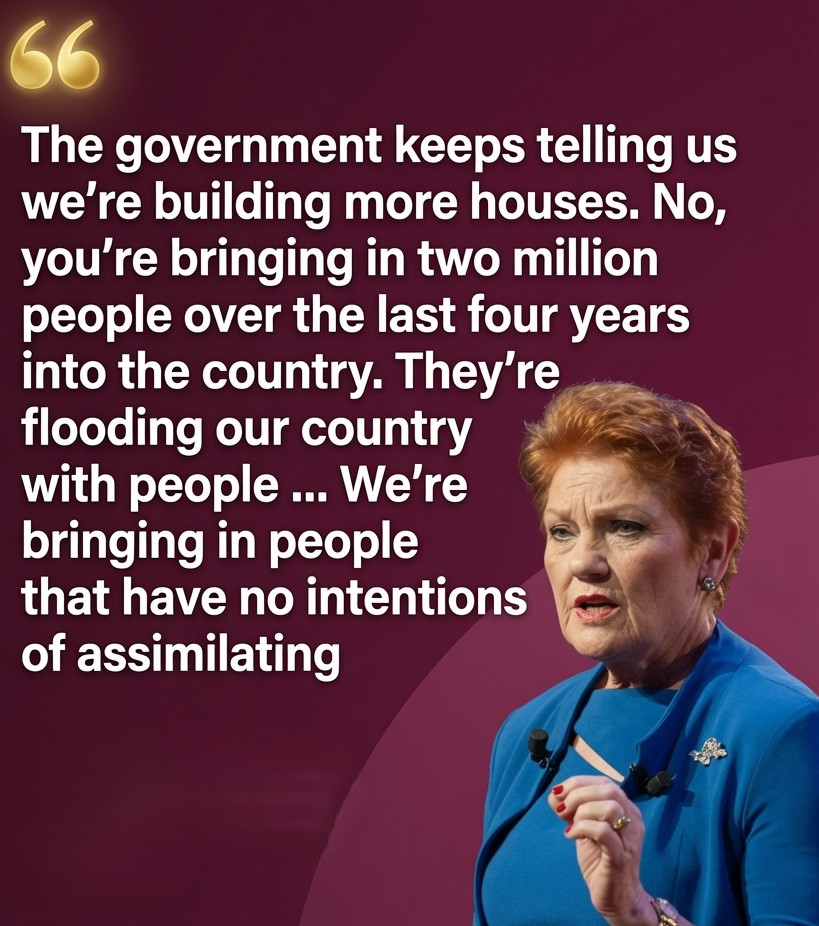
During her speech, Hanson criticised the Albanese Government’s immigration policies and argued that rapid population growth had contributed to growing pressure on housing, infrastructure, public services and community cohesion.
She told conference attendees that Australians were experiencing a “rude awakening” as they became increasingly concerned about the pace of demographic change and what she described as the erosion of Australia’s traditional identity. According to Hanson, many voters who previously dismissed such concerns were now beginning to share them.
Her comments echoed long-standing policy positions held by One Nation, which has consistently advocated for substantially lower migration levels, stronger border controls and greater expectations that migrants assimilate into Australian society.
Hanson argued that immigration itself was not the issue, but rather the scale of recent migration and the failure, in her view, of governments to ensure successful integration. She suggested Australia risked repeating social problems that she believes have emerged in parts of Britain following decades of high migration.
The speech received immediate support from Reform UK leader Nigel Farage, who met Hanson during her visit to Britain.
Farage praised the Australian senator for continuing to raise concerns about immigration despite years of political controversy, describing her as a politician who had remained consistent in her views over several decades. His endorsement reinforced the growing political relationship between elements of Australia’s and Britain’s conservative populist movements.
Hanson’s appearance formed part of a broader overseas visit during which she met several conservative political figures and attended a number of events focused on immigration, national sovereignty and cultural identity.
CPAC has become an international platform for conservative politicians from several countries, frequently hosting debates on issues including migration, free speech, energy policy and national security. Speakers at the London conference expressed differing concerns about the social and economic effects of large-scale immigration across Western democracies.
During her address, Hanson argued that Australia had historically benefited from migration but claimed recent intake levels had become unsustainable.
She linked high migration to Australia’s housing affordability crisis, growing pressure on infrastructure and changing community demographics, contending that successive governments had failed to adequately plan for rapid population growth.
Immigration has become one of the most contested political issues in Australia in recent years.
Supporters of higher migration argue it helps address labour shortages, supports economic growth and offsets the effects of an ageing population. Business groups have frequently called for skilled migration to fill vacancies across sectors including healthcare, construction, engineering and hospitality.
Critics, including One Nation, contend that migration levels have outpaced housing construction and infrastructure investment, contributing to higher property prices, rental shortages and congestion in Australia’s largest cities.
The Albanese Government has previously stated that its migration policies seek to balance economic needs with improvements to visa integrity, workforce planning and long-term housing supply. Ministers have also announced reforms aimed at reducing net overseas migration from post-pandemic peaks while maintaining skilled migration pathways.
Hanson’s remarks quickly generated political backlash in Australia.
Prime Minister Anthony Albanese accused the One Nation leader of speaking negatively about Australia while overseas, arguing that elected representatives should promote the country’s strengths rather than portray it in an unfavourable light before international audiences.
Mr Albanese described Australia as one of the world’s most successful multicultural societies and said Australians should take pride in the country’s diversity and democratic institutions.
Other political figures from both major parties also criticised elements of Hanson’s speech, with some describing her language as unnecessarily divisive and inconsistent with Australia’s multicultural traditions.
At the same time, Hanson maintained that she was expressing concerns shared by many Australians who believe mainstream political parties have failed to address public anxiety surrounding migration, housing affordability and cultural integration.
Immigration has long been central to One Nation’s political platform.
Since entering federal politics in the 1990s, Hanson has repeatedly argued for significantly lower migration levels, stronger border protection measures and policies encouraging migrants to adopt Australian values and civic traditions.
Those positions have often attracted both strong support and strong criticism, making Hanson one of Australia’s most polarising political figures. Supporters argue she raises issues ignored by the political establishment, while critics accuse her of oversimplifying complex social challenges and fuelling division.
The London speech also touched on broader debates surrounding multiculturalism, national identity and social cohesion that have become increasingly prominent across several Western democracies.
Countries including the United Kingdom, Canada and Australia continue to debate how immigration policy should balance economic demand, humanitarian commitments, housing capacity and community integration.
Although politicians frequently disagree about the appropriate level of migration, most acknowledge that population growth has become closely linked to broader discussions about infrastructure planning, public services and affordability.
For Hanson, the message delivered in London was that Australia still has an opportunity to change course before experiencing what she considers to be the more serious challenges facing Britain today.
Whether that argument resonates beyond her political base remains to be seen, but the reaction to her speech demonstrates that immigration and multiculturalism remain among the most contentious issues in Australian politics as the country continues to debate its long-term demographic and economic future.






