One Nation leader Pauline Hanson has triggered another major political controversy after claiming Australia’s immigration problems began when the White Australia Policy was abolished, while also making contentious comments about alleged fraud within the National Disability Insurance Scheme (NDIS) during a podcast interview with British far-right activist Tommy Robinson.
The interview, recorded during Hanson’s recent visit to the United Kingdom and released this week, has attracted widespread criticism from senior members of the Albanese Government and renewed debate over One Nation’s immigration policies.
During the discussion, Robinson asked Hanson how Australia had developed what he described as immigration-related social problems despite historically maintaining strict border controls.
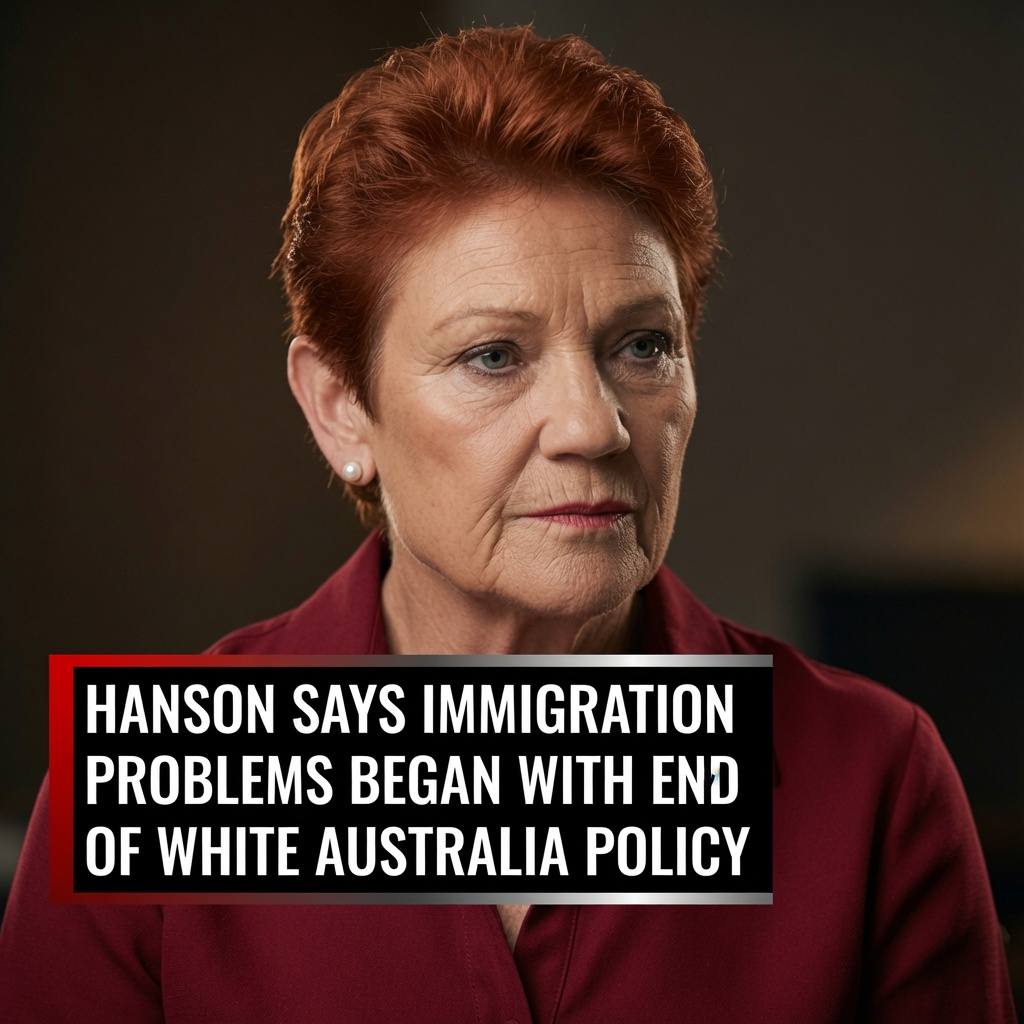
Hanson replied that the turning point came after the abolition of the White Australia Policy.
“Well it started in 1973 … they opened up and got rid of the White Australia Policy then they started bringing in the different migrants,” Hanson said.
She contrasted post-Second World War European migrants—including Italians, Germans and Poles—with more recent migration, arguing that earlier migrants integrated more successfully into Australian society by learning English and entering the workforce.
The White Australia Policy was not a single law but a collection of immigration measures introduced after Federation in 1901 that effectively restricted non-European migration to Australia. Over several decades, successive governments progressively dismantled those restrictions, with the final elements removed during the early 1970s as Australia formally embraced multicultural immigration policies.
Historians generally regard the abolition of the policy as one of the most significant turning points in Australia’s modern immigration history, paving the way for a more diverse migrant intake from Asia, the Middle East, Africa and other regions.
Hanson has long opposed Australia’s contemporary migration settings and has repeatedly argued for substantially lower immigration levels. However, her latest comments explicitly linking today’s immigration challenges to the end of the White Australia Policy have generated particularly strong political reactions.
The interview also turned to the National Disability Insurance Scheme, which Hanson described as increasingly vulnerable to fraud.
After Robinson asked whether participant data could be analysed by nationality, religion or culture, Hanson alleged that significant fraud was occurring in some Muslim-majority neighbourhoods while adding that Australians from other backgrounds were also abusing the scheme.
She did not provide evidence during the interview to support claims that fraud is disproportionately concentrated within Muslim communities.
The NDIS has experienced significant fraud investigations in recent years, with authorities uncovering criminal activity involving providers and individuals from a range of cultural and ethnic backgrounds. Government agencies have consistently stated that organised fraud targets the scheme across multiple sectors rather than attributing the problem to any single community.
Health Minister Mark Butler rejected Hanson’s suggestion that particular nationalities or religions are overrepresented in NDIS fraud.
Speaking on ABC Radio National, Butler said he had never been advised by officials that people from any particular religious or ethnic background were disproportionately involved in exploiting the disability insurance system.
The controversy quickly spread beyond the NDIS debate.
Home Affairs Minister Tony Burke accused Hanson of promoting divisive rhetoric, arguing that multiculturalism forms an essential part of modern Australian identity.
Burke said loving Australia includes recognising the contributions made by migrants from many backgrounds and rejected suggestions that the country should look back favourably on the White Australia Policy. Prime Minister Anthony Albanese similarly said Islamophobia has no place in Australia and warned against rhetoric that unfairly targets entire communities.
Hanson’s appearance with Tommy Robinson has itself become a major source of controversy.
Robinson, whose real name is Stephen Yaxley-Lennon, is one of Britain’s most polarising political activists and has frequently attracted criticism over his anti-Islam campaigning and legal troubles. Several Australian politicians questioned Hanson’s decision to appear on his podcast, arguing that it lent legitimacy to a highly controversial figure.
During the same interview, Hanson also discussed other aspects of her political career.
She revealed that she now considers former Prime Minister Tony Abbott a friend after years of political interaction and suggested that her daughter, Lee Hanson, could potentially become One Nation leader in the future if she earned sufficient support within the party. Hanson stressed that leadership would need to be based on merit rather than family connections.
The interview formed part of Hanson’s wider visit to Britain, where she attended CPAC Great Britain and met Reform UK leader Nigel Farage.
One Nation described the trip as an opportunity to exchange ideas with overseas conservative movements on issues including immigration, national sovereignty, housing affordability and cost-of-living pressures. Hanson argued that countries such as Australia and the United Kingdom face many of the same policy challenges and can learn from each other’s experiences.
The overseas visit has nevertheless generated sustained political scrutiny.
Alongside criticism over the Robinson interview, Hanson also faced questions about her attendance at social events in Europe and whether taxpayers contributed to any part of the trip. She has repeatedly denied receiving public funding for her private travel, saying it “cost taxpayers not $1”.
Immigration has remained one of the defining issues for One Nation since Pauline Hanson founded the party in the late 1990s.
The party advocates substantially reducing Australia’s annual migration intake, strengthening border security, requiring stronger integration by new arrivals and introducing tougher measures against people convicted of serious crimes while on visas. One Nation argues that rapid population growth has contributed to housing shortages, infrastructure pressure and rising living costs, while critics contend its rhetoric unfairly targets migrant communities and risks increasing social division.
The latest controversy arrives as One Nation continues polling strongly ahead of the next federal election, placing increasing pressure on both the Coalition and the Albanese Government.
Political analysts say Hanson remains one of Australia’s most polarising political figures. Supporters argue she raises concerns about immigration, government spending and national identity that many voters feel are ignored by the major parties. Critics, however, contend that her language risks inflaming tensions and oversimplifying complex social and economic issues.
Whether the latest interview strengthens One Nation’s support among disaffected conservative voters or further alienates more moderate Australians remains to be seen. What is clear is that Hanson’s comments have once again placed immigration, multiculturalism and the legacy of the White Australia Policy at the centre of Australia’s political debate.






